KCC Institute of Legal and Higher Education, Greater Noida
Law Admissions 2026 Open | Avail Merit-Based Scholarships


Bachelor of Science in Medical Laboratory Technology (BSc MLT) and Bachelor of Science in Medical Imaging Technology (BSc MIT) are paramedical courses. Both courses are important in disease diagnosis and treatment. Studying any of the courses is a one-of-a-kind experience, but both departments are interconnected and rely on one another to provide diagnostic services. This article discusses BSc MLT vs BSc MIT: Which is Better in 2026?
This Story also Contains
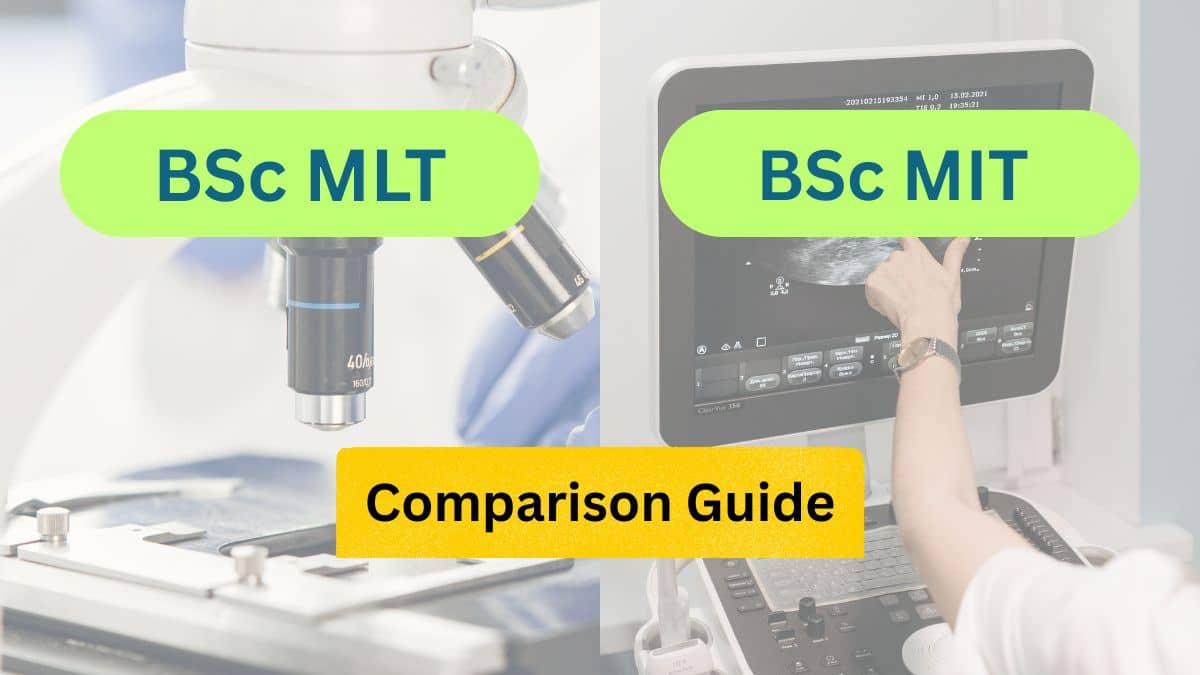
The choice of whether to pursue a Bachelor of Science in Medical Laboratory Technology (BSc MLT) or a Bachelor of Science in Medical Imaging Technology (BSc MIT) is based on the well-paying and rewarding careers in the fast-growing healthcare industry. Read further for a detailed difference between the BSc MLT and BSc MIT courses based on several key factors. These factors include scope, career, salary, course fee and more.
B.Sc MLT and B.Sc MIT are valuable healthcare degrees. They contribute to disease diagnosis and treatment, but they specialise in different types of work. The table below shows the main difference between BSc MLT and BSc MIT courses to help you choose the right one for your future.
Feature | B.Sc MLT (Medical Laboratory Technology) | B.Sc MIT (Medical Imaging Technology) |
|---|---|---|
Course Duration | 3 years (6 semesters) | 3 years (may include 1-year internship in some colleges) |
Eligibility | 10+2 with Physics, Chemistry, Biology | 10+2 with Physics, Chemistry, Biology |
Admission Mode | Merit-based or entrance exam | Merit-based or entrance exam |
Course Fee (Approx.) | ₹60,000 – ₹2,00,000 (varies by college) | ₹70,000 – ₹2,50,000 (varies by college) |
Focus Area | Diagnosis through lab testing (blood, urine, tissues) | Diagnosis using imaging machines (X-ray, MRI, CT, Ultrasound) |
Main Subjects | Microbiology, Haematology, Pathology, Biochemistry | Radiographic Physics, Imaging Techniques, Patient Care |
Tools Used | Microscopes, analysers, centrifuges, and lab kits | X-ray machines, MRI scanners, CT scanners, and Ultrasound devices |
Job Role | Conduct lab tests to detect diseases | Assists Radiologists in imaging diagnostics |
Average Starting Salary (India) | ₹2.5 – ₹4 LPA | ₹2.8 – ₹4.5 LPA |
Higher Studies | M.Sc. MLT, Clinical Research, MBA Healthcare | M.Sc. MIT, Radiology, Hospital Administration |
Individuals who complete a B.Sc MLT or a B.Sc MIT course have career opportunities in the healthcare industry. Hospitals, diagnostic centres, and research laboratories provide stable, well-paying employment opportunities.
BSc MLT graduates can work as clinical biochemists, laboratory managers, medical laboratory technologists, pathology laboratory assistants, blood bank technicians, research laboratory technicians, and quality control analysts. After completing the BSc MLT course, candidates can get the opportunity to work at research institutions, hospitals, public health laboratories, pharmaceutical companies, and diagnostic laboratories.
BSc MIT graduates can work as a radiographer, MRI/CT technologist, cath lab technologist, imaging department manager, PACS administrator, or clinical application specialist. Workplaces include some of the important healthcare facilities such as hospitals, with some special focus on radiology departments, diagnostic imaging centres, emergency and trauma centres, radiology firms, and private centres that provide specialised services.
The healthcare industry is on the rise, and so is the need for training for qualified professionals in laboratory testing and medical imaging. With rapid technological advancement, B.Sc MLT and B.Sc MIT professionals have become increasingly in demand in 2026. Both areas open career opportunities, but they also have their own challenges:
BSc MLT graduates have better opportunities with a growing and urgent requirement for reliable diagnostics that can address the rising cases of lifestyle diseases and pandemic effects.
BSc MLT graduates get work opportunities at Hospitals, diagnostic labs, research labs, and public health labs.
There are some challenges associated with this profession, like AI and automation may decrease the need for human labour, which increases the requirement for highly skilled supervisors.
Law Admissions 2026 Open | Avail Merit-Based Scholarships
BBA/MBA/PGDM Early Bird Applications Deadline 06th Nov'26. Apply now using coupon code CAREER250 and get ₹250 off the application fee
Ongoing and widespread progress being witnessed in the field of medical imaging technology is increasing the demand for BSc MIT professionals. Also, there is a growing dependence on these imaging technologies for proper diagnosis in the majority of medical ailments.
BSc MIT graduates have work opportunities as CT and MRI technologists. With growth in teleradiology services, there is also an increasing demand for skilled professionals to handle new technology like PET-CT and hybrid scanners.
There are some challenges associated with this profession, such as requiring dedication to ongoing education and training to remain updated on rapidly changing technology.
Both BSc MLT and BSc MIT have bright career opportunities in the health sector. Students can choose either of them based on their interests and career goals. Both courses have almost equal importance, and most importantly, both are related and dependent on each other in terms of providing medical services.
Select BSc MLT if you have a keen interest in diagnostic and laboratory work. You prefer to have a routine and steady working environment. You have a strong interest in the fascinating fields of pathology as well as diagnostic sciences.
Select BSc MIT if you are interested in medical technology and imaging. You have the capacity to handle and operate in physically demanding working conditions with proficiency and ease.
In the future scope, salary increase, and international demand, BSc MIT has a narrow advantage in 2026 due to the fast-paced development of radiology, imaging technology, and teleradiology. BSc MLT is still relevant, especially during the aftermath of the greater demand for healthcare diagnostics and public health programs. Both professions are essentially a part of today's healthcare, and success will be based on talent, specialisation, ongoing learning, and enthusiasm.


Law Admissions 2026 Open | Avail Merit-Based Scholarships
BBA/MBA/PGDM Early Bird Applications Deadline 06th Nov'26. Apply now using coupon code CAREER250 and get ₹250 off the application fee
Ranked #36 amongst institutions in Management by NIRF | 100% Placement
Globally Recognized by AACSB (US) & AMBA (UK) | 18 LPA Avg. CTC for PGPM 2026
NEET PG All India & State College Predictor with Admission Process Guide
NAAC A+ Accredited University