


MCQ - Practice Questions with Answers
Quick Facts
-

Orbital Velocity of Satellite is considered one the most difficult concept.
-

36 Questions around this concept.
Solve by difficulty
 EASY
EASYAn astronaut of mass m is working on a satellite orbiting the earth at a distance h from the earth’s surface. The radius of the earth is R, while its mass is M. The gravitational pull FG on the astronaut is :
A satellite of mass m revolves around the earth of radius R at a height x from its surface.If g is the acceleration due to gravity on the surface of the earth, the orbital speed of the satellite is:
If suddenly the gravitational force of attraction between Earth and a satellite revolving around it becomes zero, then the satellite will :
A particle of mass m is thrown upwards from the surface of the earth, with a velocity u. The mass and the radius of the earth are, respectively, M and R. G is gravitational constant and g is acceleration due to gravity on the surface of the earth. The minimum value of u so that the particle does not return back to earth is:
A planet moving along an elliptical orbit is closest to the sun at a distance of $r_1$ and farthest away at a distance of $r_2$. If $V_1$ and $V_2$ are the linear velocities at these points respectively, then the ratio $\frac{V_1}{V_2}$ is
A planet moving along an elliptical orbit is closest to the Sun at a distance $r_1$ and farthest away at a distance of $r_2$. If $v_1$ and $v_2$ are the linear velocities at these points respectively, then the ratio $\frac{v_1}{v_2}$ is:
Concepts Covered - 1
Orbital velocity of a satellite is the velocity which is required to put the satellite into its orbit around the earth.
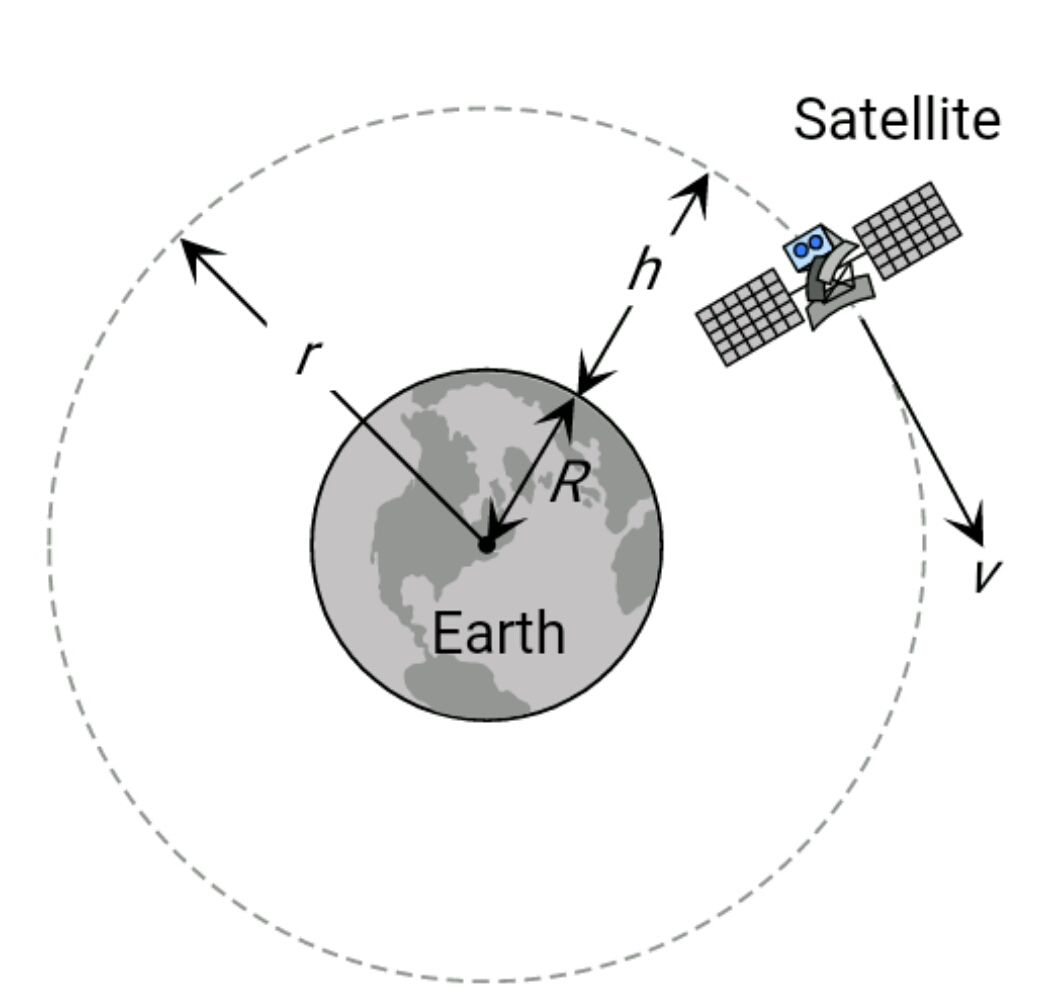
For the revolution of a satellite around the earth, there must be a centripetal force for the circular motion to happen.
The gravitational force which acts towards the center is providing the required centripetal force,
i.e $F_c=F_G$
Where Centrifugal force, $F_c=\frac{m v^2}{r}$;
Gravitational force, $F_G=\frac{G M m}{r^2}$;
So on equating we get
$$
\begin{aligned}
\quad \frac{m v^2}{r}=\frac{G M m}{r^2} \\
v=\sqrt{\frac{G M}{r}}
\end{aligned}
$$
Where
$r \rightarrow$ Position of satellite from the centre of earth
$v \rightarrow$ Orbital velocity
- If $\mathrm{r}=(\mathrm{R}+\mathrm{h})$ where R is the radius of the earth
then:
$$
v=\sqrt{\frac{g R^2}{R+h}}=R \sqrt{\frac{g}{R+h}} \quad\left[\text { As } G M=g R^2 \text { and } r=R+h\right]
$$
- Dependence of Orbital velocity
1. Orbital velocity is independent of the mass of the satellite and is always along the tangent of the orbit.
2.It depends upon the mass of the central body and radius of the orbit
means, Greater the value of radius of orbit, the less the orbital velocity
- If a satellite is close to the Earth’s surface,
As $h \lll<R$ or $h \approx 0$
and using $G M=g R^2$
$$
\begin{aligned}
& \text { So } V=\sqrt{\frac{G M}{R}}=\sqrt{g R} \\
& V=\sqrt{9.8 \times 6.4 \times 10^6} \\
& =7.9 \mathrm{~km} / \mathrm{s} \simeq 8 \mathrm{~km} / \mathrm{s}
\end{aligned}
$$
Where
$V \rightarrow$ Orbital velocity
$$
g \rightarrow 9.8 \mathrm{~m} / \mathrm{s}^2
$$
$R \rightarrow$ Radius of Earth
- The angular momentum of the satellite
$\begin{aligned} & L=m v r \\ & L=\sqrt{m^2 G M r} \\ & L=\text { Angular momentum } \\ & m \rightarrow \text { mass of satellite } \\ & v \rightarrow \text { Orbital velocity of the satellite }\end{aligned}$
- Relation of escape velocity and orbital velocity
we know that
$$
V_e=\sqrt{\frac{2 G M}{R}}
$$
and
$$
V=\sqrt{\frac{G M}{R}}
$$
$$
\Rightarrow V=\frac{V_e}{\sqrt{2}}
$$
Where
$V \rightarrow$ Orbital velocity
$V_e \rightarrow$ Escape velocity
or $\quad V_{\text {escape }}=\sqrt{2} V_{\text {orbital }}$
Or we can say that
If the speed of satellite is made $\sqrt{2}$ times the original speed, then it will escape from the gravitational pull of the earth.
- The shape of orbit of a satellite
If $0<V<v_o$, then satellite does not remain in its a circular path rather it traces a spiral path and falls on earth
$V=v_o \quad$ Satellite revolves in circular path
$V=v_e \quad$ satellite move along the parabolic path and will escape from gravitational pull.
$V>v_e$ satellite will escape but now the motion will be hyperbolic.
Here,
$V=$ velocity of body
$v_o$ - orbital velocity of a body
$v_e-$ escape velocity of a body
Study it with Videos
"Stay in the loop. Receive exam news, study resources, and expert advice!"