


Emf Of A Cell MCQ - Practice Questions with Answers
Quick Facts
-

Cell and Emf of a cell is considered one of the most asked concept.
-

11 Questions around this concept.
Solve by difficulty
 MEDIUM
In the circuit shown, current (in A) through the 50 V and 30 V batteries are, respectively :

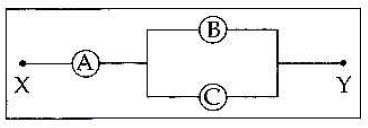
A, B, and C are voltmeters of resistance R, 1.5R, and 3R respectively as shown in the figure. When some potential difference is applied between X and Y, the voltmeter readings are VA, VB, and VC respectively. Then:
The potential difference (VA - VB) between the points A and B in the given figure is

The emf of a dry cell depends upon the following factors:
In the given circuit, the potential difference across the capacitor is 12 V . Each resistance is of $3 \Omega$ and the cell is ideal. The emf of the cell is:

A cell of e.m.f volt with no internal resistance is connected to a wire whose cross section changes. The wire has three sections of equal length. The middle section has a radius , whereas the radius of the outer two sections is 2. The ratio of the potential difference across section to the potential difference across section is
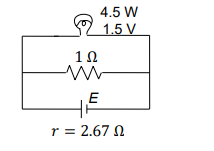
A torch bulb rated 4.5 W, 1.5 V is connected as shown in Figure. The e.m.f. of the cell needed to make the bulb glow at full intensity is
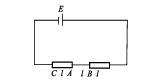
Consider a cell of e. m. f. E and internal resistance r. Its terminals are directly connected. Some current is obtained in the circuit. Now take two such cells
Consider a thin rectangular sheet with sides of length L, breadth b, and thickness a. The resistance between two opposite faces is shown in the figure by the shaded region.

Two batteries with e.m.f 100 V and 120 V are connected in parallel across a load resistor of 50Ω. The internal resistances of the two batteries are 6Ω and 12Ω respectively. The voltage across the load lies is between:
Concepts Covered - 1
Cell
The device which converts Chemical energy into electrical energy is known as an electric cell.
-
It maintains the flow of charge inside the circuit by supplying energy.
-
The direction of flow of current:
-
inside the cell is from negative to positive electrode
-
while outside the cell is from positive to negative electrode.
-
Electromotive force (Emf) of a cell:
It is the work done / energy carried by unit charge passing through one complete cycle of the circuit.
E=W/q
unit of emf is volt.
The emf of cell is also known as potential difference across the terminals of a cell when it is not giving any current.
Note-Cell is a source of constant emf but not constant current.
Potential difference (V)- It is the work done / energy carried by unit charge passing through external part (excluding the cell ) of the circuit.

Potential difference is equal to the product of current and resistance of that given part.
i.e. $V_{A B}=i R$.
Study it with Videos
"Stay in the loop. Receive exam news, study resources, and expert advice!"