


Blood Coagulation MCQ - Practice Questions with Answers
Quick Facts
-

22 Questions around this concept.
Solve by difficulty
 EASY
EASYWhich enzyme is responsible for the conversion of inactive fibrinogens to fibrins?
A patient brought to a hospital with a myocardial infarction is normally immediately given:
Which are the following statements are correct?
(i) Ca+2 is necessary for blood coagulation.
(ii) Coagulation in blood vessel is prevented during normal condition by heparin.
(iii) Clotting of blood involves changes of fibrinogen to fibrin by thrombin.
(iv) Blood clotting involves cascading process involving a number of factors present always in the active form.
For conversion of prothrombin into thrombin, which of the following is required
Which one of the following plasma proteins is involved in the coagulation of blood?
Concepts Covered - 1
Blood coagulation
- Whenever some injury occurs to any part of the body, it starts bleeding
- Blood coagulation or blood clotting refers to the process of formation of a blood clot to prevent bleeding
- The process of blood coagulation involves a cascade of reactions and these are carried out by clotting factors
- Thirteen clotting factors have been identified and these are as follows :
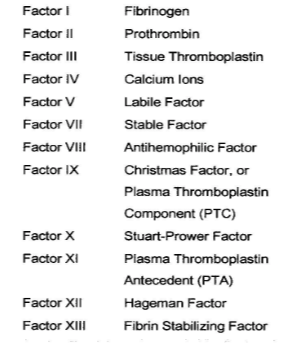
- The cascade reactions can be divided into three major steps :
Step I Formation of prothrombinase
- At the site of injury, the blood platelets disintegrate and release a phospholipid, called platelets factor -3 ( platelet thromboplastin)
- Injured tissues also release a lipoprotein called thromboplastin.
- These two factors combine with Ca ions and certain proteins of the blood plasma to form an enzyme called prothrombinase
Step II Catalyzation of prothrombin into thrombin
- The prothrombinase inactivates heparin (anti-coagulant) in the presence of calcium
- Enzyme prothrombinase catalyzes the breakdown prothrombin (inactive plasma protein) into an active protein called thrombin
- Prothrombin is factor II. It is glycoproteinaceous and synthesised in the liver by vitamin K
Step III Conversion of fibrinogen into fibrin and formation of a clot
- Thrombin acts an enzyme and brings about depolymerization of fibrinogen ( a soluble plasma protein) into its monomers
- Later thrombin stimulates repolymerization of these monomers into long insoluble fibre-like polymers called fibrin
- Fibrins form a dense network upon the wound and trap blood cells resulting in a clot.
- The blood clot seals the wound and thus the bleeding stops.
- Vitamin K is essential for clotting as it is required for the synthesis of prothrombin in the liver.
Study it with Videos
"Stay in the loop. Receive exam news, study resources, and expert advice!"