
Search Colleges, Exams, Schools & more


Login
Cyclic And Non-Cyclic Photophosphorylation MCQ - Practice Questions with Answers
Edited By admin | Updated on Sep 18, 2023 18:34 AM | #NEET
Quick Facts
-

35 Questions around this concept.
Solve by difficulty
 EASY
EASYWhich light range is least effective in photosynthesis?
Concepts Covered - 2
Light Reaction: Non-Cyclic Photophosphorylation
- It was discovered by Hill and Bandel.
- It is carried out by both PS-I and PS-II photosystems and the reaction centre is P700 and P680.
- As the name says, the electrons that are passed from the reaction centre are not returned to the same reaction centre after passing through various intermediates.
- The replacement of electrons that move from PS-II takes place due to the splitting of water molecules.
- The electrons that are needed to replace those that are removed from PS-I are provided by PS-II.
- The light energy of a specific wavelength is absorbed by the chlorophyll molecule and the accessory pigments.
- The pigments transfer their absorbed energy to the reaction centre of PS-II.
- PS-II gets photoexcited and these electrons are further accepted by Pheophytin (Chlorophyll without Mg).
- The electron passes through a series of electron carriers PQ, cytochrome b6f complex and plastocyanin.
- Plastocyanin is water-soluble, Cu containing protein that is present in the thylakoid lumen. It connects PS-II with PS-I.
- P700 extrudes the electron after absorbing light energy.
- The electron passes through a series of carriers.
- Ferredoxin and NADP-Reductase finally combine with NADP+ and is reduced to NADPH.H+ using H+ obtained from the stroma.


Light Reaction: Cyclic Photophosphorylation
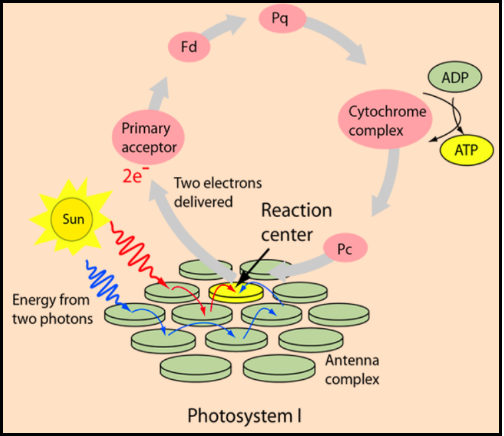
- In cyclic electron flow, only Photosystem 1 is used in order to produce ATP as a product but does not create any NADPH or O2 as a byproduct.
- Only occurs when plant cells are in need of ATP.
- It was discovered by Frankel in Purple-Sulphur bacteria.
- As the light rays fall on the reaction centre, the chl a molecule gets excited and passes these electrons to the molecule that has the ability to get reduced i.e. molecule with greater redox potential.
- After losing the electron the photo centre becomes oxidized. The expelled electron passes through a series of carriers.
- The electrons are returned by plastocyanin (Pc) to the P700 pigment in the reaction centre to complete the cycle.
Study it with Videos
"Stay in the loop. Receive exam news, study resources, and expert advice!"