


Electric Potential MCQ - Practice Questions with Answers
Quick Facts
-

Electric potential is considered one the most difficult concept.
-

53 Questions around this concept.
Solve by difficulty
 EASY
EASYTwo thin wire rings each having a radius R are placed at a distance d apart with their axes coinciding. The charges on the two rings are +Q and -Q The potential difference between the centers of the two rings is
Figure shows three points $A, B$, and $C$ in a region of uniform electric field $\vec{E}$. The line $A B$ is perpendicular and $B C$ is parallel to the field lines. Then which of the following holds good? Where $V_A, V_B$, and $V_C$ represent the electric potential at points $A, B$, and $C$ respectively.

A cube of a metal is given a positive charge Q. For the above system, which of the following statements is true
An arc of radius $r$ carries charge. The linear density of charge is $\lambda$ and the arc subtends an angle $\frac{\pi}{3}$ at the center. What is the electric potential at the center?
An electric charge $10^{-3} \mu C$ is placed at the origin $(0,0)$ of $X-Y$ co-ordinate system. Two points A and B are situated at $(\sqrt{2}, \sqrt{2})$ and $(2,0)$ respectively. The potential difference between the point $A$ and $B$ will be
Two points are maintained at the potentials of 10 V and -4 V respectively. The work done in moving 100 electrons from
is
A charge (– q) and another charge (+Q) are kept at two points A and B respectively. Keeping the charge (+Q) fixed at B, the charge (– q) at A is moved to another point C such that ABC forms an equilateral triangle of side l. The net work done in moving the charge (– q) is
This question contains Statement-1 and Statement-2. Of the four choices given after the statements, choose the one that best describes the two statements.
Statement-1: For a charged particle moving from point to point
, the net work done by an electrostatic field on the particle is independent of the path connecting point
to point
.
Statement-2: The net work done by a conservative force on an object moving along a closed loop is zero.
Four electric charges +q, +q, -q and -q are placed at the corners of a square of side 2L (see figure). The electric potential at point A, midway between the two charges +q and +q, is

Across a metallic conductor of a non-uniform cross-section, a constant potential difference is applied. The quantity which remains constant along the conductor is:
Concepts Covered - 1
In an Electric field Electric potential V at a point, P is defined as negative of work done per unit charge in changing the position of test charge from some reference point to the given point.
Note-usually reference point is taken as infinity and potential at infinity is taken as Zero.
We know that
$
W=\int \vec{F} \cdot \overrightarrow{d r}
$
$
\text { So } V=-\frac{W}{q_0}=-\int \frac{\vec{F} \cdot \overrightarrow{d r}}{q_0}
$
$V \rightarrow$ Electric potential
The negative sign indicates that as the distance from the point increases, potential decreases.
- It is a scalar quantity.
-SI Unit $\rightarrow \frac{J}{C}=$ volt while CGS unit is stat volt
1 volt $=\frac{1}{300}$ stat volt.
- Dimension -
$
[V][V]=\left[\frac{W}{q_0}\right]=\left[\frac{M Q^2 T^{-2}}{A T}\right]=\left[M L^2 T^{-3} A^{-1}\right]
$
-
Electric Potential at a distance 'r'
If the Electric field is produced by a point charge q then
$\begin{aligned} & F=\frac{K q q_0}{r^2} \\ & \qquad \begin{array}{l}V=-\frac{W}{q_0}=-\int \frac{\vec{F} \cdot \overrightarrow{d r}}{q_0} \\ \text { Using } \\ \qquad=-\frac{K q}{r} \\ \text { at } r=\infty \quad V=0=V_{\max }\end{array} \\ & \qquad \begin{array}{l} \\ V\end{array} \\ & \end{aligned}$
-
Electric Potential difference
In the Electric field, the work done to move a unit charge from one position to the other is known as Electric Potential difference.
If the point charge Q is producing the field
Point A and B are shown in the figure.
=Electric potential at point A
=Electric potential at point B

$r_B \rightarrow$ the distance of charge at $B$
$r_A \rightarrow$ distance of charge at $A$
$\Delta V=$ The Electric potential difference in bringing charge q from point A to point B in the Electric field produced by Q .
$
\begin{aligned}
& \Delta V=V_B-V_A=\frac{W_{A \rightarrow B}}{q} \\
& \Delta V=-K Q\left[\frac{1}{r_B}-\frac{1}{r_A}\right]
\end{aligned}
$
- Superposition of Electric potential
The net Electric potential at a given point due to different point masses $\left(Q_1, Q_2, Q_3 \ldots\right)$ can be calculated by doing a scalar sum of their individuals Electric potential.
$
V=V_1+V_2+V_3+\cdots=\frac{k q_1}{r_1}+k \frac{q_2}{r_2}+\frac{k\left(-q_3\right)}{r_3}+\cdots=\frac{1}{4 \pi \varepsilon_0} \sum \frac{q_i}{r_i}
$

- Electric Potential due to Continious charge distribution
$V=\int d V=\int \frac{d q}{4 \pi \varepsilon_0 r}$
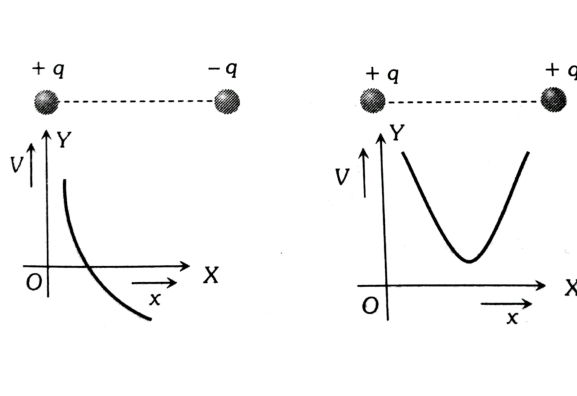
- Graphical representation
As we move on the line joining two charges then the variation of Potential with distance is given below.
- Zero potential due to a system of a two-point charge
1.For internal point
(It is assumed that $\left|Q_1\right|<\left|Q_2\right|$ )
Let at $\mathrm{P}, \mathrm{V}$ is zero
$
\begin{aligned}
& V_P=0 \Rightarrow \frac{Q_1}{x_1}=\frac{Q_2}{\left(x-x_1\right)} \\
& \Rightarrow x_1=\frac{x}{\left(Q_2 / Q_1+1\right)}
\end{aligned}
$

If both charges are like then the resultant potential is not zero at any finite point.
2.For external point
Let at P, V is zero

$\begin{aligned} & V_P \Rightarrow \frac{Q_1}{x_1}=\frac{Q_2}{\left(x+x_1\right)} \\ & \Rightarrow x_1=\frac{x}{\left(Q_2 / Q_1-1\right)}\end{aligned}$
Study it with Videos
"Stay in the loop. Receive exam news, study resources, and expert advice!"