
Search Colleges, Exams, Schools & more


Login
Extracellular structures in Bacteria MCQ - Practice Questions with Answers
Edited By admin | Updated on Sep 18, 2023 18:34 AM | #NEET
Quick Facts
-

18 Questions around this concept.
Solve by difficulty
 EASY
EASYBacteria can survive by absorbing soluble nutrients via their outer body surface, but animals cannot, because
The motile bacteria are able to move by:
The structures that help some bacteria attach to rocks and/or host tissues are:
The motile bacteria are able to move by:
Concepts Covered - 1
Extracellular structures in Bacteria
Extracellular structures in bacteria are pili, fimbriae and flagella
Pili and Fimbriae
- Pili and fimbriae are bacterial appendages that are not involved in locomotion.
- Pili are long, thick, tubular outgrowths that help in attachment of donor cell to a recipient cell and form conjugation tube.
- Pili consist of a protein called pillin.
- Fimbriae are short and narrower outgrowth that take part in adhesion of bacteria to solid surfaces.
Flagellum
- An organ of motility in bacteria.
- Arise from basal granule called blepharoplast.
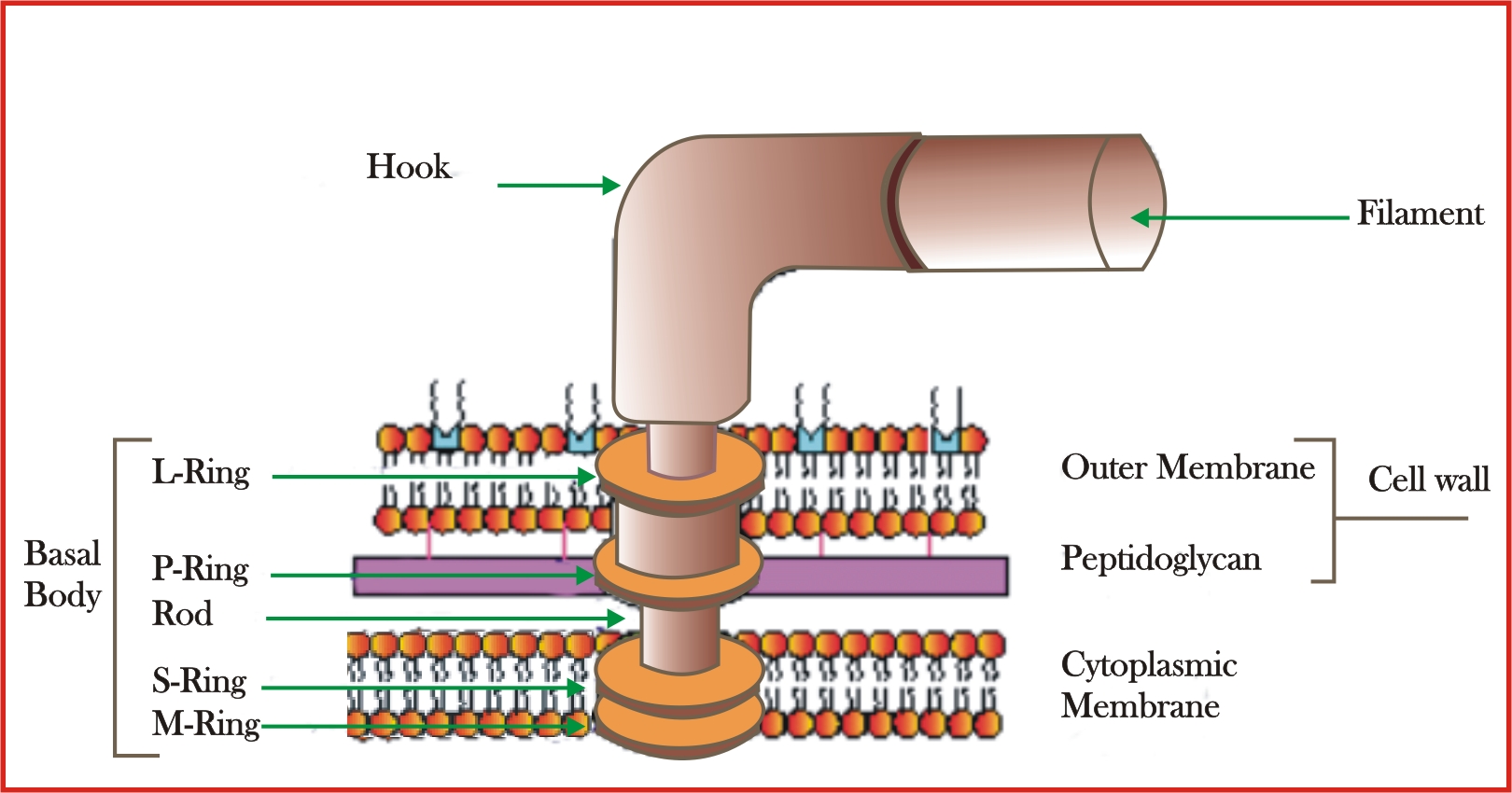
- Flagella have 3 parts i.e. basal body, hook and filament.
- The basal body is a rod-like structure having ring-like swellings and embedded in the cell envelope. There are two pairs of rings L and P (in the cell wall) and S and M (in Cell membrane).
- The hook is curved structure attaching the basal body to the filament.
- The filament is a long tubular structure composed of the protein flagellin.
- Bacterial flagella perform rotation type movement that brings backwards pushing of the water.
Study it with Videos
"Stay in the loop. Receive exam news, study resources, and expert advice!"