
Search Colleges, Exams, Schools & more


Login
Introduction to Endocrine System MCQ - Practice Questions with Answers
Edited By admin | Updated on Sep 18, 2023 18:34 AM | #NEET
Quick Facts
-

36 Questions around this concept.
Solve by difficulty
 EASY
EASYDuctless glands are called
The term ‘hormone’ was coined by
Which of the following statement is correct about hormones?
Who introduced a term hormone?
Concepts Covered - 2
Need for Endocrine System:
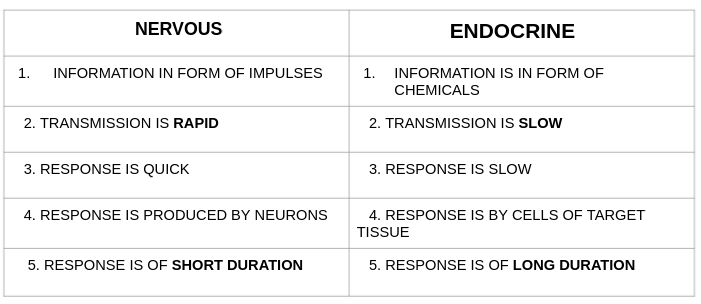
- We have seen that the neural system provides point-to-point rapid coordination among organs.
- Neural coordination is fast but short-lived.
- As the nerve fibres do not innervate all cells of the body and the cellular functions need to be continuously regulated; a special kind of coordination and integration has to be provided.
- This function is carried out by hormones.
- The neural system and the endocrine system jointly coordinate and regulate physiological functions in the body.
- The main difference between two systems are as follows :
Endocrine Glands:
- Endocrine glands lack ducts and are hence, called ductless glands.
- Their secretions are called hormones.
- The classical definition of the hormone is a chemical produced by endocrine glands and released into the blood and transported to a distantly located target organ.
- Hormones are non-nutrient chemicals which act as intercellular messengers and are produced in trace amounts.
Human Endocrine System:
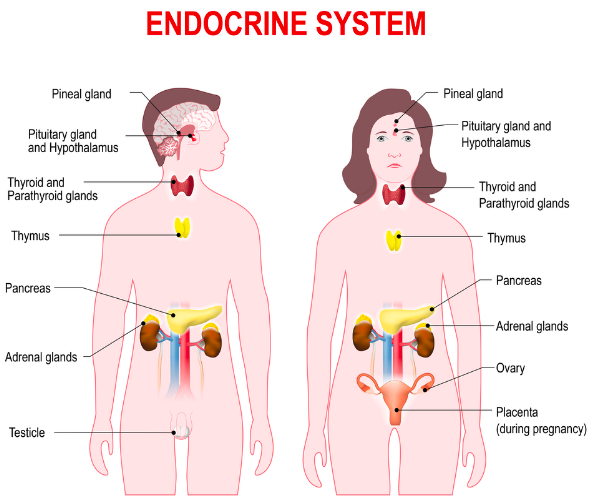
- The endocrine glands and hormone-producing diffused tissues/cells located in different parts of our body constitute the endocrine system.
- Pituitary, pineal, thyroid, adrenal, pancreas, parathyroid, thymus and gonads (testis in males and ovaries in females) are the organised endocrine bodies in our body.
- In addition to these, some other organs, e.g., gastrointestinal tract, liver, kidney, the heart also produce hormones.
Hormones: Discovery & Properties
Discovery of Hormones:
- English physiologist William M. Bayliss and Ernest H. Starling discovered the first hormone secretin in 1903. It is present in the intestinal mucosa.
- The term hormone was introduced by Starling in 1905.
Properties of Hormones:
- They are synthesized and secreted by endocrine cells
- Hormones are non-nutrient chemicals.
- They act as intercellular messengers and are produced in trace amounts.
- Hormones are transported by the bloodstream from the endocrine cells to serve as ‘chemical messengers’ which act on target cells or organs.
- Hormones do not provide energy or building materials but they do have effects on growth differentiation and metabolic activities of their target cells.
- They have low molecular weight.
- Hormones are effective in low concentration.
- Excess or deficiency leads to disorders.
- They may accelerate or inhibit a specific physiological process.
- Hormones are often used up in their regulatory activities.
Mode of Action:
- Two or more hormones can interact to affect the response of cells in a variety of ways.
- The three most common types of interaction are as follows:
- The permissive effect, in which the presence of one hormone enables another hormone to act.
- The synergistic effect, in which two hormones with similar effects produce an amplified response.
- The antagonistic effect, in which two hormones have opposing effects.
Study it with Videos
"Stay in the loop. Receive exam news, study resources, and expert advice!"