
Search Colleges, Exams, Schools & more


Login
Mechanisms of Water Absorption by Plants MCQ - Practice Questions with Answers
Edited By admin | Updated on Sep 18, 2023 18:34 AM | #NEET
Quick Facts
-

25 Questions around this concept.
Solve by difficulty
 EASY
EASYAbsorption of water by the plant cell walls by surface attraction is called
Roots play an insignificant role in the absorption of water in:
Which of the following is not observed during the apoplastic pathway?
Concepts Covered - 0
Absorption of Water by Plants
- For the absorption of water, the roots of the plant interact with soil and soil particles.
- As we have studied, there are the following regions in the root of a plant:
- Region of root cap
- Region of meristem
- Region of elongation
- Region of root hair or maturation region
- Maximum water absorption occurs through the region of root hair as the root hair provide an increased surface area for water absorption.
- In the soil water, the water potential is slightly negative due to dissolved minerals.
- Hence, soil water is a very diluted solution.
|
Pathway of water across the root: Root hairs ⟶ Cortical Cells ⟶ Passage Cells ⟶ Xylem Elements |
- The root hair cells initially absorb the water from the soil through imbibition by the cell walls.
- Water moves into the root hair cells due to the osmotic pressure.
- Now, the cell to cell movement of water begins, from the root hair cells to the cortical cells according to the DPD.
- Inner cortical cells have a higher DPD as compared to the outer cortical cells.
- The innermost layer of the cortex is endodermis. The endodermal cells have suberised Casparian strips which is impervious to water.
- Water is then directed to the passage cells or transfer cells of the endodermis that do not have suberised walls.
- From the passage cells, water moves into the xylem elements.
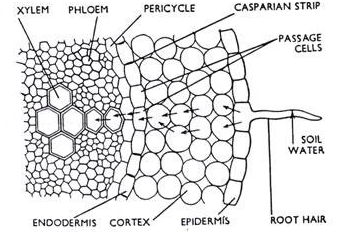
Pathways of Water Movement in the Root
- There are two pathways that can be followed by water once inside the root hair cell:
- Apoplast
- Symplast
- Apoplast is the system of adjacent cell walls continuous throughout the plant except at the casparian strips of endodermis. Apoplastic movement of water occurs through intercellular spaces. The cell membrane is not crossed. The movement of water occurs down the concentration gradient.
- Symplast is the system of interconnected protoplasts via plasmodesmata. Water has to enter the cell through the cell membrane and moves down the concentration gradient. The movement of water is also facilitated by cytoplasmic streaming.
- In the root, apoplastic movement of water occurs from the cortical cells till the endodermis.
- Due to the presence of suberised casparian strips, water has to enter the symplastic pathway in the passage cells of endodermis.
- Water then moves into the xylem vessels from the passage cells via symplastic pathway.

"Stay in the loop. Receive exam news, study resources, and expert advice!"
Get Answer to all your questions

Applications for Admissions are open.
Ranked #19 by NIRF, NAAC A++ Accredited | Recognized by dental council of India
Krishnadevaraya College of Dental Sciences and Hospital, Bangalore
ApplyRanked among the top Dental Colleges for 7 consecutive years by India Today poll