
Search Colleges, Exams, Schools & more


Login
Reflex Action & Reflex Arc MCQ - Practice Questions with Answers
Edited By admin | Updated on Sep 18, 2023 18:34 AM | #NEET
Quick Facts
-

23 Questions around this concept.
Solve by difficulty
 EASY
EASYRemoval of the proximal convoluted tubule from the nephron will result in:
Concepts Covered - 0
Reflex Action & Reflex Arc
Reflex Action & Reflex Arc
- We all have experienced a sudden withdrawal of a body part which comes in contact with objects that are extremely hot, cold pointed or animals that are scary or poisonous.
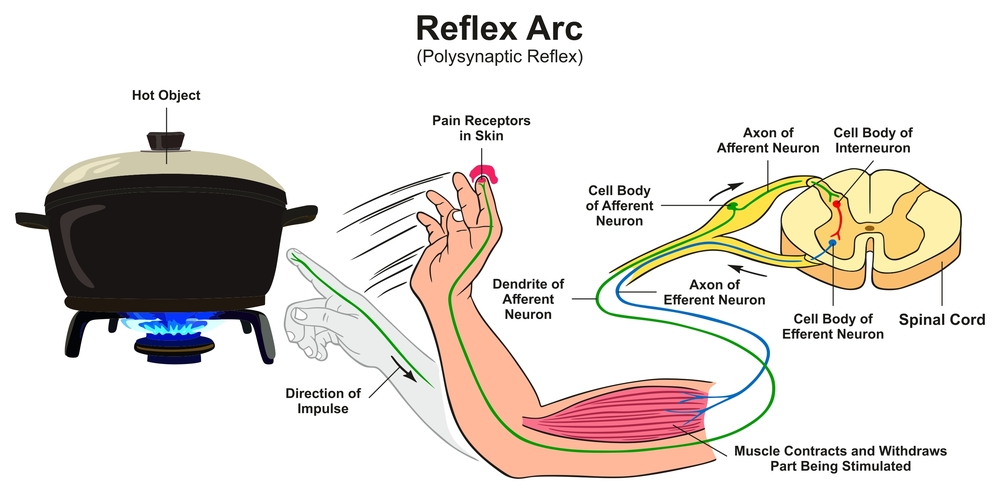
- The entire process of response to a peripheral nervous stimulation, that occurs involuntarily, i.e., without conscious effort or thought and requires the involvement of a part of the central nervous system is called a reflex action.
- The reflex pathway comprises at least one afferent neuron (receptor) and one efferent (effector or excitor) neuron appropriately arranged in a series.
- The afferent neuron receives a signal from a sensory organ and transmits the impulse via a dorsal nerve root into the CNS (at the level of the spinal cord).
- The efferent neuron then carries signals from CNS to the effector.
- The stimulus and response thus forms a reflex arc as shown below in the diagram
- It is an important activity for the survival of the animal and relieves the brain from too much strain.
- The responses of reflex action immediately protect the animal from harmful situations.
Types of Reflexes and Types of Synapses in Reflex Action
Types of Reflexes and Types of Synapses in Reflex Action
- Unconditioned reflexes are inborn reflexes and these are transmitted from parents to offsprings.
- These are also called inherited reflexes.
- Breast feeding, blinking of eyes are some examples of unconditioned reflexes.
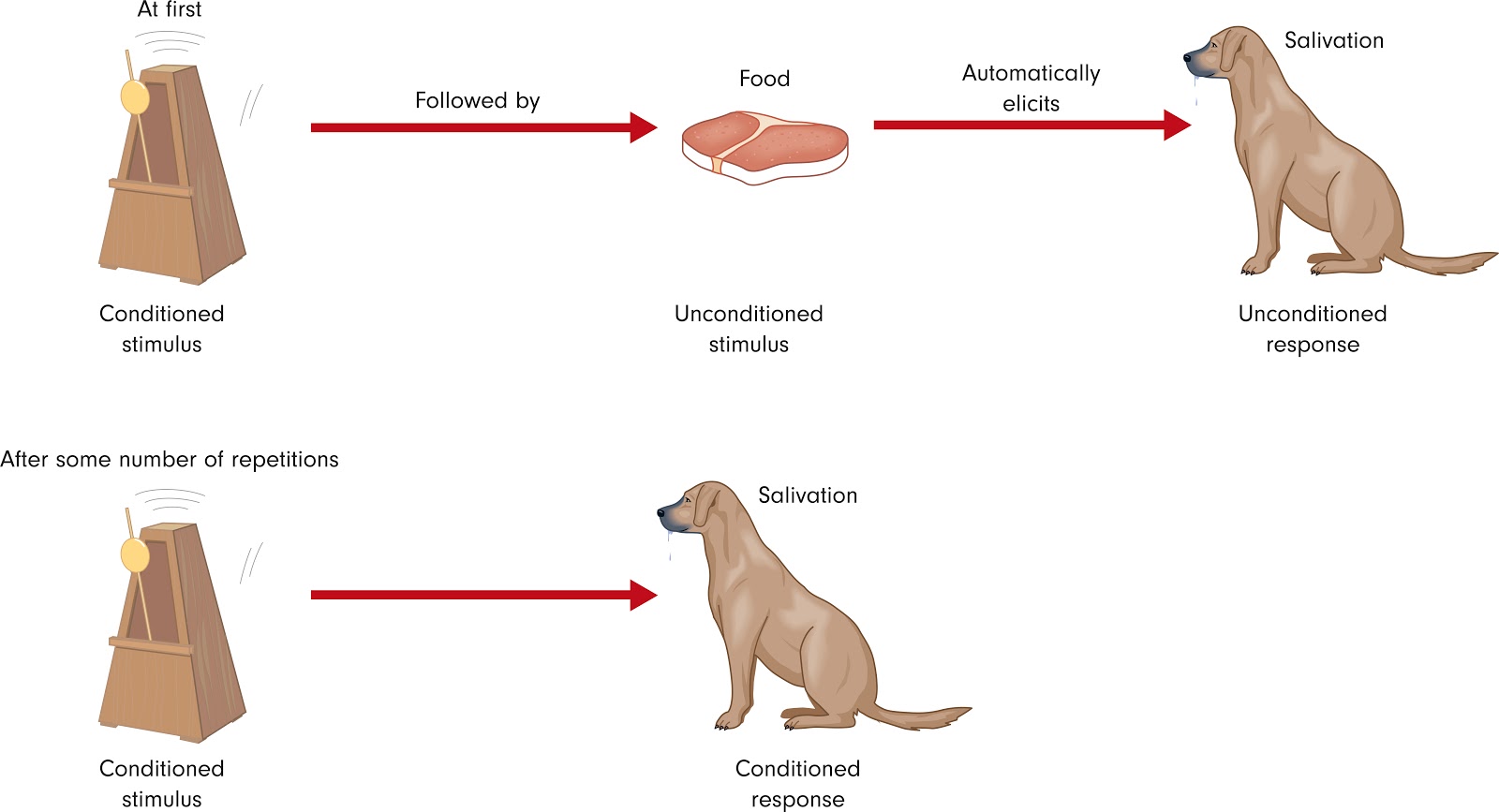
- Conditioned reflexes are acquired reflexes that are learnt by an individual during lifetime.
- These are not constant may disappear and reappear again.
- The conditioned reflexes were shown by Ivan Pavlov.
Based on how many neurons participate in one arc, reflexes can be monosynaptic or polysynaptic.
Monosynaptic Reflexes:
- The monosynaptic reflexes consist of two neurons.
- The first is located within the spinal ganglion. This is the sensory neuron (afferent) whose dendrites detects the stimuli from the muscle.
- The neuron II is a motor neuron (efferent) that sends the appropriate signal via its axon back to the same muscle in which the sensory neuron had detected the signal.
- This means that the entire arc has only one neuronal synapse that is directly between neuron I and neuron II (without the participation of interneurons).
- The perfect example of the monosynaptic reflex is the knee-jerk or the patellar reflex.
Polysynaptic Reflexes:
- The polysynaptic reflexes are accomplished with the participation of one or more interneurons, meaning that the communication between the afferent and efferent neurons is indirect.
- The body of the sensory neuron I is also situated within the spinal ganglion; receiving stimuli from muscles and other tissues.
- The afferent neuron sends signals via its axon to interneurons located in the gray matter of the spinal cord.
- These interneurons then direct these signals to the adequate motor neurons of their specific spinal cord segments, as well as adjacent and distant motor neurons.
- Because of this, one stimulus transmitted to the interneurons can cause multiple motor neurons to get excited or inhibited, and therefore, can cause more than one muscle to contract or relax.
- Generally, the different muscle groups susceptible to this way of regulation are the extensors or flexors.
- From a physiological point of view, one of the most important polysynaptic reflexes is the inverse stretch reflex.
"Stay in the loop. Receive exam news, study resources, and expert advice!"