
Search Colleges, Exams, Schools & more


Login
Vertebral Column : An Overview MCQ - Practice Questions with Answers
Edited By admin | Updated on Sep 18, 2023 18:34 AM | #NEET
Quick Facts
-

19 Questions around this concept.
Solve by difficulty
 EASY
EASYWhich one of the following is showing the correct sequential order of vertebrae in the vertebral column of human beings?
Largest vertebrae in Humans
Typical Thoracic Vertbral are
Concepts Covered - 1
Vertebral Column (Backbone)
- The Vertebral column extends from the base of the skull and constitutes the main framework of the trunk.
- It consists of four curvatures : Cervical curvature in the neck region, Thoracic curvature in the chest region, Lumbar curvature in the abdomen or lower back region and Sacral curvature in the pelvic region
- In adults the vertebral column is formed by 26 serially arranged units called vertebrae and is dorsally placed.
- In children there are 33 vertebrae present
- The Vertebrae present are as follows
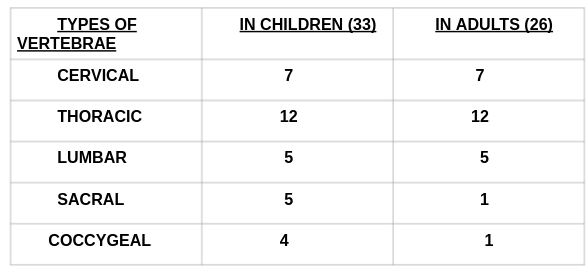
- Thus in adults the 5 Sacral are fused and 4 Coccygeal are also fused and hence the total vertebrae varies in adults and children
- Each vertebra has a central hollow portion (neural canal) through which the spinal cord passes.
Cervical Vertebrae:
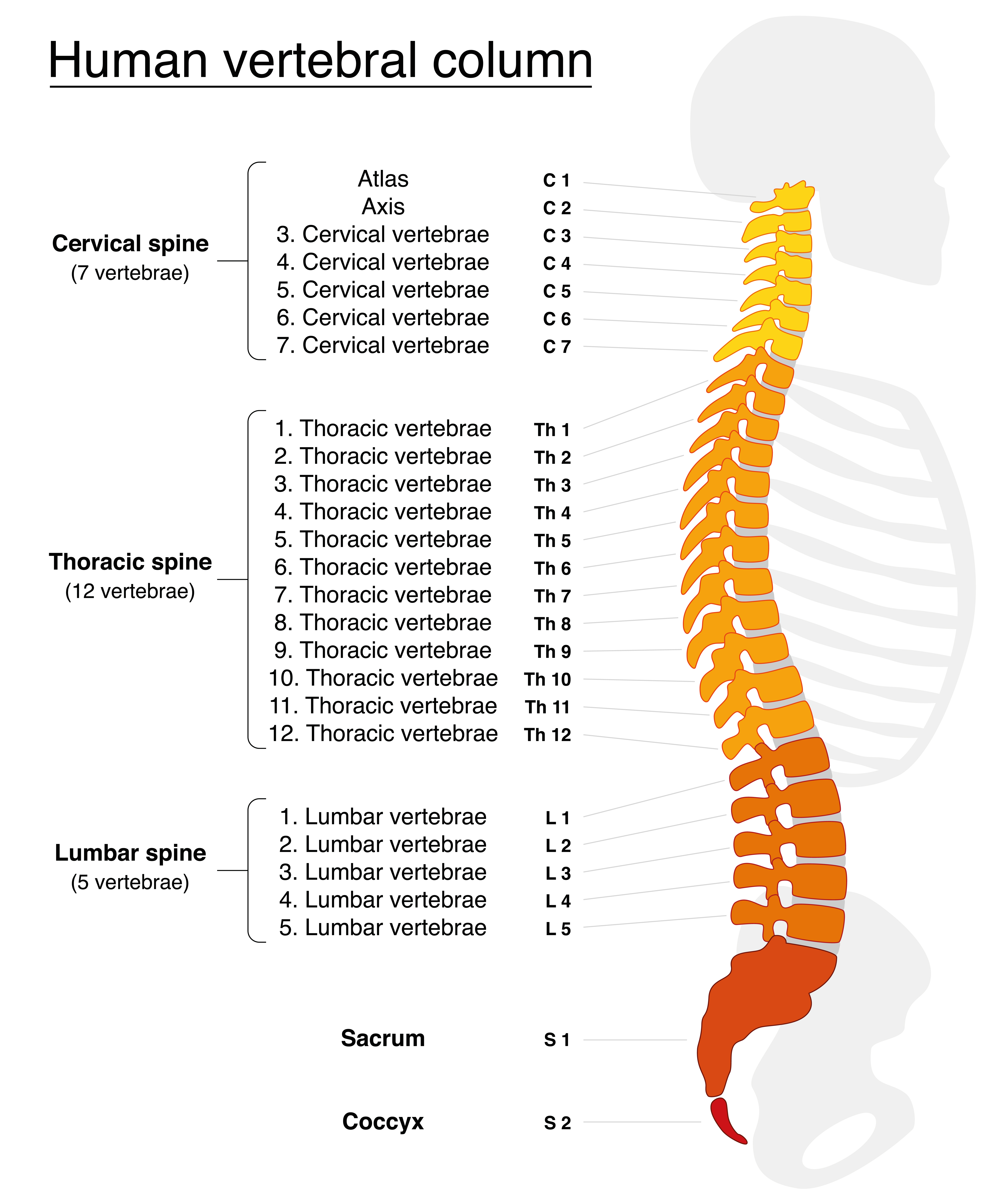
- These are 7 in number present in the neck, the first cervical vertebra is called atlas, the second cervical vertebra is known as the axis.
- The atlas supports the head and is named for the mythological Atlas who supported the world on his shoulders.
- The Axis has a peg like process called the odontoid process
Thoracic Vertebrae:
- These are 12 in number present in the chest.
- They are larger and stronger than the cervical vertebrae.
- They articulate with ribs.
Lumbar Vertebrae:
- These are 5 in number present in the abdomen.
- They are the largest and strongest in the vertebral column.
- Their processes are short and thick.
- The spinous processes are thick and broad and project posteriorly.
Sacrum:
- The five sacral vertebrae are fused in the adult, forming one structure called the sacrum, which lies between the innominate bones of the pelvic girdle.
- The female sacrum is shorter, wider than the male sacrum.
Coccyx:
- The four coccygeal vertebrae are fused to form a curved triangular bone called the coccyx.
- In females, the coccyx points inferiorly but in the male, it points anteriorly. It is considered as a vestigial tail
Intervertebral discs
- These discs are present between the adjacent vertebrae from Axis to the Sacrum
Vertebral Formula
- The formula in adults is denoted as C7T12L5S(5)C(4)
NOTE
The thoracic and sacral (pelvic) curves are termed primary curvatures, because they alone are present during fetal life. The Cervical and Lumbar curves develop later and hence are Secondary curvatures
Study it with Videos
"Stay in the loop. Receive exam news, study resources, and expert advice!"
Get Answer to all your questions
NEET Articles

Applications for Admissions are open.
Ranked #19 by NIRF, NAAC A++ Accredited | Recognized by dental council of India
Parul University, Goa
ApplySpecial Scholarship for Students from Goa (Get an exclusive scholarship of ₹20,000 if you're a Goa-based student) | Bringing Parul Education Trust's 30-year Education Legacy to Goa
Krishnadevaraya College of Dental Sciences and Hospital, Bangalore
ApplyRanked among the top Dental Colleges for 7 consecutive years by India Today poll