
Search Colleges, Exams, Schools & more


Login
Causes And Effects Of Biomagnification MCQ - Practice Questions with Answers
Edited By admin | Updated on Sep 18, 2023 18:34 AM | #NEET
Quick Facts
-

15 Questions around this concept.
Solve by difficulty
 EASY
EASYIn an area where DDT had been used extensively, the population of birds declined significantly because:
Biomagnification is highest at
Concepts Covered - 0
Water Pollution & Its Causes : Industrial Effluents & Biomagnification
- Unlike domestic sewage, wastewater from industries like petroleum, paper manufacturing, metal extraction and processing, chemical manufacturing, etc., often contain toxic substances, notably, heavy metals (defined as elements with density > 5 g/cm3 such as mercury, cadmium, copper, lead, etc.) and a variety of organic compounds.
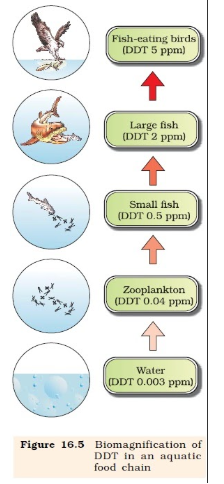
- A few toxic substances, often present in industrial waste waters, can undergo biological magnification (Biomagnification) in the aquatic food chain.
- Biomagnification refers to an increase in concentration of the toxicant at successive trophic levels.
- This happens because a toxic substance accumulated by an organism cannot be metabolised or excreted, and is thus passed on to the next higher trophic level.
- This phenomenon is well-known for mercury and DDT.
- The given figure shows biomagnification of DDT in an aquatic food chain.
- In this manner, the concentration of DDT is increased at successive trophic levels; say if it starts at 0.003 ppb (ppb = parts per billion) in water, it can ultimately can reach 25 ppm (ppm = parts per million) in fish-eating birds, through biomagnification.
- High concentrations of DDT disturb calcium metabolism in birds, which causes thinning of eggshell and their premature breaking, eventually causing decline in bird populations
"Stay in the loop. Receive exam news, study resources, and expert advice!"