


History and Discovery of Photosynthesis MCQ - Practice Questions with Answers
Quick Facts
-

20 Questions around this concept.
Solve by difficulty
 EASY
EASYVegetation purifies (phlogiston) air was demonstrated by
Which of the following statements is wrong for the experiment of photosynthesis?
Concepts Covered - 2
|
Scientists |
Contribution |
|---|---|
|
Aristotle and Theophrastus |
Plants obtain organic and inorganic nutrients from the soil - Humus Theory |
|
Von Helmont |
Plants obtain nutrients from water and soil - Willow tree experiment |
|
Stephan Hales |
Air and light are important for the nourishment of plants |
|
Joseph Priestley |
Green plants purify the air. The vital air is released from the plants. |
|
Ingenhousz |
Sunlight is required for the purification of air by the plants. Provided equation for photosynthesis:
|
|
T. Desaussure |
Plants absorb CO2 from the atmosphere. Plants need light and water for photosynthesis. The amount of O2 released is equal to the amount of CO2 absorbed |
|
Pelletier and Caventon |
Proposed the term ‘chlorophyll’ |
|
Mayer |
Proposed that plants store energy from sunlight in the form of chemical energy |
|
Leibig |
Organic carbon comes from CO2 |
|
Engelmann |
Plotted action spectrum of photosynthesis |
|
Blackman |
Discovered dark reaction of photosynthesis |
|
Von Neil |
Indicated that photosynthetic bacteria fix CO2 in the presence of H2S and S is precipitated. Similarly, green plants use H2O and O2 is released from water. |
|
Robert Hill |
Hill’s reaction to explain the light reaction of photosynthesis |
|
Reuben, Hasid and Kamen |
Confirmed that oxygen is released due to dissociation of water (by using |
Exp. 1
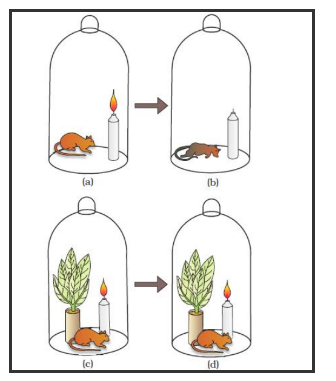
- Joseph Priestley in 1770 performed a series of experiments that revealed the essential role of air in the growth of green plants.
- Priestley observed that a candle burning in a closed space – a bell jar, soon gets extinguished. Similarly, a mouse would soon suffocate in a closed space.
- He concluded that a burning candle or an animal that breathes the air, both somehow, damage the air.
- But when he placed a mint plant in the same bell jar, he found that the mouse stayed alive and the candle continued to burn.
- Priestley hypothesized as follows: Plants restore the air whatever breathing animals and burning candles remove.
Exp. 2
- Using a similar setup as the one used by Priestley, but by placing it once in the dark and once in the sunlight, Jan Ingenhousz (1730-1799) showed that sunlight is essential to the plant process that somehow purifies the air fouled by burning candles or breathing animals.
- Ingenhousz in an elegant experiment with an aquatic plant showed that in bright sunlight, small bubbles were formed around the green parts while in the dark they did not.
- Later he identified these bubbles to be of oxygen.
- Hence he showed that it is only the green part of the plants that could release oxygen.
Exp. 3
- In 1854, Julius von Sachs provided evidence for the production of glucose when plants grow. Glucose is usually stored as starch.
- His later studies showed that the green substance in plants (chlorophyll as we know it now) is located in special bodies (later called chloroplasts) within plant cells.
- He found that the green parts in plants are where glucose is made and that the glucose is usually stored as starch.
Exp. 4
- T.W Engelmann used a prism and he split light into its spectral components and then illuminated a green alga, Cladophora, placed in a suspension of aerobic bacteria.
- The bacteria were used to detect the sites of O2 evolution.
- He observed that the bacteria accumulated mainly in the region of blue and red light of the split spectrum.
- A first action spectrum of photosynthesis was thus described.
- It resembles roughly the absorption spectra of chlorophyll a and b.
Study it with Videos
"Stay in the loop. Receive exam news, study resources, and expert advice!"