


Fraunhofer Diffraction By A Single Slit MCQ - Practice Questions with Answers
Quick Facts
-

Fraunhofer diffraction by a single slit is considered one the most difficult concept.
-

21 Questions around this concept.
Solve by difficulty
 EASY
EASYThe maximum number of possible interference maxima for slit-separation equal to twice the wavelength in Young’s doubleslit experiment is
Concepts Covered - 1
Fraunhofer diffraction by a single slit
let's assume a plane wave front is incident on a slit AB (of width b). Each and every part of the exposed part of the plane wave front (i.e. every part of the slit) acts as a source of secondary wavelets spreading in all directions. The diffraction is obtained on a screen placed at a large distance. (In practice, this condition is achieved by placing the screen at the focal plane of a converging lens placed just after the slit).
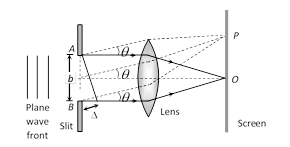
- The diffraction pattern consists of a central bright fringe (central maxima) surrounded by dark and bright lines (called secondary minima and maxima).
- At point O on the screen, the central maxima is obtained. The wavelets originating from points A and B meets in the same phase at this point, hence at O, intensity is maximum
Secondary minima : For obtaining nth secondary minima at P on the screen, path difference between the diffracted waves
$$
\Delta x=b \sin \theta=n \lambda
$$
1. Angular position of nth secondary minima:
$$
\sin \theta \approx \theta=\frac{n \lambda}{b}
$$
2. Distance of nth secondary minima from central maxima:
$$
\begin{aligned}
x_n=D \cdot \theta=\frac{n \lambda D}{b} & \\
& \text { where } \mathrm{D}=\text { Distance between slit and screen. } \\
& f \approx D=\text { Focal length of converging lens. }
\end{aligned}
$$
Secondary maxima : For nth secondary maxima at P on the screen.
Path difference $\Delta x=b \sin \theta=(2 n+1) \frac{\lambda}{2} ;$ where $\mathrm{n}=1,2,3 \ldots .$.
(i) Angular position of nth secondary maxima
$$
\sin \theta \approx \theta \approx \frac{(2 n+1) \lambda}{2 b}
$$
(ii) Distance of nth secondary maxima from central maxima:
$$
x_n=D \cdot \theta=\frac{(2 n+1) \lambda D}{2 b}
$$
Central maxima : The central maxima lies between the first minima on both sides.
(i) The Angular width d central maxima $=2 \theta=\frac{2 \lambda}{b}$
(ii) Linear width of central maxima
$$
=2 x=2 D \theta=2 f \theta=\frac{2 \lambda f}{b}
$$
Intensity distribution: if the intensity of the central maxima is $I_0$ then the intensity of the first and secondary maxima are found to be $\frac{I_0}{22}$ and $\frac{I_0}{61}$. Thus diffraction fringes are of unequal width and unequal intenstities.
(i) The mathematical expression for in intensity distribution on the screen is given by:
$$
I=I_o\left(\frac{\sin \alpha}{\alpha}\right)^2 \text { where } \alpha \text { is just a convenient connection between the angle } \theta \text { that locates }
$$
a point on the viewing screening and light intensity I.
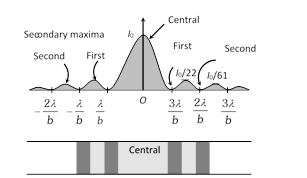
$\phi=$ Phase difference between the top and bottom ray from the slit width b .
$$
\alpha=\frac{1}{2} \phi=\frac{\pi b}{\lambda} \sin \theta
$$
(ii) As the slit width increases relative to wavelength the width of the control diffraction maxima decreases; that is, the light undergoes less flaring by the slit. The secondary maxima also decreases in width and becomes weaker.
(iii) If b>>λ, the secondary maxima due to the slit disappear; we then no longer have single slit diffraction.
Study it with Videos
"Stay in the loop. Receive exam news, study resources, and expert advice!"