


Refraction At Spherical Surface MCQ - Practice Questions with Answers
Quick Facts
-

15 Questions around this concept.
Solve by difficulty
 MEDIUM
A small object is embedded in a glass spher$\mathrm{e}(\mu=1.5)$ of radius 5cm at a distance 1.5cm left of the centre. The image of the object as seen by an observer standing to the left of the sphere is at a distance:
A spherical surface of curvature R separates air $(\mu=1.5)$. The centre of curvature is in the glass. A point object $P$ placed in the air is found to have a real image $Q$ in the glass. The line $P Q$ cuts the surface at a point $O$ and $P O=O Q$. The distance $P O$ is equal to
A spherical convex surface separates object and image space of refractive index 1 and $4 / 3$ respectively. If the radius of curvature of the surface is 0.1 m, its power is :
A glass sphere $(\mu=1.5)$ of radius 8 cm is placed in sunlight. Where is the image of the sun formed by the light passing through the sphere? When refraction by first surface of sphere
A glass sphere $(\mu=1.5)$ of radius 8 cm is placed in sunlight. Where is the image of the sun formed by the light passing through the sphere? When refraction by second surface of sphere
s
A small filament is at the centre of a hollow glass sphere of inner and outer radii and
respectively. The refractive index of glass is 1.50. Calculate the position of the image of the filament when viewed from outside the sphere.
Read the following table carefully and Answer the Questions given below:
Given table below shows the number of candidates appearing in different banking exams in five different years, while the second table shows the percentage of candidates selected in these banking exams during five different years.
$
\text { Table 1: Number of Candidates Appearing in Different Banking Exams }
$
$
\begin{array}{|l|l|l|l|l|l|}
\hline \text { Year } & \text { SBI PO } & \text { IBPS PO } & \text { IBPS Clerk } & \text { IBPS RRB Clerk } & \text { SBI Clerk } \\
\hline 2016 & 50,000 & 70,000 & 85,000 & 30,000 & 25,000 \\
\hline 2017 & 55,000 & 72,000 & 90,000 & 32,000 & 26,000 \\
\hline 2018 & 60,000 & 75,000 & 95,000 & 33,000 & 27,000 \\
\hline 2019 & 65,000 & 78,000 & 98,000 & 35,000 & 28,000 \\
\hline 2020 & 70,000 & 80,000 & 1,00,000 & 37,000 & 30,000 \\
\hline
\end{array}
$
$
\begin{aligned}
&\text { Table 2: Percentage of Candidates Selected }\\
&\begin{array}{|l|l|l|l|l|l|}
\hline \text { Year } & \text { SBI PO } & \text { IBPS PO } & \text { IBPS Clerk } & \text { IBPS RRB Clerk } & \text { SBI Clerk } \\
\hline 2016 & 5 \% & 6 \% & 7 \% & 8 \% & 5 \% \\
\hline 2017 & 6 \% & 6.5 \% & 7.2 \% & 8.5 \% & 5.5 \% \\
\hline 2018 & 6.5 \% & 7 \% & 7.5 \% & 9 \% & 6 \% \\
\hline 2019 & 7 \% & 7.2 \% & 8 \% & 9.5 \% & 6.5 \% \\
\hline 2020 & 7.5 \% & 7.5 \% & 8.5 \% & 10 \% & 7 \% \\
\hline
\end{array}
\end{aligned}
$
Find the total number of candidates who appeared in all banking exams in 2020.
In the situation illustrated below, the object is set up 0.5 m away from a converging mirror. If the focal length of the lens is 0.2 m, determine a) the location of the real image, and b) the magnification of the image.

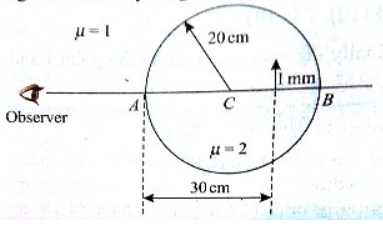
In the shown in the figure, find the position and size of the image for the situation.
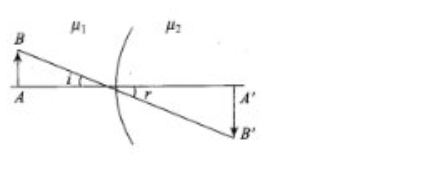
What will be the magnification formula in the mentioned figure, where v = position of the image from the pole and u = position of the object from the pole?
Concepts Covered - 0

If an object 0 is placed in front of a curved surface as shown in the above figure, then the Refraction formula is given as
where
=Refractive index of the medium from which light rays are coming (from the object).
=Refractive index of the medium in which light rays are entering.
and
and u = Distance of object, v = Distance of image, R = Radius of curvature
Note -
- use sign convention while solving the problem
- Real image forms on the side of a refracting surface that is opposite to the object,
and virtual image forms on the same side as the object. - Using
(i.e for plane surface)
we get

If an object AB is placed in front of a curved surface as shown in the above figure, then the lateral Magnification formula is given as
or
where
=Refractive index of the medium from which light rays are coming (from the object).
=Refractive index of the medium in which light rays are entering.
and
and u = Distance of object, v = Distance of image, R = Radius of curvature
"Stay in the loop. Receive exam news, study resources, and expert advice!"