
Search Colleges, Exams, Schools & more


Login
Dominant and Recessive Epistasis MCQ - Practice Questions with Answers
Edited By admin | Updated on Sep 18, 2023 18:34 AM | #NEET
Quick Facts
-

Dominant Epistasis, Supplementary gene interaction or recessive epistasis are considered the most difficult concepts.
-

23 Questions around this concept.
Solve by difficulty
 EASY
EASYIf a plant produce green coloured fruit in summer squash, its genotype would be:
What is dominant epistasis?
Concepts Covered - 2
Dominant Epistasis
- According to Mendel’s laws of inheritance, when two contrasting alleles are brought together, one of them dominates over the other in F1.
- In the phenomenon of epistasis, two independent non-allelic genes that affect the same phenotype interact in such a way that the dominant allele of one gene (for example, A) masks the effect of another gene (for example B).
- Therefore, gene A is said to be epistatic to gene B or gene B is said to be hypostatic to gene A.
Example:
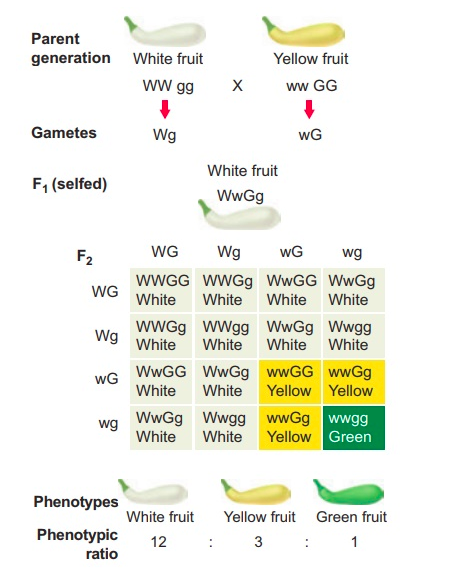
- In summer squash, the fruit colour is governed by two genes.
- The dominant gene W for white colour, suppresses the expression of the gene Y which controls yellow colour.
- So yellow colour appears only in the absence of W. Thus W is epistatic to Y.
- In the absence of both W and Y, green colour develops.
Supplementary gene interaction or recessive epistasis
- When recessive alleles at one locus mask the expression of both (dominant and recessive) alleles at another locus, it is known as recessive epistasis.
- This type of gene interaction is also known as supplementary epistasis.
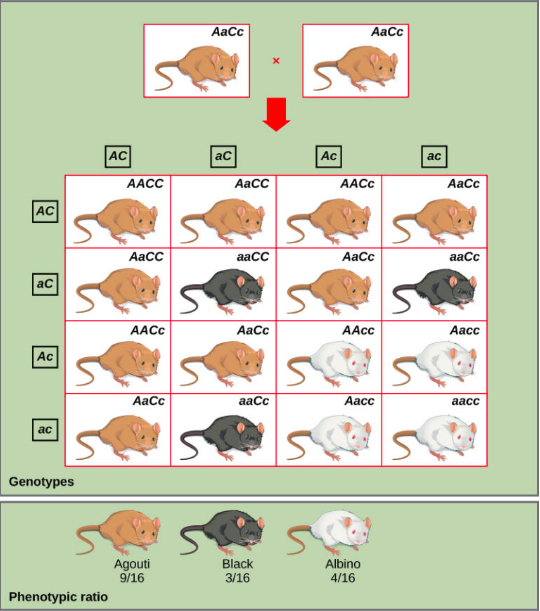
- An example of recessive epistasis is pigmentation in mice which is controlled by two pairs of genes A/a and C/c.
- Dominant C produces black colour when gene A/a is recessive homozygous.
- When gene A is homozygous recessive or heterozygous with gene C/c, agouti is produced.
- However, when gene C/c is homozygous recessive, it masks the formation of any color and albino/white coat is produced.
- Therefore, gene C/c is being epistatic in recessive homozygous condition.
- This happens because a mouse with a recessive c allele at this locus is unable to produce pigment and is albino regardless of the allele present at locus A.
Study it with Videos
"Stay in the loop. Receive exam news, study resources, and expert advice!"
Books
Reference Books
Clear your Basics with NCERT
E-books & Sample Papers
Get Answer to all your questions

Study Resources, Applications and Opportunities
Know possible Govt/Private MBBS/BDS Colleges based on your NEET rank
NEET 1-to-1 Counseling Guidance
ApplyCollege Predictors Webinars One to One Counselling Regular Updates Medical Almanac
Emversity Allied Health Programs
ApplyGet Job Ready in Healthcare | Employability-Focused Programs
KCDSH- Krishnadevaraya Dental College & Sciences Admis 2026
ApplyRanked among the top Dental Colleges for 7 consecutive years by India Today poll
SRM Kattankulathur Dental College Admissions 2026
ApplyRanked #19 by NIRF, NAAC A++ Accredited | Recognized by dental council of India