
Search Colleges, Exams, Schools & more


Login
Gynoecium MCQ - Practice Questions with Answers
Edited By admin | Updated on Sep 18, 2023 18:34 AM | #NEET
Quick Facts
-

Parts of a Flower - Gynoecium is considered one the most difficult concept.
-

13 Questions around this concept.
Solve by difficulty
 EASY
EASYFree carpels are called
Concepts Covered - 1
Parts of a Flower - Gynoecium
Parts of a Flower - Gynoecium
- Gynoecium is the female reproductive whorl of the flower.
- It is made up of one or more carpels/pistils/megasporophyll.
- A carpel consists of stigma, style and ovary.
- Ovary is the enlarged basal part on which the elongated tube called style is present.
- The style connects the ovary to the stigma.
- The stigma present at the tip is receptive surface for the pollen grains.
- Ovary contains one or more ovules attached to a flattened cushion-like placenta.
- When more than one one carpels are present and they are free, the condition is called apocarpous, e.g., lotus and rose.
- When more than one carpels are present and they are fused, the condition is called syncarpous, e.g., mustard and tomato.
- Monocarpellary : It is a gynoecium with a single carpel, e.g., Bean.
- Bicarpellary : It is the presence of two carpels in a gynoecium. e.g., Helianthus.
- Tricarpellary : It is the presence of three carpels in a gynoecium e.g., Cocos.
- Tetracarpellary : It is the presence of four carpels in a gynoecium. e.g., Cotton.
- Pentacarpellary : It is the presence of five carpels in a gynoecium. e.g., Hibiscus.
- Multicarpellary : It is the presence of many carpels in a gynoecium. e.g., Annona.
Locules in the Ovary:
- The ovary encloses one to many chambers called the locules. Based on the number of locules, the ovary may be described as follows :
- Unilocular : Ovary with one locule. e.g., Dolichos.
- Bilocular : Ovary with two locules. e.g., Solanum.
- Trilocular : Ovary with three locules. e.g., Allium.
- Tetralocular : Ovary with four locules. e.g., Datura.
- Pentalocular : Ovary with five locules. e.g., Hibiscus.
- Multilocular : Ovary with many locules. e.g., Abutilon.
Style:
- The stalk like-structure present above the ovary is called the style.
- The style may be long (Datura) or short (grasses) or absent (Papaver).
- In the family umbelliferae (apiaceae) the base of the style is swollen and forms a structure called stylopodium.
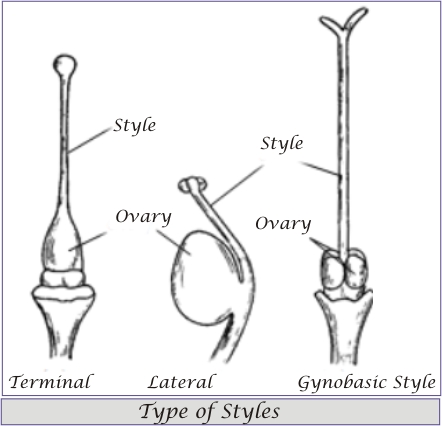
- There are three types of styles as described below :
- Terminal style : If the style arises from terminal part of the ovary, it is called terminal style, e.g., Datura, Hibiscus and Solanum.
- Lateral style : If the style arises from one side of the ovary, it is called lateral style, e.g., Mango.
- Gynobasic style : If the style arises from the base of the ovary it is called gynobasic style, e.g., Ocimum, Salvia.
Stigma:
- The terminal receptive portion of the style is called the stigma.
- It receives pollen grains during pollination.
- Usually the lobes of the stigma corresponds to the number of carpels.
- Accordingly the stigma may be unifid, bifid, trifid, tetrafid, pentafid or multifid.
Types of Stigma:
- Capitate : Round stigma. e.g., Hibiscus.
- Forked : Divided stigma. e.g., Tridax.
- Feathery : Brush like stigma. e.g., Grasses.
Study it with Videos
"Stay in the loop. Receive exam news, study resources, and expert advice!"