


Meter Bridge MCQ - NEET Practice Questions with Answers
Quick Facts
-

Meter Bridge is considered one of the most asked concept.
-

10 Questions around this concept.
Solve by difficulty
 EASY
EASYShown in the figure below is a meterbridge set up with null deflection in the galvanometer. The value of the unknown resistance R is :

Concepts Covered - 1
Meter bridge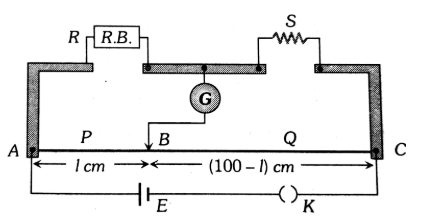
- It is used to find the resistance of a given wire using a meter bridge and hence determine the specific resistance of its materials.
- It works on the principle of Wheatstone's bridge
- The meter bridge arrangment is shown in the above figure. The wire connected between $A$ and $C$ is of 1 merer length and have uniform crossection. A constant current is passed through the wire AC so that potential of the wire is proportional to the length of the wire. R is the known resistance which is selected from the resistance box. S is the unknown resistance whose value can be measured. The arrangment also has a galvanometer with a jokey
- We will slide the galvanometer through wire AC so as to obtain null deflection in the galvanometer. Let $B$ is the point on $A C$ where null deflection is obtained and length $A B=l$. Pand $Q$ resistance of the portion $A B$ and $B C$ respectively then then by principle of Wheatstone's bridge
$$
\frac{P}{Q}=\frac{R}{S} \Rightarrow S=\frac{(100-l)}{l} R
$$
Study it with Videos
"Stay in the loop. Receive exam news, study resources, and expert advice!"