
Search Colleges, Exams, Schools & more


Login
Pleiotropy : An Overview MCQ - Practice Questions with Answers
Edited By admin | Updated on Sep 18, 2023 18:34 AM | #NEET
Quick Facts
-

13 Questions around this concept.
Solve by difficulty
 EASY
EASYPleiotropic gene:
A pleiotropic gene:
Choose the statement which is not correct:
Match the terms in Column I with their description in Column II and choose the correct option:
| Column I |
Column II |
|
(a) Dominance |
(i) Many genes govern a single character |
| (b) Codominance |
(ii) In a heterozygous organism, only one allele expresses itself |
| (c) Pleiotropy |
(iii) In a heterozygous organism, both alleles express themselves fully |
| (d) Polygenic inheritance |
(iv) A single gene influences many characters |
Codes:
(a) (b) (c) (d)
Concepts Covered - 1
Pleiotropy
- There are instances where a single gene can exhibit multiple phenotypic expressions. Such a gene is called a pleiotropic gene.
- The underlying mechanism of pleiotropy in most cases is the effect of a gene on metabolic pathways which contribute towards different phenotypes.
Instance 1 of pleiotropy:
- When we discussed Mendel’s experiments with purple-flowered and white-flowered plants, we didn’t mention any other phenotypes associated with the two flower colors.
- However, Mendel noticed that the flower colors were always correlated with two other features: the color of the seed coat (covering of the seed) and the color of the axils (junctions where the leaves met the main stem).
- In plants with white flowers, the seed coats and axils were colorless, while in plants with purple flowers, the seed coats were brown-gray and the axils were reddish.
- Thus, rather than affecting just one characteristic, the flower color gene actually affected three.
Instance 2 of pleiotropy:
- Another example can be the gene that controls starch-synthesis as well as shape of seeds in pea plants.
- It has two alleles (B and b).
- Starch is synthesised effectively by BB homozygotes and therefore, large starch grains are produced.
- In contrast, bb homozygotes have lesser efficiency in starch synthesis and produce smaller starch grains.
- After maturation of the seeds, BB seeds are round and the bb seeds are wrinkled.
- Heterozygotes produce round seeds, and so B seems to be the dominant allele.
- But, the starch grains produced ar of intermediate size in Bb seeds.
Instance 3 of pleiotropy:
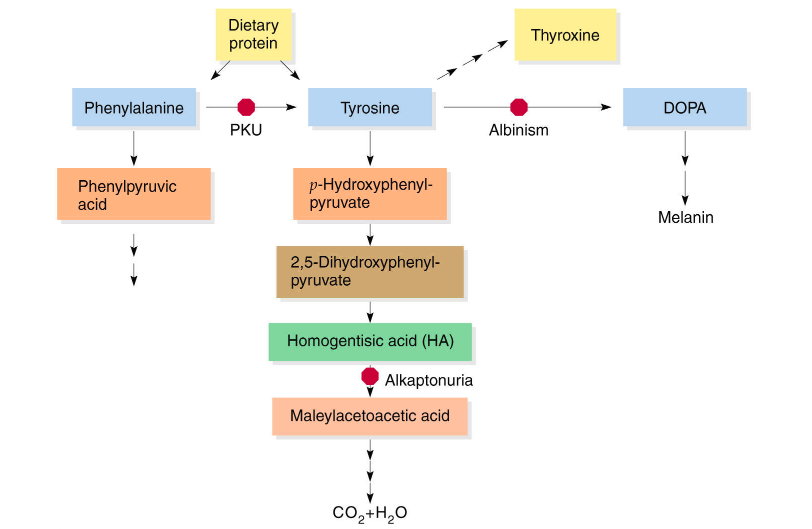
- Phenylketonuria is a disease which occurs in humans.
- The disease is caused by mutation in the gene (present on chromosome 12) that codes for the enzyme phenylalanine hydroxylase (single gene mutation).
- It results in accumulation of phenylalanine and is not converted to tyrosine.
- This manifests itself through phenotypic expression characterised by mental retardation and a reduction in hair and skin pigmentation.
Study it with Videos
"Stay in the loop. Receive exam news, study resources, and expert advice!"