
Search Colleges, Exams, Schools & more


Login
Racemose Inflorescence and Its Types MCQ - Practice Questions with Answers
Edited By admin | Updated on Sep 18, 2023 18:34 AM | #NEET
Quick Facts
-

17 Questions around this concept.
Solve by difficulty
 EASY
EASYThe catkin inflorescence is found in
Concepts Covered - 2
Racemose Inflorescence and Its Types - Category A
Racemose Inflorescence and Its Types - Category A
Racemose Inflorescence:
- It is also called the indeterminate or indefinite inflorescence.
- The main axis continues to grow and never ends in a flower.
- The flowers occur acropetally, that is, oldest flower towards the base and gradually the youngest flowers the apex.
- The flowers can also occur centripetally, that is, the oldest flower towards the margin and the youngest one at the centre.

Category A: Main axis elongated
1. Raceme:
- Main axis grows indefinitely
- Flowers are pedicellate and are borne directly on the main axis
- Flowers are borne acropetally.
- Examples - Mustard, Caesalpinia
- Some plants produce complex raceme called raceme of racemes or panicle.
- The maix axis produces branches and flowers are borne on these branches.
- Examples - Gulmohar, Radish

2. Spike:
- The main axis is elongated.
- The flowers are sessile and are borne on the main axis directly.
- Examples - Amaranthus, Bottlebrush, etc
- A small spike with a few small bracteate flowers is called the spikelet.
- Examples - Oats and grasses.
- A compound spike is the one in which the main axis is branched and the branches bear spikes or spikelets.
- It is called the spike of spikelets.
- Example - Wheat

3. Catkin:
- The main axis is elongated.
- It is a specialised spike.
- The axis is long and pendulous.
- The pendulous axis bears clusters of sessile flowers.
- Flowers are unisexual.
- Example - Mulberry, Acalypha, Populus

4. Spadix:
- The main axis is elongated.
- It is a specialised spike with a fleshy axis.
- The entire inflorescence is surrounded by a large bract called spathe.
- Flowers are unisexual and plants and monoecious.
- The female flowers are present towards the base.
- The male flowers are present towards the apex.
- In between the male and female flowers, sterile flowers are present.
- The terminal end of the axis is called appendix.
- The appendix and spathe attract the pollinators,
- It is a characteristic feature of the Arum family.

Racemose Inflorescence and Its Types - Category B and C
Racemose Inflorescence and Its Types - Category B and C
Category B - Main axis shortened
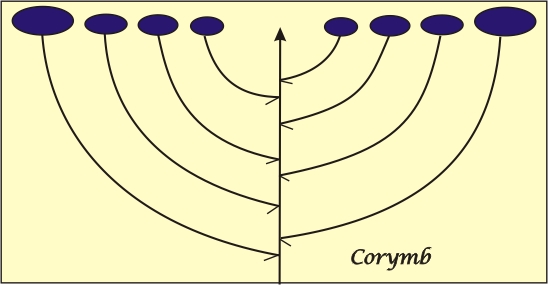
1. Corymb:
- It is a modified raceme.
- The main axis is shortened.
- The lower or older flowers have large pedicels.
- The upper or younger flowers have smaller pedicels.
- Due to this all the flowers appear to be at the same level.
- This make whole inflorescence conspicuous and noticeable to the pollinators.
- Examples - Candytuft, Cherry, Quisqualis, etc.
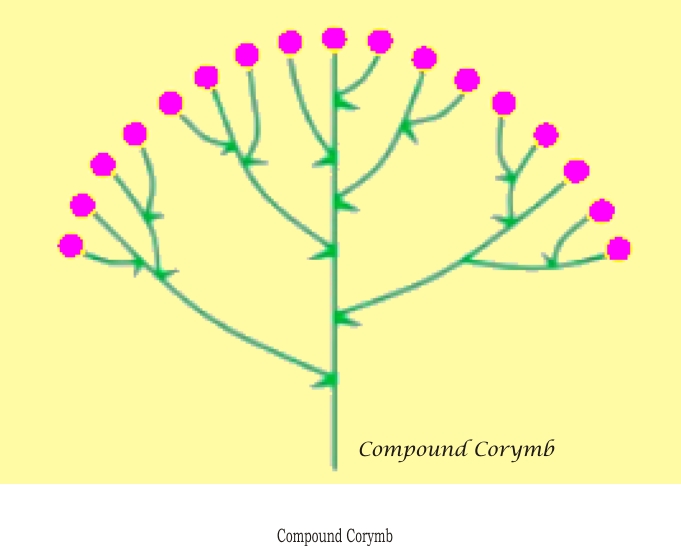
- In compound corymb, the main axis is branched and the flowers are borne on these branches, e.g., Pyrus.
2. Umbel:
- It is a modified raceme.
- The main axis is severely reduced.
- The flowers have pedicels of an equal length and appear to develop at the same point.
- Each flower arises in the axil of a bract.
- These bracts fuse to form a whorl called involucre.
- Umbel inflorescence resembles a loose head of pedicellate flowers that are arranged centripetally, that is, the older flowers towards the periphery and the younger ones towards the centre.
- It is a characteristic of the family Umbelliferae or Apiaceae.
- In compound umbel, the reduced main axis branches and the individual umber are borne on these branches.
- For example, coriander.

Category C: Main Axis Flattened
Racemose Capitulum or Racemose Head:
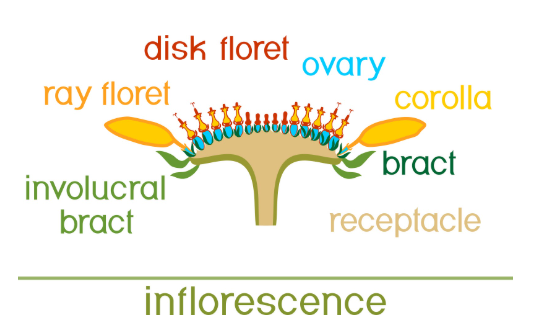
- The main axis is flattened.
- It appears like a flat disc and is called receptacle.
- A large number of sessile flowers are borne on the receptacle in a centripetal succession.
- Whorl of bracts called involucre is present.
- This inflorescence is an evolved form of umbel inflorescence.
- The individual flowers in the capitulum are called florets.
- The peripheral florets are called ray florets.
- The central florets are called disc florets.
- For example, Sunflower.
Study it with Videos
"Stay in the loop. Receive exam news, study resources, and expert advice!"