
Search Colleges, Exams, Schools & more


Login
The Reproductive structure of the Angiosperms MCQ - Practice Questions with Answers
Edited By admin | Updated on Sep 18, 2023 18:34 AM | #NEET
Quick Facts
-

18 Questions around this concept.
Solve by difficulty
 EASY
EASYRay florets have
Concepts Covered - 2
Revision of Flower- The Reproductive structure of the Angiosperms
- The organs specialised to perform sexual reproduction in the angiosperms are called flowers.
- We have read the details of inflorescence and parts of flowers in the chapter morphology of flowering plants.
- Flowers are modified condensed reproductive shoots.
- Flowers are formed when the appropriate conditions set for the reproductive maturity of the plant.
- This occurs in response to the hormones we have discussed in plant physiology lectures.
- Hormones bring about physiological changes in the shoot apices wherein, the shoot apices are transformed into an inflorescence over which floral primordia develop.
- The primordial grow into floral buds which undergo anthesis to form flowers.
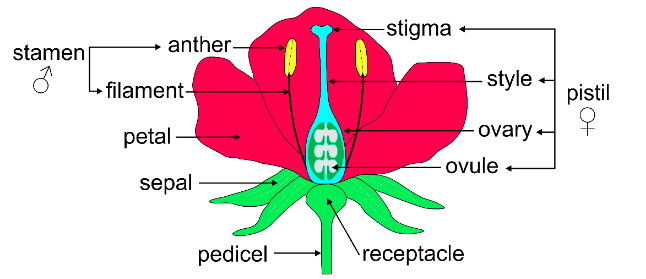
- A typical flower has a base called the thalamus which bears the four whorls as:
- Calyx made of sepals
- Corolla made of petals
- Androecium made of stamens
- Gynoecium made of the pistil
- This chapter will focus on the stamens and pistil because these are the male and female reproductive parts of a flower.
Stamen
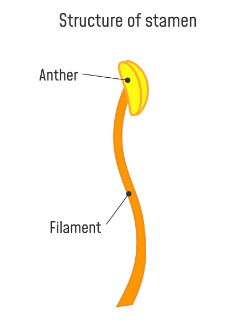
- Stamen is the male reproductive organ or the microsporophyll of a flower.
- There are two parts of a typical stamen – the long and slender stalk called the filament, and the terminal generally bilobed structure called the anther.
- The proximal end of the filament is attached to the thalamus or the petal of the flower.
- The number and length of stamens are variable in flowers of different species.
- A typical angiosperm anther is bilobed or dithecous.
- The anther is the fertile part of the stamen.
- The two lobes of the anther are separated in the anterior region by a deep groove.
- On the backside, the two lobes are connected by a sterile parenchymatous tissue called connective.
Study it with Videos
"Stay in the loop. Receive exam news, study resources, and expert advice!"