


Venation MCQ - Practice Questions with Answers
Quick Facts
-

9 Questions around this concept.
Solve by difficulty
 MEDIUM
Which of the following is true for divergent parallel venation?
Which of the following is correct for parallel venation?
The prominent veins that reach up to the margins are seen in
Which of the following plants has reticulate venation?
Which of the following plants has parallel venation?
Whorled simple leaves with reticulate venation are present in
Unicostate venation is called
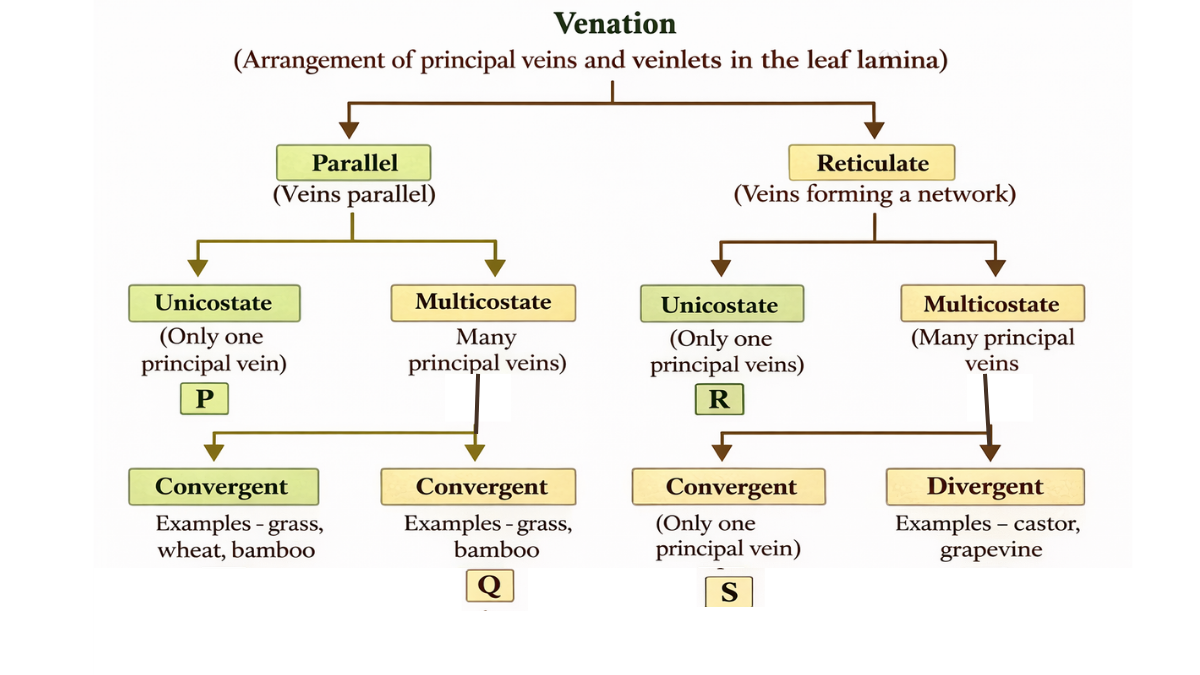
Study the following flow chart and select the correct option for P, Q, R and S.
Concepts Covered - 1
Venation
- Venation refers to the arrangement of the veins and veinlets in the lamina of the leaf.
- Venation provides skeletal support to the lamina.
- They perform the conduction of water and minerals.
Types of Venation:
1. Reticulate Venation: When veins form a network, it is called reticulate venation. It is further divided into the following types:
- Pinnate or Unicostate Reticulate Venation: There is a single prominent vein called midrib which extends from the base to the apex of the lamina. The midrib gives rise to lateral veins along its length. For example, mango, peepal, etc.
- Palmate or Multicostate Reticulate Venation: A number of prominent veins arise from the tip of the petiole and reach up to the apex or margin of the apex. For example, Ziziphus, grapevine, etc.


2. Parallel Venation: When the veins run parallel to each other, it is called parallel venation. There is a single prominent vein which runs from the base to the apex and the lateral veins run parallel to one another. It can be further divided into following types:
- Pinnate parallel venation: There is a single parallel vein that runs from the base to the apex. The lateral veins run parallel without forming anastomoses. For example, banana, canna, etc.
- Palmate or convergent parallel venation: Several parallel principal veins arise from the base and converge towards the apex. For example, bamboo, grasses, etc.
- Palmate or divergent parallel venation: Several veins arise from the base of the lamina and diverge towards the margins. For example Fan palm.


Study it with Videos
"Stay in the loop. Receive exam news, study resources, and expert advice!"