


Active Site and models of the Enzyme MCQ - Practice Questions with Answers
Quick Facts
-

22 Questions around this concept.
Solve by difficulty
 MEDIUM
Transition state structure of the substrate formed during an enzymatic reaction is:
Which of the following models suggests for modification of active sites by substrate?
The catalytic activity of an enzyme is restricted to its small portion called
The most important property of an enzyme is its
Active sites of the enzymes
The figure given below shows the conversion of a substrate into product by an enzyme.
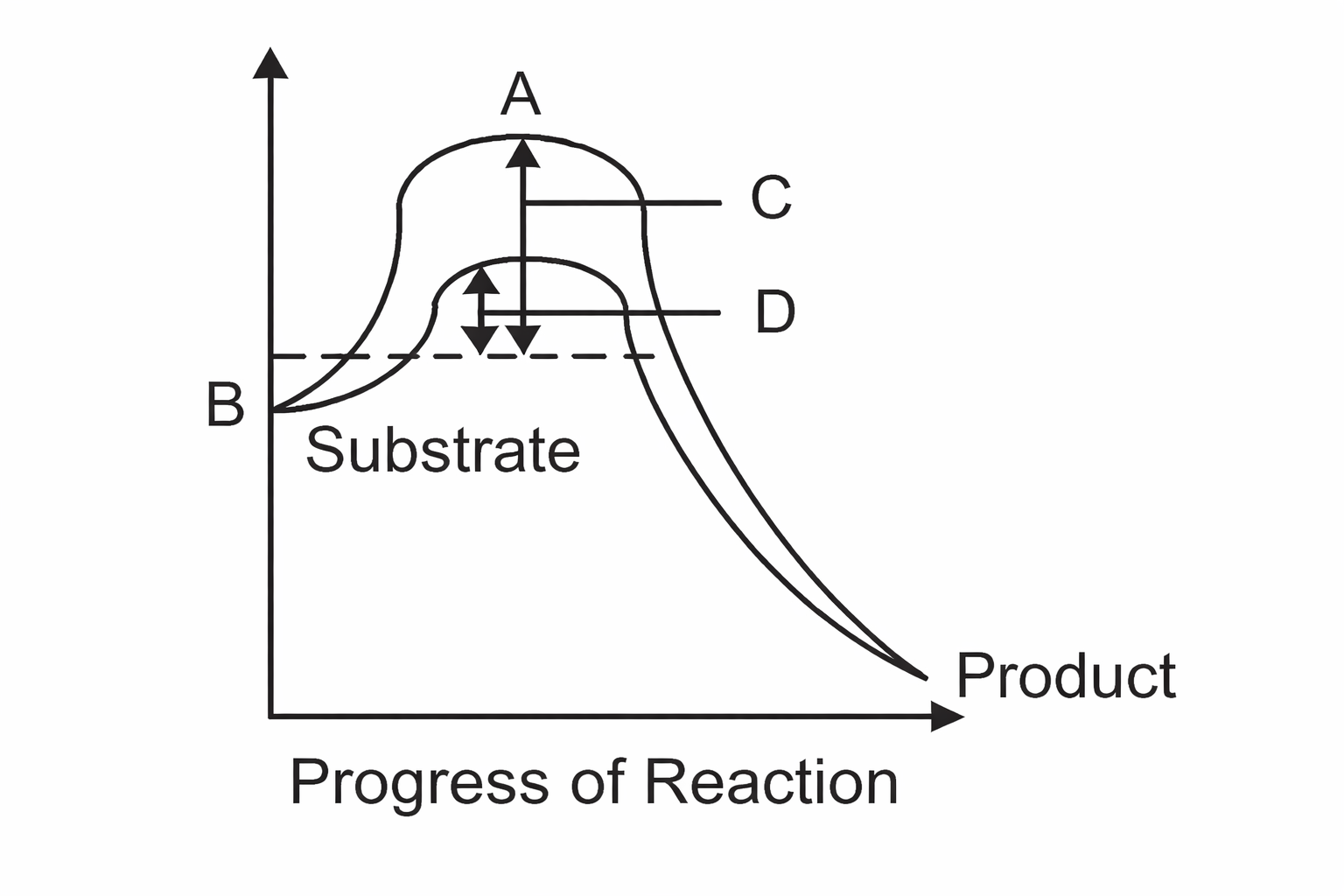
In which one of the four options (1-4) the components of reaction labelled as A, B, C and D are identified correctly?
| A | B | C | D |
|---|
Enzyme alcohol dehydrogenase is activated by
Consider the following statements A, B, and C. Which of the following options accurately represents the statements?
Statement A: All enzymes exhibit a proteinaceous nature.
Statement B: Certain competitive inhibitors are frequently employed to manage bacterial pathogens.
Statement C: The active site of an enzyme is formed through the intricate folding of the protein's tertiary structure.
The active site of the enzyme is present at which level of organisation of proteins (enzymes)?
Arrange the steps of the catalytic action of an enzyme in order and choose the right option
1. The enzyme releases the products and is free to bind to another substrate.
2. The active site of the enzyme is nearby of the substrate and breaks the chemical bonds of the substrate.
3. Binding of the substrate induces the enzymes to alter its shape fitting more tightly around the substrate.
4. Substrate binds to the active site of the enzyme.
Concepts Covered - 1
How Enzymes Work - Active Sites and Models
Active Sites:
- Enzymes bind the specific substrates on regions called active sites to form enzyme-substrate complexes.
- By binding substrates, enzymes stabilize the energy of the transition state, which in turn stimulates the breakage of old bonds and formation of new bonds.
- At a constant concentration of enzyme, the enzyme activity will continue to rise up until a certain maximal value.
- This maximal value represents the condition in which all the active sites are filled with the appropriate substrate.
- The active site is a specific region on enzymes that binds to the substrate.
- The active site is a three-dimensional crack in the enzyme that contains the catalytic groups which catalyse the actual reaction.
- As enzymes are proteins, the active sites have a combination of unique amino acid residue.
- Each residue has a different property.
- These properties provide specific environment suited to bind to a very specific chemical substrate.
- Active sites stabilize the transition state.
- Active sites make up only a small component of the overall enzyme. The remaining portion of the enzymes acts to create and support the active site by bringing residues together.
Models:
- The active site and the substrate bind via non-covalent bonds.
- In order for these bonds to be functional, the distance between the active sites and substrate should be minimal.
- It implies that the substrate must fit in the active sites.
- Lock and Key Model: It was put forward by Emil Fischer in 1894. It suggests that the substrate fit into active site like a key fits into the lock, all because of exact complementary shapes.
- Induced Fit Model: It is modification of lock and key hypothesis which was proposed by Koshland in 1959. It suggests that the shape of the active site becomes complementary to the substrate when the substrate binds to the active site.


Study it with Videos
"Stay in the loop. Receive exam news, study resources, and expert advice!"