


Polysaccharides : Definition, Types and Examples MCQ - Practice Questions with Answers
Quick Facts
-

27 Questions around this concept.
Solve by difficulty
 MEDIUM
Match the following:
(a) Inhibitor of catalytic activity (i) Rieia
(b) Possess peptide bonds (ii) Malorinta
(c) Cell wall material in fungi (iii) Chitin
(d) Secondary metabolite (iv) Collagen
Choose the correct option from the following:
Identify the polysaccharide with α-1,4 glycosidic bonds.
Chitin is the second most abundant organic substance present in the exoskeleton of insects and crustaceans. It is a
Which of the following is/are homopolymer/s?
Select the correct match
Match the following:
| (a)Aquaporin | (i)Amide |
| (b)Asparagine | (ii)Polysaccharide |
| (c)Abscisic acid | (iii)Polypeptide |
| (d)Chitin | (iv)Carotenoids |
Select the correct option:
Which is true for oligosaccharides?
Examples of Homopolysaccharides are
Stachyose consists of
Which of the following is true of a glycosidic bond?
Concepts Covered - 1
Polysaccharides
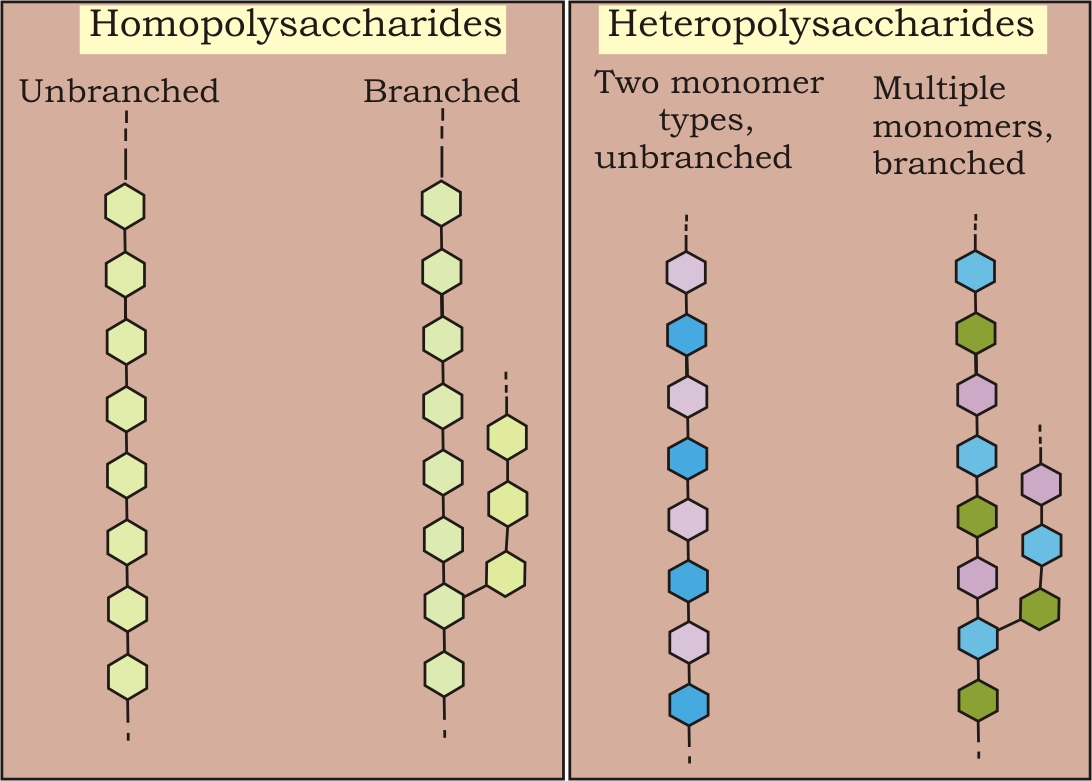
- Polysaccharides are made up of ten or more than ten monosaccharides.
- These are the polymers of monosaccharides.
- These are also called glycans.
- Homopolysaccharides contain only a single type of monomeric unit.
- Heteropolysaccharides contain two or more different kinds of monomeric units
Starch:
- Starch is the stored form of sugar in plants.
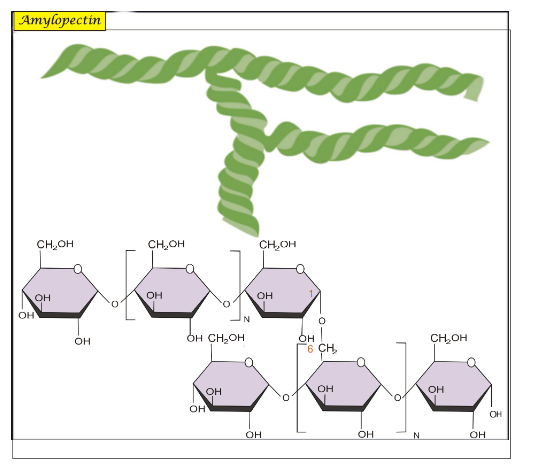
- Starch is made up of amylose and amylopectin.
- Amylose is an unbranched polysaccharide that consists of glucose monomers connected via α-1,4 glycosidic bond.
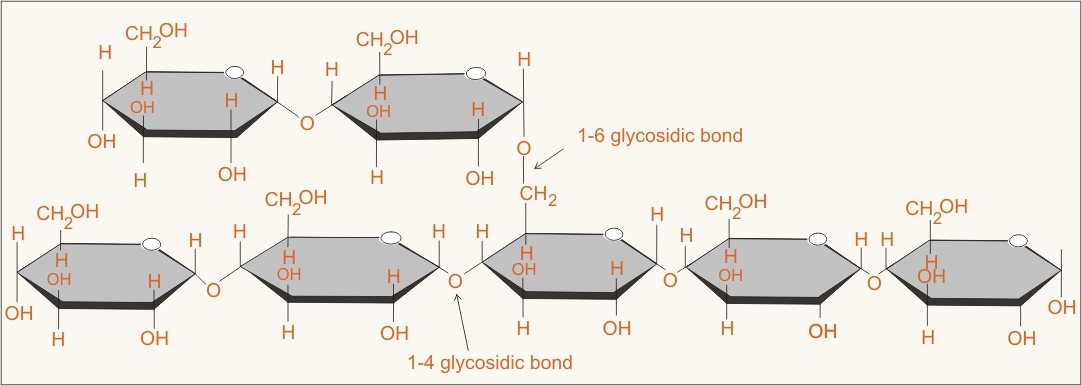
- Amylopectin is a branched polysaccharide that consists of glucose monomers linked via α-1,4 glycosidic bond and branches via α-1,6 glycosidic bond.

Cellulose:
- In cellulose, glucose monomers are linked in unbranched chains by β 1-4 glycosidic linkages. Because of the way the glucose subunits are joined, every glucose monomer is flipped relative to the next one resulting in a linear, fibrous structure.
- Cellulose is found in the cell walls of plants.
- Cellulose is a fibrous, tough, water-insoluble substance.
- Cellulose constitutes much of the mass of wood, and cotton is almost pure cellulose.

Glycogen:
- It is a homopolymer consisting of glucose monomers linked via α-1,4 glycosidic bond and branches via α-1,6 glycosidic bond at every ten or so units.
- It is a branched polysaccharide.
- It is the stored form of food in animals and fungi.
Chitin:
- Chitin is a linear homopolysaccharide composed of N-acetyl-D-glucosamine residues in β linkage.
- Chitin forms extended fibers similar to those of cellulose, and like cellulose, it is indigestible by vertebrate animals.

Study it with Videos
"Stay in the loop. Receive exam news, study resources, and expert advice!"