
Search Colleges, Exams, Schools & more


Login
Magnetic Field Due To Circular Current Loop MCQ - Practice Questions with Answers
Edited By admin | Updated on Sep 25, 2023 25:23 PM | #NEET
Quick Facts
-

Magnetic Field due to circular current loop is considered one the most difficult concept.
-

51 Questions around this concept.
Solve by difficulty
 EASY
EASYA current $i$ ampere flows along an infinitely long straight thin walled tube, then the magnetic induction at any point inside the tube is
Two concentric coils each of radius equal to $2 \pi \mathrm{~cm}$ are placed at right angles to each other. 3 A and 4 A are the currents flowing in each coil, respectively. The magnetic induction in $\mathrm{Wb} / \mathrm{m}^2$ at the centre of the coils will be:
$\left(\mu_0=4 \pi \times 10^{-7} \mathrm{~Wb} / \mathrm{A}-\mathrm{m}\right)$
A current loop consists of two identical semicircular parts each of radius R, one lying in the x-y plane and the other in the x-z plane. If the current in the loop is i., the resultant magnetic field due to the two semicircular parts at their common centre is
Choose the correct sketch of the magnetic field lines of a circular loop shown by the dot and
.
A conducting circular loop is placed in a uniform magnetic field, B = 0.025 T with its plane perpendicular to the loop. The radius of the loop is made to shrink at a constant rate of 1 mms-1. The induced emf when the radius is 2 cm is
A thin ring of radius R meter has charge q coulomb uniformly spread on it. The ring rotates about its axis with a constant frequency of f revolutions/s. The value of magnetic induction in Wb/m2 at the centre of the ring is:
Concepts Covered - 1
Magnetic Field due to circular current loop
Magnetic Field due to circular current loop at its centre:
Magnetic Field due to circular coil at Centre-

$$
B_0=B_{\text {Centre }}=\frac{\mu_0}{4 \pi} \frac{2 \pi N i}{r}=\frac{\mu_0 N i}{2 r}
$$
where $\mathrm{N}=$ number of turns, $\mathrm{i}=$ current and $\mathrm{r}=$ radius of a circular coil.
Similarly, if Arc subtend angle theta at the centre as shown below then
$$
B_0=\frac{\mu_0}{4 \pi} \cdot \frac{\theta i}{r}
$$

similarly, if Arc subtends angle $(2 \pi-\theta)$ at the centre then
$$
B_0=\frac{\mu_0}{4 \pi} \cdot \frac{(2 \pi-\theta) i}{r}
$$

So the magnetic field of Semicircular arc at the centre is
$$
B_0=\frac{\mu_o}{4 \pi} \frac{\pi i}{r}=\frac{\mu_o i}{4 r}
$$

So Magnetic field due to three quarter Semicircular Current-Carrying arc at the centre is
$$
B_0=\frac{\mu_o}{4 \pi} \frac{\left(2 \pi-\frac{\pi}{2}\right) i}{r}
$$

- The direction of the magnetic field-
Right-Hand Thumb Rule gives the direction of the magnetic field of Circular Currents.
Right-hand thumb rule is stated below:
If the fingers are curled along the current, the stretched thumb will point towards the magnetic field.

1. If the current is in a clockwise direction then the direction of the magnetic field is away from the observer or perpendicular inwards.

2. If the current is in anti-clockwise direction then the direction of the magnetic field is towards the observer or perpendicular outwards

- Special cases-
1. If the Distribution of current across the diameterthen $B_0=0$

2. if Current between any two points on the circumference-
Then $B_0=0$

3.Concentric co-planar circular loops carrying the same current in the Same Direction-

$$
B_{\text {centre }}=\frac{\mu_o}{4 \pi} 2 \pi i\left[\frac{1}{r_1}+\frac{1}{r_2}\right]
$$
If the direction of currents are the same in concentric circles but having a different number of turns then
$$
B_{\text {centre }}=\frac{\mu_o}{4 \pi} 2 \pi i\left[\frac{n_1}{r_1}+\frac{n_2}{r_2}\right]
$$
4.Concentric co-planar circular loops carrying the same current in the opposite Direction-
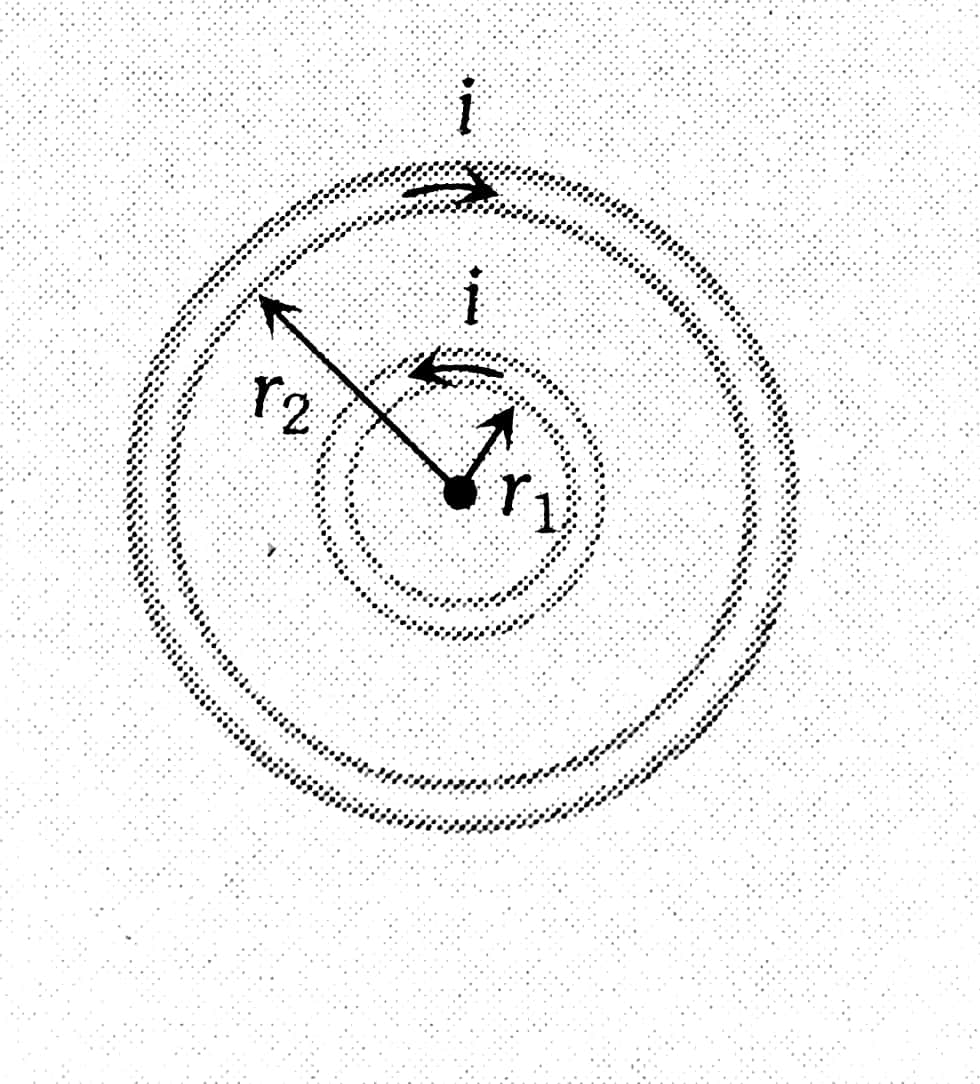
$$
B_{\text {centre }}=\frac{\mu_o}{4 \pi} 2 \pi i\left[\frac{1}{r_1}-\frac{1}{r_2}\right]
$$
If the number of turns is not the same i.e $n_1 \neq n_2$
$$
B_{\text {centre }}=\frac{\mu_o}{4 \pi} 2 \pi i\left[\frac{n_1}{r_1}-\frac{n_2}{r_2}\right]
$$
5. Concentric loops but their planes are perpendicular to each other-
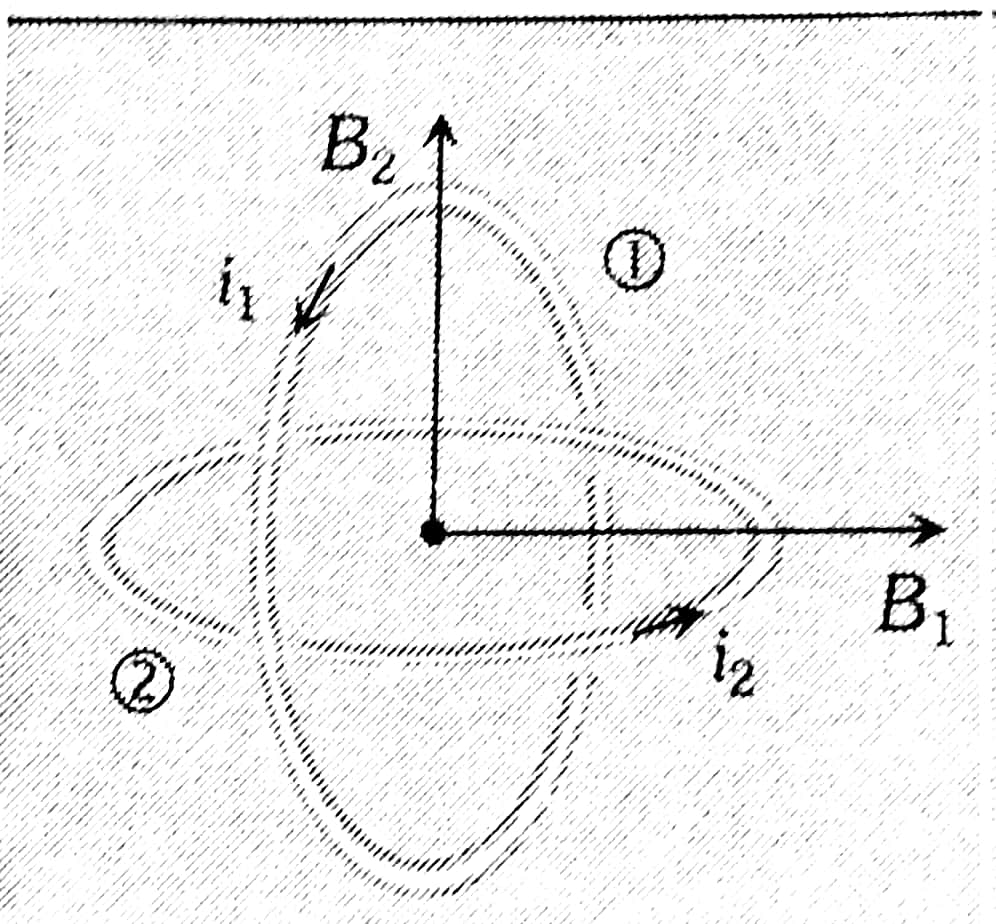
Then $B_{\text {net }}=\sqrt{B_1^2+B_2^2}$
6. Concentric loops but their planes are at an angle ϴ with each other-

$B_{\text {net }}=\sqrt{B_1^2+B_2^2+2 B_1 B_2 \cos \theta}$
Study it with Videos
"Stay in the loop. Receive exam news, study resources, and expert advice!"
Get Answer to all your questions
NEET Articles

Applications for Admissions are open.
Ranked #19 by NIRF, NAAC A++ Accredited | Recognized by dental council of India
Parul University, Goa
ApplySpecial Scholarship for Students from Goa (Get an exclusive scholarship of ₹20,000 if you're a Goa-based student) | Bringing Parul Education Trust's 30-year Education Legacy to Goa
Krishnadevaraya College of Dental Sciences and Hospital, Bangalore
ApplyRanked among the top Dental Colleges for 7 consecutive years by India Today poll