
Search Colleges, Exams, Schools & more


Login

Thermodynamics NEET, Solutions To Question Papers Of Last Six Years
A good rank in the National Eligibility cum Entrance Test (NEET) for undergraduates is a dream of many students who wish to get an MBBS seat in colleges across India. To prepare for NEET, students should practice the previous year's questions and understand the important areas to be focused on for the NEET exam. Every question of NEET is important as it is a highly competitive exam. Here we analyse the Class 12 NCERT chapter Thermodynamics using past six-year papers and discuss the past six-year questions from Thermodynamics NEET Physics paper.
In the last six years of NEET papers a total of eight questions were asked from the chapter Thermodynamics. Thermodynamics belongs to the Class 11 NCERT Physics syllabus. NEET Thermodynamics is a small chapter that can be understood easily. Questions from Thermal Properties Of Matter are not included here. Only the NCERT Class 11 Physics, chapter 12 - Thermodynamics is included. Let us see the topics covered in the past six years of NEET papers and their weightage.
Topics And Number Of Questions
Topic | Number Of Questions | Weightage |
First Law Of Thermodynamics | 2 | 25% |
Thermodynamic Processes | 4 | 50% |
Carnot Engine | 2 | 25% |
A total of eight questions are analysed out of which three are from thermodynamic processes. From the topic thermodynamic process, two questions are from adiabatic processes and one is a match to the following questions that cover all the important thermodynamic processes. Two questions were from the topics First Law Of Thermodynamics and Carnot Engine. Let us have a look at the previous year questions from Thermodynamics (2017-2022).
Also Read| NEET Previous Year Question Papers
Q 1 - NEET 2017
A Carnot engine having an efficiency of 1/10as heat engine, is used as a refrigerator. If the work done on the system is 10 J, the amount of energy absorbed from the reservoir at a lower temperature is:
Answer-
For a Carnot cycle

 = Coefficient of performance
 = Efficiency of Carnot engine



Q 2 - 2017
Thermodynamic processes are indicated in the following diagram.
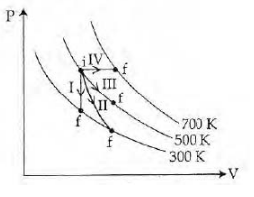
Match the following
Column-1 Column-2
| P. Process I | a. Adiabatic |
| Q. Process II | b. Isobaric |
| R. Process III | c. Isochoric |
| S. Process IV | d. Isothermal |
Answer-
P  c, Q
c, Q  a, R
a, R  d, S
d, S  b
b
Process I-volume is constant-isochoric
Process IV-pressure is constant-Isobaric
Process II is adiabatic and Process III is isothermal
Q 3 - NEET 2018
A sample of 0.1 g of water at 100°C and normal pressure (1.013 x 10⁵ Nm-2) requires 54 cal of heat energy to convert to steam at 100°C. If the volume of the steam produced is 167.1 cc, the change in internal energy of the sample, is
Answer-



Change in internal energy-

Q 4 - NEET 2018
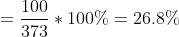
The efficiency of an ideal heat engine working between the freezing point and boiling point of water, is
Answer-

Q 5 - 2018
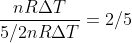
The volume (V) of a monatomic gas varies with its temperature (T), as shown in the graph. The ratio of work done by the gas, to the heat absorbed by it, when it undergoes a change from state A to state B, is
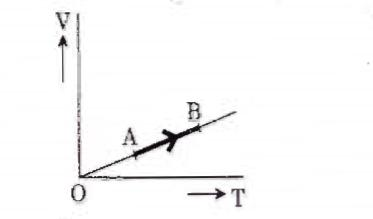
Answer-work done =

heat absorbed = 

ratio of work to heat
Q 6 - 2019
In which processes, the heat is neither absorbed nor released by a system?
Answer-
In the adiabatic process heat is neither absorbed nor released by the system.
Q 7 - 2021
Two cylinders A and B of equal capacity are connected to each other via a stop cock. A contains an ideal gas at standard temperature and pressure. B is completely evacuated. The entire system is thermally insulated. The stop cock is suddenly opened. The process is:
Answer-
As the entire system is thermally insulated and as free expansion will be taking place the temperature of the gas remains the same. The process is adiabatic
A similar type of question is asked in the NCERT Class 11 physics book. The question is given below-
Two cylinders A and B of equal capacity are connected to each other via a stopcock. A contains gas at standard temperature and pressure. B is completely evacuated. The entire system is thermally insulated. The stopcock is suddenly opened. Answer the following
(a) What is the final pressure of the gas in A and B ?
(b) What is the change in internal energy of the gas?
(c) What is the change in the temperature of the gas?
(d) Do the intermediate states of the system (before settling to the final equilibrium state) lie on its P-V-T surface?
Q 8- 2022
An ideal gas follows a process described by  from
from  to
to  (C is a constant). Then
if P1 > P2 then T2 > T1
if V2 > V1 then T2 < T1
if V2 > V1 then T2 > T1
if P1 > P2 then V2 > V1

![\left [\frac{nRT}{V} \right ]V^{2}= C](https://cache.careers360.mobi/media/articles/uploads/froala_editor/images/2022/9/21/1663753497645.png)
TV = constant
so

All the concepts of NCERT Class 11 chapter Thermodynamics are essential for the NEET exam. Following the NCERT book and the previous year, question papers will give enough information to crack the NEET questions from Thermodynamics.
Articles
Related Stories
|
Certifications By Top Providers
Explore Top Universities Across Globe
Popular Courses and Specializations
List of colleges accepting NEET

Browse Medicine Colleges by State
Questions related to NEET
On Question asked by student community
Have a question related to NEET ?
Hello, you can pursue BPT in Kerala without NEET UG. Admission is generally based on the LBS Centre rank list and the applicable admission process. You can check BPT colleges in Kerala and their details here: https://medicine.careers360.com/colleges/list-of-bpt-in-physiotherapy-colleges-in-kerala
Hello Student,
If you are looking for information about NEET PG 2025 DNB seat allotment and the fees payable at the allotted college or hospital, DNB seats are allotted through the respective counselling process based on your rank, category, choice of speciality, and seat availability.
For the 2025 session, the
Dear Student, with a NEET PG 2026 rank of 6,600 in the EWS category, your options should be assessed using the relevant counselling year's college-wise closing ranks, category-wise seats and counselling round. Please also confirm whether you are applying through the applicable All India counselling route or another quota. That
Hello
If you mean whether a school/college will be strict about attendance when you are preparing for NEET UG, it depends on the institution’s rules. NEET preparation itself is generally not a reason to ignore regular attendance.
For example, CBSE requires 75% attendance for board-exam eligibility, with limited relaxation for
Hello Student,
Aapke NEET marks 372 aur AIR 3,51,532 hain. Lekin 3rd round mein MBBS seat ke liye counselling karani chahiye ya nahi, iska sahi answer dene ke liye mujhe aapki category, domicile state, aur aap AIQ se counselling kar rahe hain ya state quota se—ye details chahiye.
In details
Popular NEET Questions
the product 'P' will be ,
Option: 1

Option: 2

Option: 3
Option: 4


| Column A | Column B |
| A |
a) Organisation of cellular contents and further cell growth. |
| B |
b) Leads to formation of two daughter cells. |
| C |
c) Cell grows physically and increase volume proteins,organells. |
| D |
d) synthesis and replication of DNA. |
Match the correct option as per the process shown in the
0.16 g of dibasic acid required 25 ml of decinormal solution for complete neutralisation. The modecular weight of the acid will be
Option: 1
32
Option: 2
64
Option: 3
128
Option: 4
256
0xone is
Option: 1
Option: 2
Option: 3
Option: 4

Study Resources, Applications and Opportunities
Know possible Govt/Private MBBS/BDS Colleges based on your NEET rank
NEET 1-to-1 Counseling Guidance
ApplyCollege Predictors Webinars One to One Counselling Regular Updates Medical Almanac
ITMBU Medical & Health Scinces Admissions 2026
ApplyHighest Package: ₹32 LPA | Placement Rate: 90% students placed | 5000+ Students Placed 900+ Placements Recruiters | Scholarships Available
Quantum University | Allied Health Sciences Admissions 2026
Apply33.5 LPA-Highest Package | Up to 100% scholarship worth 30 CR
Emversity Allied Health Programs
ApplyGet Job Ready in Healthcare | Employability-Focused Programs
Max Institute of Allied and Paramedical Education (MIAPE)
ApplyGet Started With Your Healthcare Career. 2026 Admissions open.
NEET Notifications
Latest updates
Best Chemistry Books For NEET 2027 Preparation
Oct 07, 2026
Last Minute Preparation Tips For NEET 2027 Exam
Oct 07, 2026
How to Make Short Notes for NEET Exam 2027?
Oct 07, 2026
Never miss NEET update
Get timely NEET updates directly to your inbox. Stay informed!