SRM Kattankulathur Dental College and Hospital, Kattankulathur
Ranked #19 by NIRF, NAAC A++ Accredited | Recognized by dental council of India


The most frequently asked concepts in NEET Biology can help NEET 2027 candidates in determining the concepts and chapters which have occurred again and again in recent years' question papers. NEET has 90 questions and 360 marks in the subject of biology. It is the most significant part of the NEET exam. Analysis of previous year questions will be helpful for students to focus on revision; however, it should not be considered as a prediction of the questions to come in NEET 2027.
This Story also Contains
.jpg)
From the NEET Biology question papers of 2021 to 2026, it can be observed that concepts such as Genetics and Evolution, Cell Biology, Biotechnology, Human Reproduction, Human Health and Disease, Plant Reproduction, Ecology and Plant Physiology have been relevant in all these years. Although there have been variations in the number of questions from any particular chapter in exam.
This article brings out a chapter-wise list of frequently asked Biology concepts according to recent NEET trends, along with the revision areas and NCERT-focused questions. Students can take help of this list for their revision process alongside covering the whole NEET Biology syllabus.
Certain NEET Biology topics appeared repeatedly from 2021 to 2026. Focusing on these most scoring concepts will help students revise efficiently, study smart, and maximise their score in the NEET 2027.
Chapter | Important Concepts |
Molecular Basis of Inheritance |
|
Animal Kingdom |
|
Biotechnology: Principles & Processes | |
Human Health and Disease |
|
Sexual Reproduction in Flowering Plants |
|
Cell Cycle and Cell Division |
|
Principles of Inheritance & Variation |
|
Get expert advice on college selection, admission chances, and career path in a personalized counselling session.
Biology is a major part of the NEET 2027 syllabus, accounting for 50% of the total marks. Focusing on chapters that frequently appear in the exam can help increase the score. Analysing NEET Biology question paper trends from 2021 to 2026 shows which chapters are high-weightage.
NEET Chapter-wise weightage analysis for biology is given below. This will help students prioritise topics and plan their revision more effectively.
The data is from the last five years, and the chapters on plant transport, food production improvement strategies, digestion and absorption, organism reproduction, and mineral nutrition are no longer part of the syllabus.
Chapters | 2021 | 2022 | 2023 | 2024 | 2025 | 2026 |
3 | 4 | 2 | 1 | 5 | 2 | |
4 | 1 | 3 | 5 | 3 | 4 | |
8 | 6 | 5 | 7 | 4 | 4 | |
3 | 3 | 3 | 4 | 2 | 0 | |
1 | 2 | 2 | 2 | 1 | 4 | |
8 | 6 | 3 | 2 | 3 | 3 | |
5 | 6 | 6 | 5 | 0 | 3 | |
3 | 3 | 2 | 4 | 3 | 8 | |
4 | 3 | 4 | 2 | 2 | 3 | |
2 | 4 | 5 | 6 | 5 | 3 | |
3 | 2 | 2 | 4 | 1 | 6 | |
3 | 4 | 2 | 2 | 3 | 1 | |
3 | 3 | 3 | 5 | 6 | 2 | |
3 | 4 | 3 | 4 | 7 | 5 | |
4 | 4 | 4 | 4 | 7 | 5 | |
11 | 9 | 7 | 6 | 7 | 2 | |
5 | 4 | 5 | 2 | 3 | 1 | |
2 | 2 | 3 | 3 | 2 | 5 | |
2 | 2 | 0 | 2 | 1 | 3 | |
2 | 2 | 1 | 1 | 4 | 1 | |
1 | 1 | 2 | 2 | 0 | 1 | |
5 | 4 | 4 | 6 | 6 | 4 | |
4 | 2 | 2 | 2 | 0 | 1 | |
1 | 0 | 2 | 4 | 6 | 3 | |
3 | 3 | 1 | 2 | 0 | 1 | |
1 | 1 | 4 | 0 | 0 | 0 | |
1 | 3 | 2 | 2 | 0 | 2 | |
0 | 3 | 3 | 1 | 6 | 2 | |
0 | 2 | 1 | 2 | 0 | 4 | |
0 | 0 | 2 | 5 | 2 | 1 | |
0 | 0 | 2 | 1 | 0 | 2 | |
0 | 0 | 2 | 2 | 1 | 1 |
Understanding concept-based questions is key to scoring well in NEET Biology. These questions test how well aspirants can apply concepts, not just recall facts. By practising top 100 NEET biology questions to score 330+ marks, students can improve accuracy and build confidence for the actual exam. Some important concepts based on previous year NEET biology questions are given below:
Ques: In a cross between a male and female, both heterozygous for the sickle cell anaemia gene, what percentage of the progeny will be diseased? (NEET 2021)
Option 1) 50 %
Option 2) 75 %
Option 3) 25 %
Option 4) 100 %
Correct Answer: 25%
Chapter: Principles of Inheritance and Variation
Explanation:
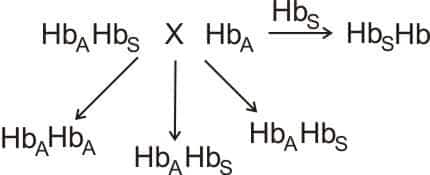
Autosomal recessive inheritance is the mode of inheritance for sickle cell disease. Thus, an individual has to inherit two copies of the mutated HBB gene-one from each parent-to be affected. This will affect about 25% of the offspring when both parents are carriers (sickle cell trait). Carriers have genotype AS and are usually asymptomatic but can pass the gene to their children.
Hence, the correct answer is Option 3) 25%
Ques: Which of the following are Autoimmune disorders? (NEET 2024)
A. Myasthenia gravis
B. Rheumatoid arthritis
C. Gout
D. Muscular dystrophy
E. Systemic Lupus Erythematosus (SLE)
Choose the most appropriate answer from the options given below:
Chapter: Human Health and Disease
Option 1) A, B & D only
Option 2) A, B & E only
Option 3) B, C & E only
Option 4) C, D & E only
Correct Answer: A, B & E only
Explanation: Autoimmune disorders are conditions wherein the immune system erroneously targets the body's cells, perceiving them as foreign entities.
The correct answer is option (2) as Myasthenia gravis, Rheumatoid arthritis and Systemic Lupus Erythematosus (SLE) are autoimmune disorders.
Muscular dystrophy is a genetic disorder which progressively affects the skeletal muscles.
Gout is the inflammation of joints due to the deposition of uric acid crystals.
Hence, the correct answer is option 2) A, B & E only.
Ques: Given below are two statements: One is labelled as Assertion (A) and the other is labelled as Reason (NEET 2025)
Assertion (A): Both wind and water-pollinated flowers are not very colourful and do not produce nectar.
Reason (R): The flowers produce an enormous amount of pollen grains in the wind and water-pollinated flowers.
In light of the above statements, choose to correct answer from the options given below:
Chapter: Sexual Reproduction in Flowering Plants
Option 1) A is false, but R is true
Option 2) Both A and R are true, and R is the correct explanation of A
Option 3) Both A and R are true, but R is NOT the correct explanation of A
Option 4) A is true, but R is false
Correct Answer: Both A and R are true, but R is NOT the correct explanation of A
Explanation:
Assertion (A): Wind and water-pollinated flowers are generally not colourful and do not produce nectar because they do not require any pollinators such as birds or insects.
Reason (R): These flowers produce a large number of pollen grains, so the chances of pollination will increase. But the absence of nectar and colour is because no pollinators are required by these flowers.
Hence, the correct answer is option(3), both A and R are true, but R is NOT the correct explanation of A.
Many NEET Biology questions are directly framed from NCERT statements, diagrams, and definitions. Students should pay special attention to the following areas:
NCERT diagrams in Genetics and Biotechnology
Examples mentioned in the Animal Kingdom classification
Tables and summaries in Human Health and Disease
Processes like DNA replication, transcription, and translation
Steps of recombinant DNA technology
Analysis of the frequently asked concepts of NEET Biology (from 2021 to 2026) allows you to prepare more efficiently by not giving equal attention to all the topics. The concepts that recur through the years have a high chance of being included in the NEET paper. You can use the chapter-wise trend analysis provided below for making a proper revision strategy for NEET 2027.
Prioritise the Recurring Concepts
Start your preparation with the concepts that have kept coming up in NEET papers recently and that come from chapters like Molecular Basis of Inheritance, Human Health and Diseases, Biotechnology Principles and Processes, Cell: The Unit of Life, Animal Kingdom, and Human Reproduction.
Improve NCERT Basics
Go through the NCERT Biology books properly and revise all the diagrams, flowcharts, tables, scientific names, and definitions given in the NCERT biology books. Most frequently asked concepts in NEET are either directly or indirectly related to NCERT.
Solve Previous Year Questions of Individual Chapters
Practice the previous year questions of individual chapters as soon as you complete those chapters.
Smart preparation is the key to scoring well in NEET 2027 Biology. These proven strategies will help students build strong concepts, retain information longer, and attempt exams with confidence:
NEET Biology tests your understanding, not memory.
Pay attention to the logic behind each concept rather than mugging up definitions.
Understand how and why something occurs – such as enzyme activity or genetic differences.
Concepts free from confusion help students answer application-based questions correctly.
Always refer to NCERT diagrams and examples, since many questions are directly framed from them.
Regular revision helps in long-term memory.
Plan a weekly schedule to go through 3–4 chapters you've already read.
Use flashcards, short note cards, or summary sheets to speed up revision.
Don't wait until the exam to start revising; instead, continue to do so throughout your preparation.
Attempting the previous year's NEET Biology questions helps to understand trends and patterns.
Determine the NEET most frequently asked questions in previous papers.
Attempt topic-wise questions immediately after finishing each chapter.
Attempt NEET biology mock tests to improve speed, accuracy, and time management.
Carefully analyse mistakes and improve your weak spots.
Start with NCERT Biology (Class 11 & 12) – it's the base of the NEET syllabus.
NEET Biology questions are mostly derived directly from the NCERT text.
Use good additional books, such as MTG NEET Biology and Trueman's Biology.
Avoid using too many books; instead, study from a few and revise them several times.
Frequently Asked Questions (FAQs)
Based on the NEET previous year analysis, the most important chapters for NEET biology are the molecular basis of inheritance, the animal kingdom, genetics and evolution and sexual reproduction in flowering plants.
Yes. These processes are high‑yield concepts that appear regularly in NEET papers. Understanding steps of recombinant DNA technology and molecular processes ensures conceptual clarity and scoring accuracy in NEET 2027.
Yes, you can score 360 in Biology by studying only NCERT, provided you master every line, diagram, and example thoroughly. Make sure to revise multiple times and practice NCERT-based MCQs regularly to strengthen your recall and application skills.

On Question asked by student community
Hello Suma,
Here are the links you asked for. I hope they serve your purpose.
Hello Bhanuday,
Here are the links you requested. I hope you find them helpful.
Hello Savi
Please check the link below:
Hope it helps.
Hello, for AP NEET PG Category C seats, NRI documents are generally required if you are applying under the NRI quota, and eligibility depends on the applicable counselling rules. The fee payment currency and procedure should be confirmed from the current Dr. NTRUHS notification at its official website drntr.uhsap.in.
Hello, the NEET PG stipend at Parul University depends on the postgraduate course, academic year and applicable university policies.
the product 'P' will be ,


| Column A | Column B |
| A |
a) Organisation of cellular contents and further cell growth. |
| B |
b) Leads to formation of two daughter cells. |
| C |
c) Cell grows physically and increase volume proteins,organells. |
| D |
d) synthesis and replication of DNA. |
Match the correct option as per the process shown in the
0.16 g of dibasic acid required 25 ml of decinormal solution for complete neutralisation. The modecular weight of the acid will be
32
64
128
256
0xone is

Ranked #19 by NIRF, NAAC A++ Accredited | Recognized by dental council of India
Ranked among the top Dental Colleges for 7 consecutive years by India Today poll