
Search Colleges, Exams, Schools & more


Login

NEET Five-Year Analysis: Solving Vectors Algebra, Logarithmic, And Exponential Questions
Vector algebra is one of the fundamental topics of algebra. There are two types of physical quantities – scalar quantity and vector quantity. In vector algebra, we study the vector quantities. Vector quantity is a quantity that has both magnitude and direction and follows vector addition rules whereas scalar quantity only has magnitude.
This Story also Contains
- Vectors Addition Rules
- Subtraction And Addition Of Vectors
- Multiplication Of Vectors
- Other Important Formulas
- Logarithmic
- Exponential
- Exponential Function Rules
- NEET Previous Five Years’ Analysis
- Previous Years Questions To Understand The Concepts

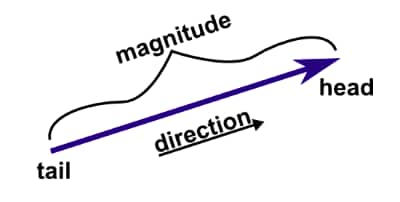
Vector: A vector is a measurement or quantity that includes both magnitude and direction. Generally, it can be represented physically by an arrow, and mathematically as A⃗ can be read as “A vector”. Arrow (➙) indicates the direction of the vector and its length represents the magnitude of the vector that is given in the following figure. |A⃗| represents the magnitude of the vector A. If we say that two vectors are equal, then both must have the same direction as well as magnitude.
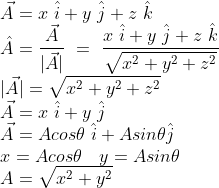
Unit Vector: It is a vector that has a unit magnitude. Generally, it is used to show the direction of the vector. Conventionally three-unit vectors namely  are used in the direction of the x-axis, y-axis, and z-axis.
The unit vector can be calculated by dividing the vector by its magnitude and represented as mentioned below.

Vectors Addition Rules
Triangle Rule
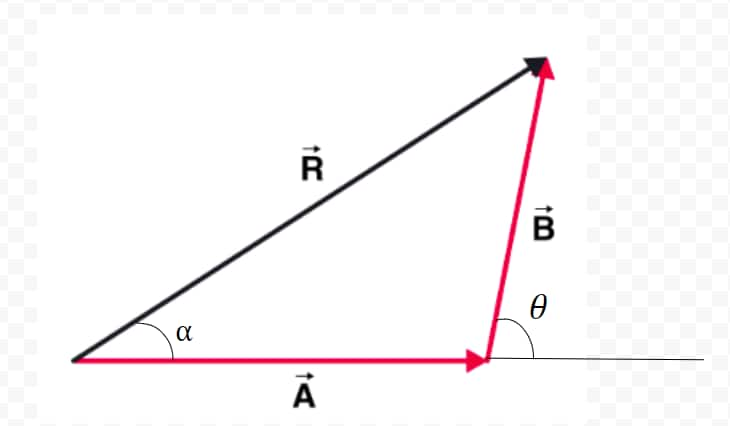
Let us consider two vectors  and
and  represented by two sides of a triangle, the head of
  is connected with the tail of
  as shown above in the image, then the third side in the opposite direction represents the resultant sum of these two vectors. Mathematically the resultant of two vectors can be calculated by the given formula.


Where angle ⍺ is the angle between the resultant R vector and  . ? is the angle between
  and
and  . Remember that angle between two vectors can only be calculated when both vectors are connected head to head or tail to tail.
Parallelogram Rules
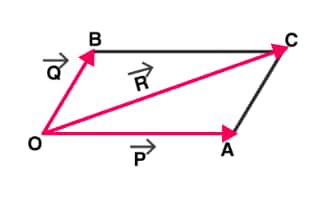
Let's consider two adjacent sides of a parallelogram represent two vectors  and
and  . As mentioned above in the diagram, the diagonal joining the intersecting point to the other corner of the parallelogram represents the resultant sum of vectors as shown in the image.
Confused About College Admissions?
Get expert advice on college selection, admission chances, and career path in a personalized counselling session.
Book a Counselling Slot
Select Date
Pick a Slot
Subtraction And Addition Of Vectors
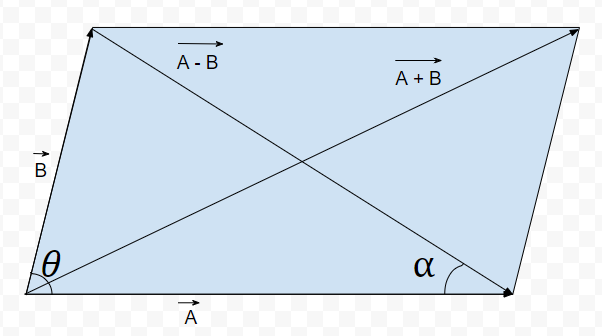
Subtraction of the vector is nothing but the addition of the negative vector to the other vector. Keeping the same magnitude and reversing the direction of a vector gives a negative vector. In a Parallelogram, one diagonal shows the addition of vectors, and the other one shows the subtraction of vectors as shown above in the figure.
Mathematical formula of subtraction of two vectors  and
and 


Where ? is the angle between  and
and  and angle ? is between resultant vector
 and
and 
Multiplication Of Vectors
Multiplication of vectors can be of two types: scalar vector multiplication and vector-vector multiplication. If we multiply a vector  with a scalar quantity “k”, when “k” is positive, the direction remains the same and magnitude becomes “k” times, and when “k” is negative, magnitude becomes “k” time, but the direction gets reversed.
Vector multiplication is two types i.e dot product or scalar product and cross product or vector product which are explained below.
Dot Product
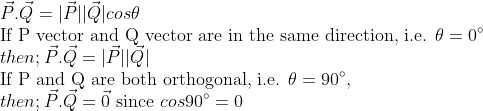
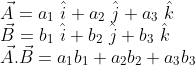
It is also called a scalar product, represented as (.) between two vectors. Dot product physically represents the multiplication of the magnitude of one vector with a component of another vector in the direction of the vector.
Cross Product
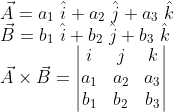
Cross product is also known as the vector product is represented by the “X” sign between two vectors. If  and
and  are two vectors.


Other Important Formulas

NEET Syllabus: Subjects & Chapters
Select your preferred subject to view the chapters
Logarithmic
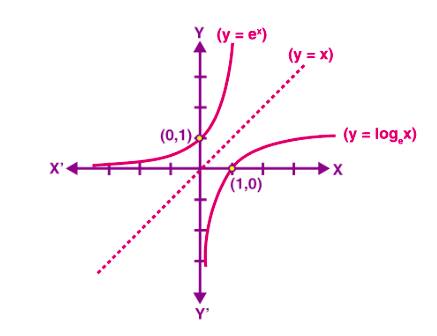
Logarithmic Function is an inverse function of exponential function which is defined as
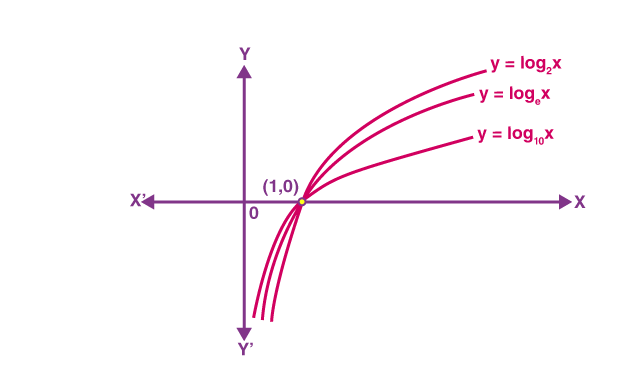
x = logb a, for b > 0, a > 0, and b ≠ 1, if and only if a = bx. Generally, we come across two types of bases while solving NEET problems. That is 10 and the mathematical constant “e”. When the base is “e” it is called a natural logarithmic function and when the base is 10 then it is called a common logarithmic function.
Natural logarithmic function f(x) = loge x
Common logarithmic function f(x) = log10 x
Logarithmic Function
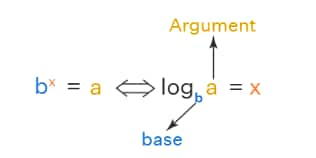
Logarithmic Table
x | Base = 10 Log10 x | Base = e ≈ 2.71; Loge x |
1 | 0 | 0 |
2 | 0.3010 | 0.693147 |
3 | 0.4771 | 1.098612 |
4 | 0.6020 | 1.386294 |
5 | 0.6989 | 1.609438 |
6 | 0.7781 | 1.791759 |
7 | 0.8450 | 1.94591 |
8 | 0.9030 | 2.079442 |
9 | 0.9542 | 2.197225 |
10 | 1 | 2.302585 |
Graph
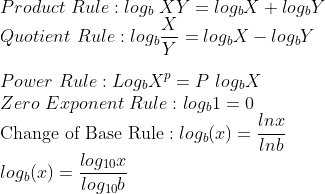
Properties
Exponential
It is a mathematical function that is used to find exponential decay and exponential growth of many real-life events like population models, radioactive decay, wounds healing models, and many more. Mathematically defined by a function f (x) = a.bx, where “x” is a variable that can be any real number, “a” is constant but can not be zero, and “b” is an also constant know as base of exponential function and it should be greater than zero and not equal to 1. And the most commonly used exponential bases are 10 and “e” which is approximately equal to 2.718. This article includes rules, formulas, graphs, etc of the exponential function.
Exponential Growth
Initially, the quantity increases very slowly, and then rapidly. The rate of change increases over time. A mathematical expression that defines exponential growth is y = a ( 1+ r )x where “ r ” is the growth percentage.
Exponential Decay
Initially, quantity decreases very rapidly, and then slowly. The mathematical expression to define exponential decay is y = a ( 1- r )x where “ r ” is the decay percentage.
Exponential Growth And Decay Graph
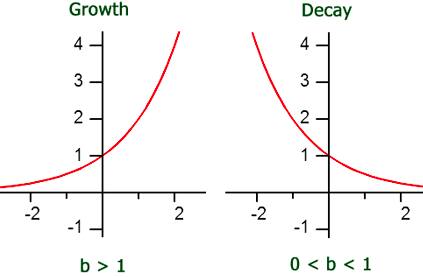
Exponential And Logarithmic Function
Exponential Function Rules
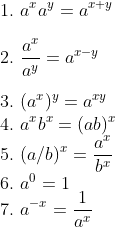
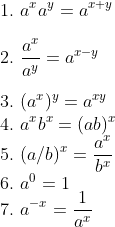
Following are some important rules that are repeatedly used. Here x and y are real numbers whereas “a” and “b” are positive numbers.
If a>0, and b>0, the following hold true for all the real numbers x and y:
NEET Previous Five Years’ Analysis
Since the NEET exam is highly competitive, smart study can help students to succeed in the exam. Careers360 came up with an analysis to help them. The following list shows the number of questions in which vector algebra, exponential, and logarithmic concepts are used.
Numbers Of Questions Asked In Previous Five Years NEET Exam
Vector Algebra | Exponential | Logarithmic | |
2021 | 4 | 2 | 1 |
2020 | 1 | 2 | 2 |
2019 | 5 | 2 | 1 |
2018 | 4 | 1 | 1 |
2017 | 1 | 3 | 1 |
Previous Years Questions To Understand The Concepts
Here is a list of previous year's questions with step-by-step explanations to understand vector algebra, exponential, and logarithmic concepts. NEET aspirants can develop an understanding of the level of questions along with the spread and depth of the concepts.
Q.1 NEET - 2021
In the product
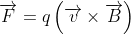



What will be the complete expression for 
Solution:

![\left [ 4\hat{i}-20\hat{j}+12\hat{k} \right ]=\left [ 2\hat{i}+4\hat{j}+6\hat{k} \right ]\times \left [ B\hat{i}+B\hat{j}+B_{0}\hat{k} \right ]](https://cache.careers360.mobi/media/articles/uploads/froala_editor/images/2022/6/9/1654753326488.png)









Concepts used:
Cross product formula:

Q.2. NEET - 2020
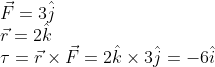
Find the torque about the origin when a force of  acts on a particle whose position vector is
Solution:
Concepts used:
Cross product formula:

Q.3. NEET - 2021
If force [F], acceleration [A], and time [T] are chosen as the fundamental physical quantities. find the dimensions of energy.
Solution:
![[Energy ]=[F]^{x}[A]^{y}[T]^{Z}](https://cache.careers360.mobi/media/articles/uploads/froala_editor/images/2022/6/9/1654753324512.png)
![\left[M^{1} L^{2} T^{-2}\right]=\left[M^{1} L^{1} T^{-2}\right]^{x}[L^{1}T^{-2}]^{y}[T^{1}]^{z}](https://cache.careers360.mobi/media/articles/uploads/froala_editor/images/2022/6/9/1654753325357.png)
![\left[M^{1} L^{2} T^{-2}\right]=M^{x} L^{x+y} T^{-2 y-2 x+z}](https://cache.careers360.mobi/media/articles/uploads/froala_editor/images/2022/6/9/1654753326748.png)





Concepts Used:
Q.4. NEET - 2020
The rate constant for a first-order reaction is  The time required to reduce 2 g of the reactant to 0.2 g is:
Solution:
We have given  Thus, the reaction is of the first order.

Thus,

Concepts Used:
Log10 10 = 1
Q.5 NEET - 2020
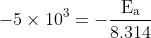
The slope of the Arrhenius Plot 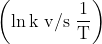 of a first-order reaction is
  . The value of
  of the reaction is. Choose the correct option for your answer.

Solution:
We know the Arrhenius equation


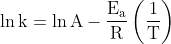
The slope of 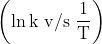 of the above equation -

Given, m =  and
and 



Concepts Used:
Using property ln xp = p ln x, simplify the equation and ln e = 1.
After going through this article it is clear that the NEET exam does not go deeper and asks just formula-based and simple concept-based questions. Therefore, even without mastering complex formulas and concepts of vector algebra students can score well in the exam. With continuous practice, aspirants can get command of the concepts.
Articles
Related Stories
|
Upcoming Medicine Exams

Certifications By Top Providers
Explore Top Universities Across Globe
Popular Courses and Specializations
List of colleges accepting NEET
Browse Medicine Colleges by State
Questions related to NEET
On Question asked by student community
Have a question related to NEET ?
Hello Chetan,
Here are the links you asked for. I hope they serve your purpose.
Hello Suma,
Here are the links you asked for. I hope they serve your purpose.
Hello Bhanuday,
Here are the links you requested. I hope you find them helpful.
Hello Savi
Please check the link below:
- https://medicine.careers360.com/articles/neet-previous-year-question-paper-with-solution
- https://www.careers360.com/download/neet-sample-papers-previous-years
Hope it helps.
Hello, for AP NEET PG Category C seats, NRI documents are generally required if you are applying under the NRI quota, and eligibility depends on the applicable counselling rules. The fee payment currency and procedure should be confirmed from the current Dr. NTRUHS notification at its official website drntr.uhsap.in.
Popular NEET Questions
the product 'P' will be ,
Option: 1

Option: 2

Option: 3
Option: 4


| Column A | Column B |
| A |
a) Organisation of cellular contents and further cell growth. |
| B |
b) Leads to formation of two daughter cells. |
| C |
c) Cell grows physically and increase volume proteins,organells. |
| D |
d) synthesis and replication of DNA. |
Match the correct option as per the process shown in the
0.16 g of dibasic acid required 25 ml of decinormal solution for complete neutralisation. The modecular weight of the acid will be
Option: 1
32
Option: 2
64
Option: 3
128
Option: 4
256
0xone is
Option: 1
Option: 2
Option: 3
Option: 4

Applications for Admissions are open.
Ranked #19 by NIRF, NAAC A++ Accredited | Recognized by dental council of India
Krishnadevaraya College of Dental Sciences and Hospital, Bangalore
ApplyRanked among the top Dental Colleges for 7 consecutive years by India Today poll
NEET Notifications
Never miss NEET update
Get timely NEET updates directly to your inbox. Stay informed!