SRM Kattankulathur Dental College and Hospital, Kattankulathur
Ranked #19 by NIRF, NAAC A++ Accredited | Recognized by dental council of India


What is Pascal's Law?The French mathematician, scientist, inventor, and theologian Blaise Pascal in 1653 published his work on fluids ‘The physical treatises of Pascal: the equilibrium of liquids’, in which he discussed principles of static fluids. A fluid at rest is a static fluid and such a state of the fluid is said to be static equilibrium. If the fluid under consideration is water then we say it is in hydrostatic equilibrium. In static equilibrium, the net force on any part of the fluid must be zero at all times otherwise the fluid will start to flow. Fluid taken here for the study is incompressible i.e., its density will remain constant.
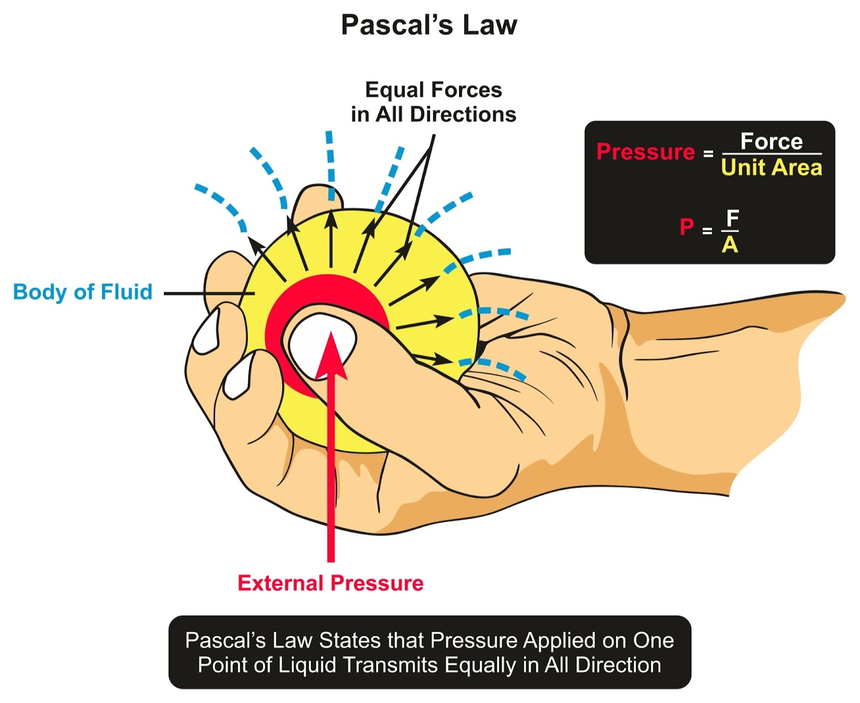
Statement: Let us see how the National Council for Educational Research and Training (NCERT) treats Pascal’s law, also known as Pascal's principle. This principle states that when a change in pressure is applied to an enclosed fluid, it is transmitted equally and undiminished to all portions of the fluid and to the walls of its container.
In the above illustration, you can see that pressure is applied on the sponge ball by pressing it with the thumb and according to Pascal’s law we know that the pressure applied is transmitted equally in all directions. Hence, fluid is released with the same pressure through the pores of the sponge ball.
Before discussing the application of Pascal’s law, let us look at the mathematical expression of Pascal’s law. Suppose you apply force F1 on one of the movable pistons (left side) thereby exerting pressure p1 on the cylindrical container of cross-sectional area A1. Because of the change in pressure due to force F1, it transmits equally and undiminished to all portions of fluids.
From Pascal’s law,

Pressure applied on one of the left cylinders is equal to the pressure exerted on the right cylinder

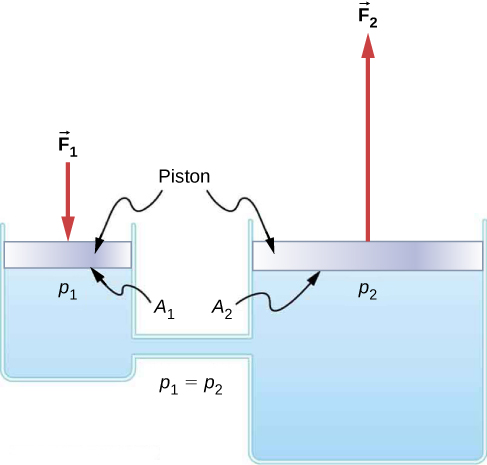
The hydraulic system is based on Pascal's principle of transmission of fluid pressure equally and undiminished in all directions. Let us discuss the application of Pascal’s law
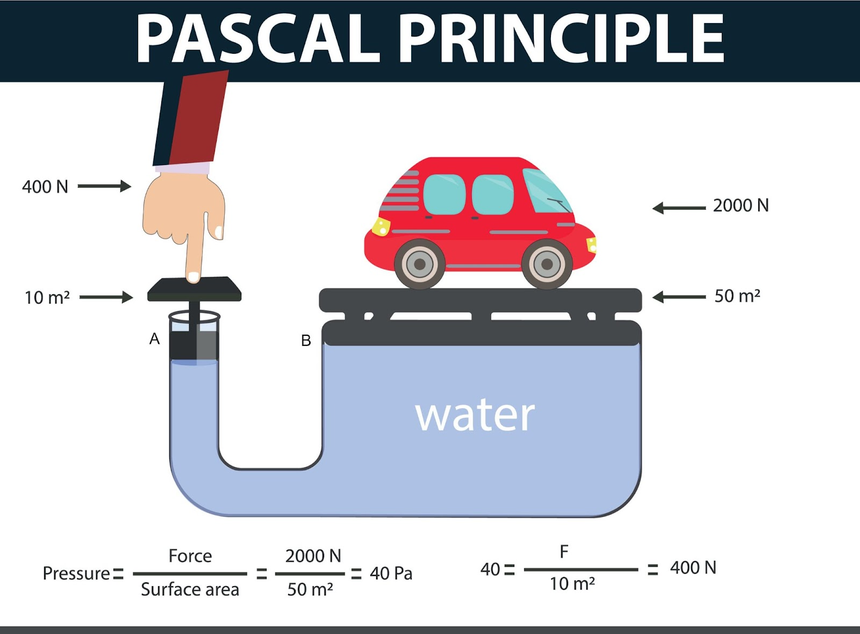 Hydraulic Lift(Image: Shutterstock)
In a hydraulic lift, fitted with airtight cylinders, there are two cylinders; a narrow cylinder A is connected with a wider cylinder B by an ideal fluid (incompressible). The lowering of the piston fitted to cylinder A because of application of pressure is transmitted equal and undiminished to the piston fitted to cylinder B by virtue of Pascal’s law. As a result the platform cum piston connected with the wider cylinder is lifted up.
Advantages of Hydraulic Lifts:
It is cheaper to install than other elevator types.
It is more portable than other elevating means.
Disadvantages of Hydraulic Lifts:
It has a relatively slow lifting speed.
Fluid (oil in the given case) in the piston system can overheat quickly due to compression, so an efficient cooling mechanism is needed.
Slight jerk may be felt compared to the other lift systems.
The lifting mechanism of a hydraulic lift that we have shown here is utilizing mechanical power (because of the pressing of the piston by a person as shown in the figure) but for practical purposes we use an electrically powered pump in which fluid is pushed into a jack lifting system to lift the platform up.
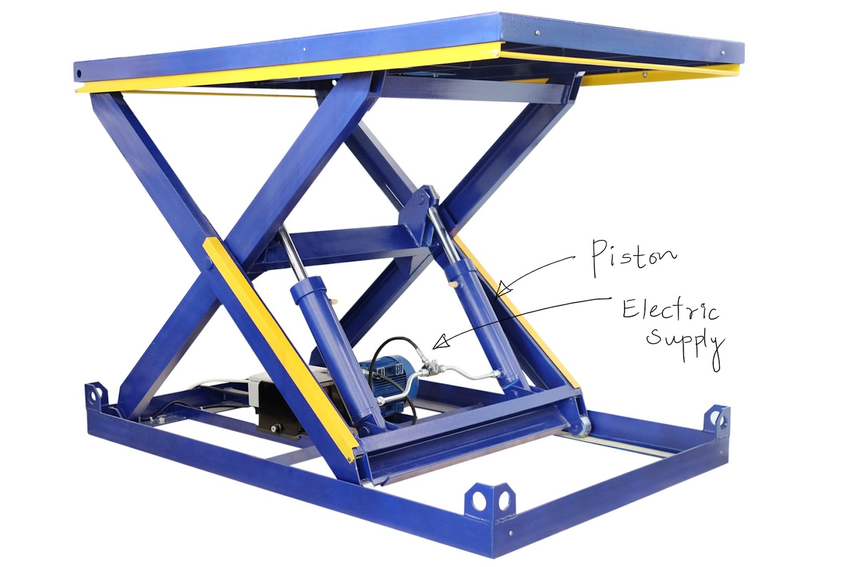 Electrically powered hydraulic lifting system
Pistons within a cylinder at the base of the lift provide the power to the elevator to move the object placed over it up and down.
Get expert advice on college selection, admission chances, and career path in a personalized counselling session.
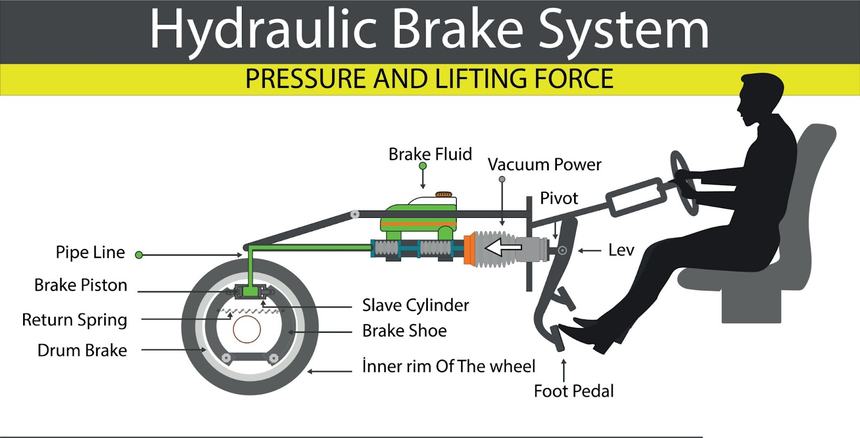 Application of Pascal's law: Hydraulic brake system
The braking systems of cars, trucks, etc. are based on Pascal's law. The hydraulic brakes allow equal pressure to be transmitted throughout the liquid. It consists of a master cylinder, four-wheel cylinders (slave cylinder), and pipeline carrying braking fluid from the master cylinder to a slave cylinder.
Brakes Applied: When the brake pedal is pressed, the force exerted applies pressure on the piston connected with the master cylinder and the pressure applied is transmitted equally and undiminished with the help of braking fluid via metal pipeline. The increase in pressure applied after pressing the pedal transmits to all the pistons of the other cylinders which leads to outward stretching of spring connected with the shoe which in turn presses drum brake. The force of friction between the brake shoe and the drum brake stops the wheels. The spring is extended because of the pressing of the brake shoe with the drum brake and both the arms of the brake shoe are in sync because of the same pressure transmitted by the liquid as per Pascal’s law.
Brakes Released: As soon as the foot is taken off the brake pedal the spring gets relaxed because of the restoring spring force and the liquid is pushed back due to the returning of the piston towards its initial position.
Advantages of Hydraulic Braking System :
Equal braking action on all wheels (equal pressure transmission because of Pascal’s law).
It is easy to build.
The low wear rate of brake linings(a layer of hard material attached to a brake shoe or brake pad to increase friction against the drum or disc).
Disadvantages of Hydraulic Braking System :
The braking system may fail due to leakage of fluid from brake linings.
The presence of air inside the pipeline affects the whole system
Comparatively, it requires frequent maintenance more than the other braking systems.
There are many devices around us that work on the principle of Pascal’s law. It may appear like a simple law but its greatness lies in its application.

On Question asked by student community
Hello Suma,
Here are the links you asked for. I hope they serve your purpose.
Hello Bhanuday,
Here are the links you requested. I hope you find them helpful.
Hello Savi
Please check the link below:
Hope it helps.
Hello, for AP NEET PG Category C seats, NRI documents are generally required if you are applying under the NRI quota, and eligibility depends on the applicable counselling rules. The fee payment currency and procedure should be confirmed from the current Dr. NTRUHS notification at its official website drntr.uhsap.in.
Hello, the NEET PG stipend at Parul University depends on the postgraduate course, academic year and applicable university policies.
the product 'P' will be ,


| Column A | Column B |
| A |
a) Organisation of cellular contents and further cell growth. |
| B |
b) Leads to formation of two daughter cells. |
| C |
c) Cell grows physically and increase volume proteins,organells. |
| D |
d) synthesis and replication of DNA. |
Match the correct option as per the process shown in the
0.16 g of dibasic acid required 25 ml of decinormal solution for complete neutralisation. The modecular weight of the acid will be
32
64
128
256
0xone is

Ranked #19 by NIRF, NAAC A++ Accredited | Recognized by dental council of India
Ranked among the top Dental Colleges for 7 consecutive years by India Today poll