NEET PG College Predictor
NEET PG All India & State College Predictor with Admission Process Guide


NEET 2026 chapter-wise weightage helps aspirants identify the most important and high-scoring chapters from Physics, Chemistry, and Biology based on previous years’ NEET question paper trends. Since the NEET UG syllabus is vast, focusing on chapters with consistently high weightage can improve revision efficiency, accuracy, and overall score performance. Aspirants who prioritise high-weightage NEET chapters early often complete revision faster, attempt more mock tests, and improve score stability significantly during the final months before the examination.
This Story also Contains
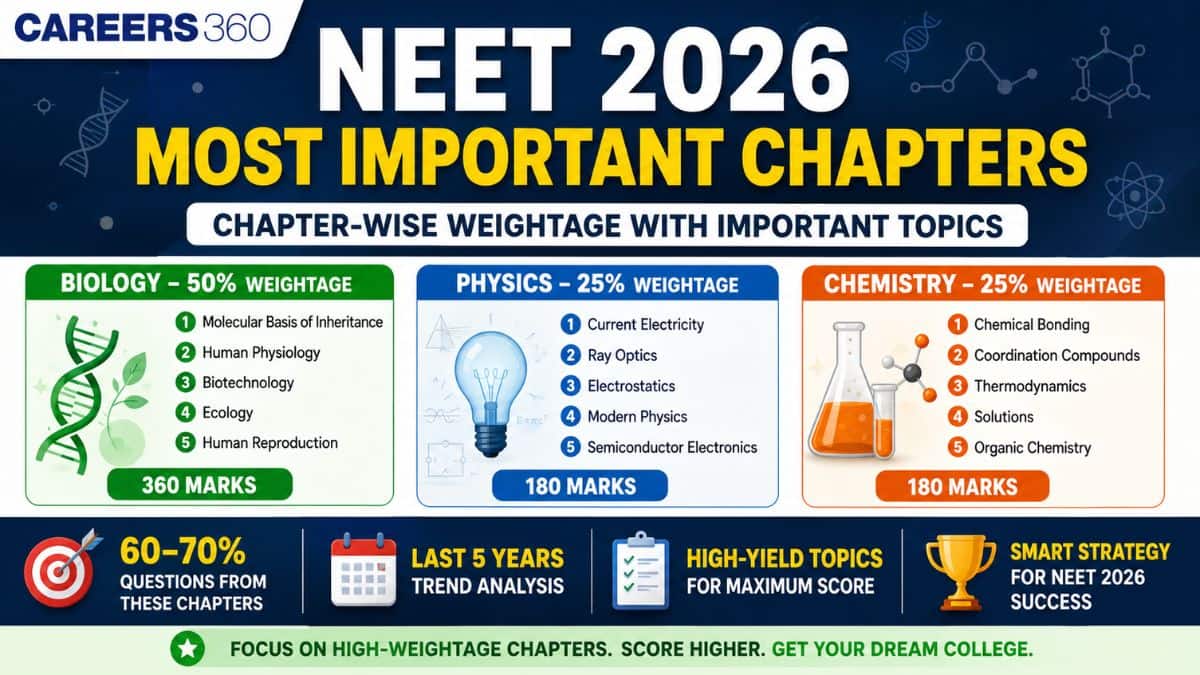
NEET Biology continues to carry the highest weightage in the NEET examination, while chapters such as Molecular Basis of Inheritance, Human Physiology, Current Electricity, Chemical Bonding, Coordination Compounds, Biotechnology, and Ray Optics repeatedly contribute multiple questions every year.
This detailed NEET 2026 chapter-wise weightage analysis covers:
Before analysing individual chapters, it is important to understand the subject-wise distribution of marks in NEET 2026:
Biology contributes 50% of the total NEET marks, making NCERT-based preparation extremely important for rank improvement. Physics requires strong conceptual clarity and numerical practice, while Chemistry rewards aspirants who focus on NCERT revision, reaction mechanisms, and formula application regularly.
Get expert advice on college selection, admission chances, and career path in a personalized counselling session.
Physics is often considered the most challenging section of NEET, and understanding the chapter-wise weightage for NEET 2026 Physics helps aspirants focus on high-scoring and frequently asked chapters. Analysing previous year trends shows that certain chapters contribute more questions every year, making them important for scoring well.
Students can also practise chapter-wise previous year important NEET physics questions to understand the pattern and difficulty level of NEET Physics.
The table below presents the NEET Physics chapter-wise weightage along with the most important topics, helping students prioritise revision and practice numericals from high-weightage topics.
Chapter Name | Total Weightage (%) (based on last 5 years) | Important Topics to Focus |
7.95% | Ohm’s law, resistivity, drift velocity, Kirchhoff’s laws, Wheatstone bridge, meter bridge | |
6.28% | Electric potential, capacitors, energy stored in capacitor, dielectrics, series–parallel combination | |
5.86% | Reflection and refraction, mirror and lens formula, magnification, optical instruments | |
5.86% | Newton’s law, gravitational potential, escape velocity, satellites, Kepler’s laws | |
Semiconductor Electronics: materials, devices and simple circuits | 5.86% | Diodes, Zener diode, transistor, logic gates, PN junction |
5.44% | Lorentz force, motion in magnetic field, Biot–Savart law, Ampere’s law | |
5.44% | Simple harmonic motion, time period, energy in SHM, spring–mass system | |
Alternating Current | 5.02% | AC circuits, RMS value, impedance, resonance, power factor |
5.02% | Dimensional analysis, significant figures, error analysis | |
Electric Charges and Fields | 5.02% | Coulomb’s law, electric field, flux, Gauss’s law |
3.77% | Work–energy theorem, potential energy, power, collisions | |
3.77% | EM spectrum, displacement current, properties of EM waves | |
3.35% | Laws of thermodynamics, heat engines, Carnot cycle | |
3.35% | Kinematics, equations of motion, graphs | |
3.35% | Newton’s laws, friction, free body diagrams | |
Nuclei | 3.35% | Radioactivity, nuclear reactions, mass defect, binding energy |
2.93% | Centre of mass, torque, angular momentum, moment of inertia | |
2.93% | Faraday’s laws, Lenz’s law, induced emf | |
2.51% | Photoelectric effect, de Broglie wavelength | |
Mechanical Properties of Fluids | 2.51% | Pascal’s law, Bernoulli’s principle, viscosity |
Wave Optics | 2.51% | Interference, diffraction, Young’s double slit experiment |
Magnetism and Matter | 2.09% | Magnetic properties, earth’s magnetism |
Atoms | 2.09% | Bohr model, atomic spectra |
1.67% | Ideal gas equation, RMS speed, degrees of freedom | |
1.67% | Vector addition, projectile motion | |
Mechanical Properties of Solids | 1.26% | Stress–strain, Young’s modulus |
0.84% | Wave equation, sound waves | |
0.84% | Calorimetry, thermal expansion |
Physics preparation for NEET 2026 should focus heavily on numerical practice, formula revision, and PYQ analysis. Chapters such as Current Electricity, Ray Optics, Electrostatics, Semiconductor Electronics, and Oscillations consistently carry high weightage and should be revised multiple times before the examination.
Students struggling with Physics should first strengthen formula-based chapters and regularly practise moderate-level MCQs to improve speed and confidence.
Chemistry is one of the most scoring sections in NEET when prepared strategically, as many questions are directly based on NCERT concepts, reactions, and formulas. Understanding the chapter-wise weightage for NEET 2026 Chemistry helps aspirants identify high-return chapters from Physical, Organic, and Inorganic Chemistry.
The table below presents the NEET Chemistry chapter-wise weightage along with high-yield topics, enabling students to prioritise revision, strengthen weak areas, and maximise their score in NEET 2026. Aspirants should also practise NEET chemistry important questions for a better score.
Chapter Name | Total Weightage (%) (based on last 5 year data) | Important Topics to Focus |
3.91% | Mole concept, stoichiometry, limiting reagent, concentration terms | |
5.12% | Bohr model, quantum numbers, electronic configuration, spectra | |
5.57% | Periodic trends, atomic size, ionisation energy, electron affinity | |
6.12% | VSEPR theory, hybridisation, molecular orbital theory, hydrogen bonding | |
States of Matter | 3.34% | Note: Removed from NEET 2026 syllabus |
5.15% | Laws of thermodynamics, enthalpy changes, Hess’s law, Gibbs free energy | |
2.97% | Chemical equilibrium, ionic equilibrium, buffer solutions, pH | |
2.82% | Oxidation number, balancing redox equations, redox titrations | |
0.84% | Note: Removed from NEET 2026 syllabus | |
The s-Block Element | 1.25% | Note: Removed from NEET 2026 syllabus |
3.58% | Group 13–17 properties, oxides, halogens | |
3.43% | Electronic configuration, oxidation states, magnetic properties | |
6.94% | Werner theory, IUPAC naming, isomerism, CFT | |
Solid State | 2.34% | Note: Removed from NEET 2026 syllabus |
6.33% | Colligative properties, Raoult’s law, abnormal molar mass | |
2.32% | Electrochemical cells, Nernst equation, conductance | |
4.73% | Rate law, order of reaction, Arrhenius equation | |
Surface Chemistry | 0.87% | Note: Removed from NEET 2026 syllabus |
5.44% | Reaction mechanisms, acidity–basicity, purification methods | |
6.63% | Alkanes, alkenes, alkynes, aromatic compounds, reactions | |
4.28% | SN1 & SN2 reactions, elimination reactions | |
4.28% | Preparation, reactions, acidic nature of phenols | |
4.70% | Nucleophilic addition, oxidation–reduction, name reactions | |
3.66% | Basic strength, diazotisation, Hoffmann bromamide reaction | |
2.60% | Carbohydrates, proteins, enzymes, vitamins | |
Polymers | 1.25% | Note: Removed from NEET 2026 syllabus |
Environmental Chemistry | 0.87% | Note: Removed from NEET 2026 syllabus |
General Principles and Processes of Isolation of Elements | 1.28% | Note: Removed from NEET 2026 syllabus |
The data is from past five years. As per the latest NEET 2026 syllabus updates, certain chapters have reduced or no direct weightage. Aspirants should always refer to the latest official NEET 2026 syllabus notification released by NTA before finalising their preparation strategy.
NCERT remains the most important resource for NEET Chemistry preparation, especially for Inorganic Chemistry and Organic Chemistry reactions. Aspirants should prioritise Chemical Bonding, Coordination Compounds, Hydrocarbons, Thermodynamics, and Solutions because these chapters consistently contribute multiple questions every year.
Daily MCQ practice and regular revision of reaction mechanisms can significantly improve Chemistry accuracy in NEET 2026.
Biology carries the highest weightage in NEET, contributing 360 marks out of 720, making it the most scoring subject for NEET 2026 aspirants. Analysing the chapter-wise weightage for NEET Biology helps students identify frequently asked chapters and focus on NCERT-based, most important NEET Biology questions.
Since most Biology questions are directly NCERT-based, aspirants must revise NCERT line-by-line before attempting advanced-level MCQs. Therefore, following an NCERT-based biology preparation strategy is crucial for scoring high in NEET 2026.
The table below presents the NEET Biology chapter-wise weightage along with important topics, based on previous year trends, to support smart revision and effective exam preparation.
Chapter Name | Total Weightage (%) | Important Topics to Focus |
1.54% | Five-kingdom system, viruses, viroids, lichens | |
2.86% | Algae, bryophytes, pteridophytes, gymnosperms, angiosperms | |
3.52% | Root, stem, leaf modifications, inflorescence, flower, fruit | |
3.30% | Tissue systems, secondary growth, dicot vs monocot anatomy | |
3.30% | Cell organelles, membrane structure, cell theory | |
4.84% | Mitosis, meiosis, Prophase-I stages | |
4.40% | Proteins, carbohydrates, lipids, enzymes | |
5.49% | Non-chordates, chordates, diagnostic features | |
4.18% | Animal tissues, Morphology, anatomy and functions of different systems of an insect (Frog) | |
1.10% | Blood components, cardiac cycle, ECG | |
1.10% | Nephron structure, urine formation | |
2.64% | Light reaction, Calvin cycle, photorespiration | |
1.32% | Glycolysis, Krebs cycle, ETS | |
1.76% | Plant hormones, photoperiodism, vernalisation | |
2.86% | Endocrine glands, hormones, hormonal disorders | |
Transport in Plants | 1.10% | Note: Removed from NEET 2026 syllabus |
Digestion and Absorption | 1.54% | Note: Removed from NEET 2026 syllabus |
Mineral Nutrition | 0.44% | Note: Removed from NEET 2026 syllabus |
4.84% | Microsporogenesis, megasporogenesis, double fertilisation | |
4.62% | Gametogenesis, menstrual cycle, fertilisation | |
2.20% | Contraceptive methods, STDs, infertility | |
4.84% | Mendelian crosses, linkage, gene interaction | |
8.79% | DNA replication, transcription, translation, genetic code | |
2.64% | Evidences of evolution, Hardy–Weinberg principle | |
5.06% | Immunity, AIDS, cancer, drugs and alcoholism | |
2.20% | Antibiotics, sewage treatment, biogas | |
6.60% | rDNA technology, vectors, PCR, bioreactors | |
3.08% | GM crops, insulin production, gene therapy | |
3.30% | Population growth, interactions, adaptations | |
3.30% | Energy flow, nutrient cycles, ecological pyramids | |
Strategies for Enhancement in Food Production | 1.10% | Note: Removed from NEET 2026 syllabus |
Reproduction in Organisms | 0.22% | Note: Removed from NEET 2026 syllabus |
The data is from the last five years, and the chapters on plant transport, food production improvement strategies, digestion and absorption, reproduction in organisms, and mineral nutrition are no longer part of the syllabus.
Biology contributes 50% of the total NEET marks, making NCERT-based preparation extremely important for rank improvement. Most NEET Biology questions are directly or indirectly based on NCERT diagrams, examples, definitions, and conceptual statements.
Students should prioritise chapters such as Molecular Basis of Inheritance, Biotechnology, Human Physiology, Ecology, and Human Reproduction because these chapters consistently carry the highest weightage in NEET Biology.
Students preparing for NEET 2026 should prioritise high-weightage chapters that consistently contribute the maximum number of questions every year.
Molecular Basis of Inheritance
Human Physiology
Biotechnology
Ecology
Cell Cycle and Cell Division
Human Reproduction
Chemical Bonding
Coordination Compounds
Thermodynamics
Electrochemistry
Organic Chemistry
Solutions
Current Electricity
Ray Optics
Electrostatics
Modern Physics
Semiconductor Electronics
Oscillations
Focusing on these chapters first can significantly improve scoring potential and revision efficiency before NEET 2026.
Check now:
Molecular Basis of Inheritance
Human Physiology
Biotechnology
Current Electricity
Ray Optics
Chemical Bonding
Coordination Compounds
Electrostatics
Human Reproduction
Ecology
Modern Physics
Thermodynamics
Semiconductor Electronics
Cell Cycle and Cell Division
Organic Chemistry
These chapters consistently contribute a major share of NEET questions every year and should be prioritised during the final months of preparation.
Yes. The NEET 2026 chapter-wise weightage analysis is based on question distribution patterns observed in the last five years of the NEET UG exam. While the exact number of questions may slightly vary each year, certain chapters consistently carry higher weightage.
For example, chapters like Current Electricity in Physics, Coordination Compounds in Chemistry, and Molecular Basis of Inheritance in Biology have repeatedly contributed a significant number of questions. Understanding these patterns of high weightage NEET chapters helps aspirants prepare strategically without ignoring conceptual clarity.
Understanding NEET 2026 chapter-wise weightage helps aspirants plan their preparation in a smart and result-oriented way instead of studying all chapters with equal effort.
Identifies high-scoring and frequently asked chapters in the NEET exam.
Helps in prioritising important topics from Physics, Chemistry, and Biology
Saves time by reducing focus on low-weightage chapters during initial preparation
Improves revision efficiency, especially in the last months NEET preparation.
Supports better time management and subject-wise balance
Increases accuracy by focusing on NCERT-based and repeated concepts
Helps aspirants build a target-oriented study plan for NEET 2026
Using NEET chapter-wise weightage effectively helps students to maximise their score with focused preparation and systematic revision.
Students can also check the detailed NEET 2026 exam pattern and NEET 2026 syllabus before planning subject-wise preparation.
Analysis of previous year NEET papers shows that a limited number of high-weightage chapters contribute nearly 60–70% of the total questions asked in the examination. Many NEET toppers prioritise these high-weightage chapters first because mastering them can significantly improve mock-test scores and reduce revision overload during the final preparation phase.
Molecular Basis of Inheritance
Biotechnology
Human Physiology
Ecology
Human Reproduction
Chemical Bonding
Coordination Compounds
Hydrocarbons
Solutions
Thermodynamics
Current Electricity
Electrostatics
Ray Optics
Semiconductor Electronics
Oscillations
Prioritising these chapters first can significantly improve revision efficiency and score potential during the final months before NEET 2026.
High-Value Re-NEET 2026 Study Resources for Maximum Score:
Previous year NEET trends show that Class 12 chapters usually contribute slightly higher weightage than Class 11 chapters, especially in Biology and Physics.
Human Physiology
Genetics
Biotechnology
Current Electricity
Ray Optics
Coordination Compounds
Cell Biology
Thermodynamics
Laws of Motion
Plant Kingdom
Organic Chemistry Basics
Students should maintain a balanced preparation strategy while prioritising Class 12 chapters during the final revision phase.
Students running short on time should revise chapters in the following order:
Biology high-weightage NCERT chapters
Modern Physics and Current Electricity
Chemical Bonding and Coordination Compounds
Human Physiology and Genetics
PYQs and mock-test weak areas
Formula revision and Biology diagrams
This approach helps maximise score improvement during the final revision phase before NEET 2026.
With very limited time before NEET 2026, aspirants should focus on chapters contributing nearly 60–70% of the paper. Prioritising high-weightage topics first, followed by quick revision of medium-weightage chapters, ensures maximum score increase in the final phase.
Aspirants should not use chapter weightage to completely ignore low-weightage chapters. Instead, weightage should help prioritise preparation smartly.
Smart Study Strategy
High-weightage chapters can significantly improve scores, especially during the final phase of preparation. However, relying only on selective chapters is risky because NEET question distribution changes slightly every year.
Experts recommend mastering high-weightage chapters first and then gradually covering medium-weightage topics to maximise accuracy, reduce risk, and improve overall score stability in NEET 2026.
Access Other Preparation Resources:
Frequently Asked Questions (FAQs)
Biology has the highest weightage in NEET 2026, contributing 360 marks out of 720. Due to its NCERT-based questions and repeated topics, Biology is considered the most scoring subject for NEET aspirants.
While high-weightage chapters should be prioritised, low-weightage chapters should not be ignored completely. Once important chapters are well prepared, low-weightage topics can be revised to avoid losing easy marks.
High-weightage chapters should be revised at least 3-4 times before the NEET exam. Regular revision, along with PYQ practice and mock tests, helps improve accuracy and long-term retention.
NTA does not release official chapter-wise weightage. The analysis is based on previous year question trends and subject-wise question distribution.
High-weightage chapters from Biology such as Molecular Basis of Inheritance, Biotechnology, and Human Health & Disease, along with key chapters from Physics and Chemistry, together contribute nearly 60–70% of the total questions.
Chemical Bonding, Coordination Compounds, Hydrocarbons, Thermodynamics, and Solutions are considered highly scoring chapters for NEET 2026 Chemistry.

On Question asked by student community
Hello, the NEET PG stipend at Parul University depends on the postgraduate course, academic year and applicable university policies.
Hello Student,
If you are looking for information about NEET PG 2025 DNB seat allotment and the fees payable at the allotted college or hospital, DNB seats are allotted through the respective counselling process based on your rank, category, choice of speciality, and seat availability.
For the 2025 session, the
Dear Student, with a NEET PG 2026 rank of 6,600 in the EWS category, your options should be assessed using the relevant counselling year's college-wise closing ranks, category-wise seats and counselling round. Please also confirm whether you are applying through the applicable All India counselling route or another quota. That
Hello, with a NEET PG rank of 11,000, your chances of getting MS ENT at Government Medical College, Thiruvananthapuram depend on your category, state quota, counselling round and previous year’s closing rank. You can check the cutoff details here: https://medicine.careers360.com/articles/kerala-neet-pg-cut-off
Dear Student, with a NEET PG rank of 8,571, you can explore DNB Pediatrics options through the relevant counselling process. If Bangalore is your preferred location, it would be useful to compare the available hospitals on factors such as patient load, paediatric case exposure, teaching environment, stipend, bond conditions and

NEET PG All India & State College Predictor with Admission Process Guide
End-to-End NEET PG Admission Guidance | One-to-One Counselling | College Predictors | Regular Updates | E-books