SRM Kattankulathur Dental College and Hospital, Kattankulathur
Ranked #19 by NIRF, NAAC A++ Accredited | Recognized by dental council of India


The National Testing Agency (NTA) conducts the National Eligibility cum Entrance Test (NEET) for undergraduate (UG) admissions to medical courses every year. NEET (UG) is a highly competitive exam to get admission to various medical and other allied science courses across India. To get a good rank it is essential that the aspirants are thorough with every subject and all possible questions that may be asked in the NEET exam. One-fourth of the NEET questions are from Physics, So, how well you prepare Physics will play a crucial role in your plans to get a good rank in the NEET exam. It is essential for the NEET candidates to know the areas to be focused on beforehand in order to make a winning preparation plan. Analysis of each subject and chapters from which questions were asked in the previous papers will help your preparation plan in a big way.
Here is an analysis of the Class 12 Physics chapter, Current Electricity. The analysis is done for the past 5 years of the NEET Paper from 2017 to 2021. The total number of questions from Physics for the past 5 years is 230. And out of these 230 questions, 17 were from the chapter, Current Electricity. That is, 7.39% of the questions were from Current Electricity. This makes Current Electricity an important chapter from the point of NEET (UG)
Current can be mainly classified into two. Direct Current (DC) and Alternating Current (AC). The chapter, Current Electricity discusses DC current. The AC current is dealt with in the NCERT Class 12 chapter, Alternating Current. Let us see the topics of Current Electricity from which questions were asked in NEET in the last five years.
Topic Most Scoring Concepts for NEET 2027 Download the NEET Most Scoring Chapters and Topics PDF based on the past 5 years’ analysis. Focus on high-weightage topics and boost your NEET preparation. Download EBook | Number Of Questions | Weightage |
Definition Of Current And Drift Velocity | 2 | 11.76% |
Ohm's Law | 1 | 5.88% |
Resistance And Resistivity | 6 | 35.29% |
Combination Of Cells | 2 | 11.76% |
Heating Effect Of Electric Current and Power Consumed | 2 | 11.76% |
KVL and KCL | 1 | 5.88% |
Wheatstone bridge And Meter Bridge | 1 | 5.88% |
Potentiometer And Its Application | 2 | 11.76% |
Total | 17 | 100% |
The above table shows that studying all the topics of the chapter, Current Electricity, of NCERT Class 12 Physics is essential to cracking NEET with a good score. There were 6 questions from the topic Resistance And Resistivity, in the last five years' NEET Papers. The subtopics coming under Resistance And Resistivity are: The Concept Of Resistance And Resistivity; Colour Coding Of Resistance; The Formula Of Resistance In Terms Of Length, Area And Resistivity; Stretching And Recasting Of A Wire; Temperature Dependence Of Resistance And Resistivity; and Series And Parallel Combination Of Resistance.
All the concepts coming under each topic are essential and students cannot skip concepts as all of them are connected. For example, questions may be a combination of the concept of Power Consumed and the Combination Of Resistors; to solve questions related to the Heating Effect, it is necessary to understand Ohm's Law. To solve circuit related problems KVL and KCL are quite useful.
Example 1 - NEET 2019
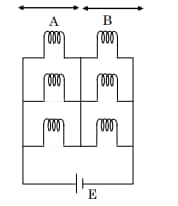
Six similar bulbs are connected as shown in the figure with a DC source of emf E, and zero internal resistance.
The ratio of power consumption by the bulbs when 1) all are glowing and 2 ) in the situation when two from section A and one from section B are glowing will be:
Answer:
Assume that each bulb is having a resistance of R ohms.
Case 1- When all the bulbs are glowing
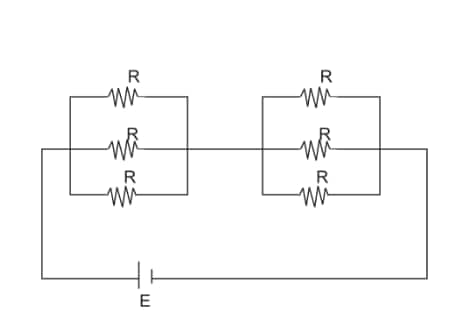
First the equivalent resistance needs to be calculated and then the power consumed. Three resistance of values R in parallel will give a net value of R/3. And the series combination of two resistance of value R/3 will give a net value of 2R/3. So the power consumed by bulbs P1=3E2/2R.
Case 2-
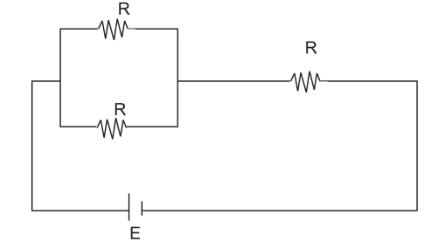
The equivalent resistance of the combination is R/2 + R=3R/2. Power consumed P2=2E2/3R
The ratio P1/P2= 9/4
Example 2 - NEET 2021
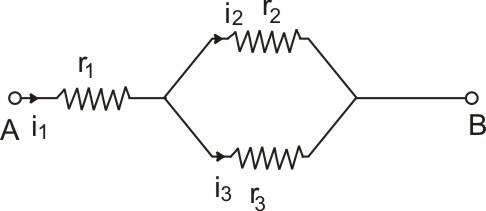
Three resistance having resistances r1, r2 and r3 are connected as shown in the given circuit. The ratio i3/i1 of currents in terms of resistances used in the circuit is
Answer:
The concept of KCL and Combination Of Resistance is used to solve the problem. The resistors r2 and r3 are connected in parallel. Therefore voltage across r2 and r3 will be the same.
i2r2=i3r3…….(1)
From KCL
i1=i2+i3…….(2)
From (1) and (2)
(i1-i3)r2=i3r3
i1r2=i3(r2+r3)
i1/i3=(r2+r3)/r2
The Current Electricity chapter is easy to crack and NEET questions were of easy to medium type difficulty level. Understanding the concepts, knowing the basic equations, understanding circuit laws and practising NCERT questions and previous years’ NEET papers would give enough knowledge to crack the NEET questions from the chapter Current Electricity.
Get expert advice on college selection, admission chances, and career path in a personalized counselling session.

On Question asked by student community
Hello Chetan,
Here are the links you asked for. I hope they serve your purpose.
Hello Suma,
Here are the links you asked for. I hope they serve your purpose.
Hello Bhanuday,
Here are the links you requested. I hope you find them helpful.
Hello Savi
Please check the link below:
Hope it helps.
Hello, for AP NEET PG Category C seats, NRI documents are generally required if you are applying under the NRI quota, and eligibility depends on the applicable counselling rules. The fee payment currency and procedure should be confirmed from the current Dr. NTRUHS notification at its official website drntr.uhsap.in.
the product 'P' will be ,


| Column A | Column B |
| A |
a) Organisation of cellular contents and further cell growth. |
| B |
b) Leads to formation of two daughter cells. |
| C |
c) Cell grows physically and increase volume proteins,organells. |
| D |
d) synthesis and replication of DNA. |
Match the correct option as per the process shown in the
0.16 g of dibasic acid required 25 ml of decinormal solution for complete neutralisation. The modecular weight of the acid will be
32
64
128
256
0xone is

Ranked #19 by NIRF, NAAC A++ Accredited | Recognized by dental council of India
Ranked among the top Dental Colleges for 7 consecutive years by India Today poll