Emversity Allied Health Programs
Get Job Ready in Healthcare | Employability-Focused Programs


The National Testing Agency (NTA) has started the NEET 2025 registrations on February 7, 2025. Regarding the NEET 2025 registrations, NTA announced an important update - Aadhaar integration for NEET 2025 registration. In the notice released by the authority on January 14, 2025, the authority has emphasized on using APAAR ID and Aadhaar-based authentication during the NEET 2025 application process and further examination process. However APAAR ID is not mandatory, NTA clarified on January 24, 2025. The NTA has also released NEET 2025 Aadhaar registration guidelines to ensure smooth functioning during the registration process.
Check NTA's APAAR ID not mandatory notice
This Story also Contains
The NEET 2025 registration process has started on February 7, 2025. Therefore, the authority has asked aspirants wishing to appear for the NEET 2025 exam to update their credentials in their APAAR ID as well as in their Aadhaar card to have a hassle-free registration process. Candidates must also ensure that the Aadhaar card is linked with a valid mobile number for OTP-based authentication for APAAR ID NEET UG registration 2025. Read the article on NEET 2025 Aadhaar integration to get more details on what APAAR ID is, how to update the Aadhaar card details and others.
The authority released a notice for the NEET 2025 aspirants to update their Aadhaar card details. Check the image below for more information.

Get expert advice on college selection, admission chances, and career path in a personalized counselling session.
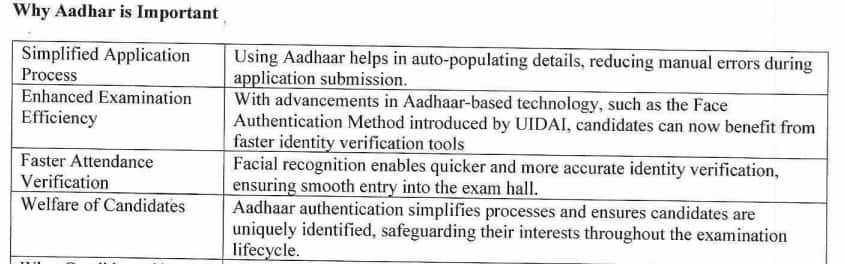
As the NEET application form is released by the authority, aspirants must update their Aadhaar card details. Updating the details of Aadhaar card is important for the NEET 2025 exam because of the below mentioned reasons.
Simplified process of application form filling
During NEET 2025 registration, candidates are required to provide their Aadhaar number for identity verification. This helps in auto-filling details in the NEET 2025 application form, thus reducing the manual errors which can lead to application rejection. Therefore updating Aadhaar details ensures that the details match across all documents, avoiding errors or delays.
Generation of APAAR ID
NTA can use the student's APAAR ID to cross verify the details. Therefore, accurate information in Aadhaar is necessary for successfully creating APAAR ID.
Consistency across records
Candidates must update their Aadhaar card details and link it with a valid mobile number as inconsistent details in Aadhaar, school certificates and NEET application forms can lead to discrepancies in the later stage such as issuance of NEET 2025 admit card or in the counselling process.
Important for Biometric verification
The authority conducts the biometric attendance to grant entry in the NEET exam centre. NEET biometric attendance 2025 is conducted at various stages to check the authenticity of the student appearing for the exam. Therefore, updating the Aadhaar card details is important as if the Aadhaar-linked biometrics (fingerprints, photograph) are outdated, it can cause delays or authentication failures.
As per the notice by NTA, candidates must update their Aadhaar credentials before the NEET registration 2025 process starts. Details which are mandatorily to be updated in Aadhaar are:
Name of the candidates (as per class 10 passing certificate)
Date of Birth (as per class 10 passing certificate)
Facial recognition data
Get Job Ready in Healthcare | Employability-Focused Programs

Below are the steps following which students can update their Aadhaar card details.
Visit the nearest Aadhaar Enrollment Center or update online via the UIDAI portal.
Provide supporting documents such as birth certificates, school IDs, or address proof for the update.
Request an update in fields such as name, address, date of birth, mobile number, or biometrics as needed.
Verify the updates to ensure they match your academic and NEET registration records.
APAAR stands for Automated Permanent Academic Account Registry. APAAR ID is a digital ID card of the student studying in various schools in India. It is a 12-digit code that helps students to store, manage and access all their academic records including marksheets, scorecards, diplomas, certificates and other academic accomplishments. As a part of ‘One Nation, One Student ID’, APAAR creates a permanent centralised academic record for each student, acting as a single, unique identifier across various academic and examination platforms.
As the NTA has asked students to update their APAAR ID along with the Aadhaar Card, aspirants can check the steps mentioned below on how they can obtain their APAAR ID for the NEET exam.
Students need to visit the school to verify their demographic details such as the student's name, date of birth, gender and address.
If the student is a minor (below 18 years of age), parental or guardian consent is mandatory before proceeding with APAAR ID creation.
Once the demographic details are verified and consent is obtained, the student's identity is authenticated by the school authorities. Authentication confirms the legitimacy of the student’s identity and ensures that the APAAR ID is being created for the right person.
After successful verification and authentication, the APAAR ID is generated. This 12-digit unique identifier is securely linked to the student’s academic profile and stored in DigiLocker, a government-approved digital repository. DigiLocker provides secure online access to the APAAR ID, enabling students to retrieve it anytime and use it for academic and examination-related purposes.
The following details are required for APAAR ID creation for NEET 2025 exam.
UDISE+ Unique Student Identifier (PEN)
Student Name
Date of Birth (DOB)
Gender
Mobile number
Mother's name
Father's name
Name as per Aadhaar
Aadhaar number

On Question asked by student community
Hello Savi
Please check the link below:
Hope it helps.
Hello, for AP NEET PG Category C seats, NRI documents are generally required if you are applying under the NRI quota, and eligibility depends on the applicable counselling rules. The fee payment currency and procedure should be confirmed from the current Dr. NTRUHS notification at its official website drntr.uhsap.in.
Hello, some B.Sc Nursing colleges may offer admission without NEET, but the admission process depends on the college and its eligibility rules. You can find colleges offering B.Sc Nursing admission without NEET here: https://medicine.careers360.com/articles/bsc-nursing-admission-without-neet
Hello, you can pursue BPT in Kerala without NEET UG. Admission is generally based on the LBS Centre rank list and the applicable admission process. You can check BPT colleges in Kerala and their details here: https://medicine.careers360.com/colleges/list-of-bpt-in-physiotherapy-colleges-in-kerala
Hello Student,
If you are looking for information about NEET PG 2025 DNB seat allotment and the fees payable at the allotted college or hospital, DNB seats are allotted through the respective counselling process based on your rank, category, choice of speciality, and seat availability.
For the 2025 session, the
the product 'P' will be ,


| Column A | Column B |
| A |
a) Organisation of cellular contents and further cell growth. |
| B |
b) Leads to formation of two daughter cells. |
| C |
c) Cell grows physically and increase volume proteins,organells. |
| D |
d) synthesis and replication of DNA. |
Match the correct option as per the process shown in the
0.16 g of dibasic acid required 25 ml of decinormal solution for complete neutralisation. The modecular weight of the acid will be
32
64
128
256
0xone is

Know possible Govt/Private MBBS/BDS Colleges based on your NEET rank
College Predictors Webinars One to One Counselling Regular Updates Medical Almanac
Get Job Ready in Healthcare | Employability-Focused Programs
Ranked among the top Dental Colleges for 7 consecutive years by India Today poll
Ranked #19 by NIRF, NAAC A++ Accredited | Recognized by dental council of India