SRM Kattankulathur Dental College and Hospital, Kattankulathur
Ranked #19 by NIRF, NAAC A++ Accredited | Recognized by dental council of India


The mole concept is an important concept in NEET Chemistry. There are at least 1-3 mole concept questions in the NEET exam every year. These questions check your knowledge of formulas, stoichiometry, limiting reagents, and gas laws. It is very important to practice the mole concept NEET 2026 questions in order to score high marks in Physical Chemistry.
This Story also Contains

NEET previous year mole concept questions are available to practise. The questions range from basic to advanced level, so aspirants can practice all concepts efficiently. Practice the mole concept questions for the NEET exam will make calculations more precise and faster. Aspirants can check the solutions given in the article to know the right methods and how to avoid silly mistakes.
The mole concept connects measurable amounts, such as grams to small particles like molecules and atoms. These concepts form an important component of NEET mole concept questions and appear frequently in the exam.
Mixing of substances
Determining the amount of each substance in a blend
Chemical reactions
Understanding how much of one material turns into another
Gas calculations
Studying the nature of gases and calculating their volume and moles
Get expert advice on college selection, admission chances, and career path in a personalized counselling session.
The types of questions asked about the mole concept NEET previous year question paper are discussed below:
These examine simple concepts of mole-particle-mass relationships:
Calculate atoms in 0.5 moles of oxygen
Determine the number of moles in 49g H2S04
Ranked #19 by NIRF, NAAC A++ Accredited | Recognized by dental council of India
Special Scholarship for Students from Goa (Get an exclusive scholarship of ₹20,000 if you're a Goa-based student) | Bringing Parul Education Trust's 30-year Education Legacy to Goa
Key Formula:
\text{Number of particles} = \frac{\text{Given mass}}{\text{Molar mass}} \times N_A
Focus on molarity, molality, normality, and their interconversions.
Examples:
Find the molarity of 98% H2SO4 (density = 1.84 g/cm3).
Prepare 250 mL of 2 M HNO3 from 70% concentrated acid.
Key Formula:
For molarity:
\( M = \frac{10 \times \text{density} \times \% \text{purity}}{\text{Molar mass}} \)
These involve multi-step calculations using balanced chemical equations and mole ratios.
Examples:
Determine the mass of CaCO3 needed to produce 11 g CO2.
Identify the limiting reagent in N2+3H2→2NH3.
Strategy:
Always verify mole ratios from the balanced equation before proceeding with calculations.
Combine mole concepts with percentage composition analysis.
Examples:
A compound contains 40% C, 6.67% H, and 53.33% O. Find its empirical formula.
Determine the molecular formula from combustion data.
Approach:
Convert percentages into moles.
Find the simplest whole-number ratio.
Use molar mass to derive the molecular formula.
Ranked among the top Dental Colleges for 7 consecutive years by India Today poll
These integrate Avogadro’s law and ideal gas equations.
Examples:
Calculate the volume occupied by 2 moles O2 at STP.
Determine molar mass from gas density measurements.
For non-STP conditions:
PV=nRT
At STP: 1 mole gas=22.4 L
Where:
P=Pressure (atm)
P=Pressure (atm),
V=Volume (L)
V=Volume (L),
n=Moles
n=Moles,
R=0.0821 L⋅atm/(mol⋅K)
T=Temperature (K)
T=Temperature (K).
Given below are some mole concept questions NEET for practice and analysis. Solving these questions helps understand the exam pattern, focus on important concepts, and improve speed and accuracy for NEET 2026.
Ques: 1 Which of the following is the correct option for the right relationship between Cp and Cv for one mole of ideal gas?
Option 1: Cp+Cv=R
Option 2: Cp−Cv=R
Option 3: Cp=RCv
Option 4: Cv=RCp
Answer: The relation between Cp and Cv for one mole of an ideal gas is given as Cp−Cv=R.
Hence, the answer is option (3). Cp=RCv
Ques:2 The number of moles of electrons in 1 mole of NH₄⁺ is:
10
9
8
7
Answer: (2) 9
Explanation:
Atomic numbers: N = 7, H = 1
NH₄⁺ has (1N + 4H) = (7 + 4) = 11 electrons
Since NH₄⁺ loses one electron, total electrons = 10 electrons per molecule
For 1 mole of NH₄⁺, number of moles of electrons = 10 moles of electrons
Hence, the correct answer is option (2) 9 moles.
Ques: 3 On applying repeated electric sparks to a 15 mL mixture of N2 and CO, it produced CO2 and NO. For the process of combustion, 11 mL O2 was needed. Calculate mole \% of CO in the mixture. (All V are measured under similar conditions).
5.3
53.33
4.667
46.67
Answer: (2) 53.33
N2+O2→2NO
CO+12O2→CO2
Let x mL be the volume of the 15 mL mixture.
The total volume of O2 required =x+15−x2=11
2x+15−x=22
x=22−15=7
Volume of CO=15−7
=8 mL
Mol \% of CO=815×100
=53.33%
Hence, the answer is the option (2).
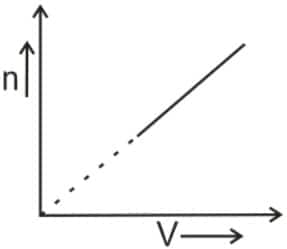
Ques:4 For a given 1 mole of ideal gas kept at 3.5 atm in a container at capacity 4.463 I , the Avagadro proportionality constant for the hypothesis (see figure)
2.46
1.275
4.667
46.67
Answer: 2)1.275
Explanation: According to Avogadro's hypothesis
V∝n
V=n(RT)P
Proportionality constant =RTP
Using PV=nRT
∴Vn=4.46×3.5R=1.275
Hence, the answer is the option (2).
Ques:5 Assertion: The volume of a gas and the number of moles of gas have an inverse relationship, meaning that as the number of moles of gas increases, the volume of the gas will decrease, and vice versa.
Reason: The ratio by volume of gaseous reactants and products is in relation to their mole ratio.
Both assertion and reason are true, and the reason is the correct explanation of the assertion.
Both assertion and reason are true, but the reason is not the correct explanation of the assertion
The assertion is true, but the reason is false.
The assertion is false, but the reason is true.
Answer: 2) Both assertion and reason are true, but the reason is not the correct explanation of the assertion
Explanation: The assertion and reason both are correct and related to each other, but they are not directly dependent on each other. Let's break them down:
Here are some steps to prepare from mole concept neet pyq:
Step 1: Understand the Basics
Know what a mole is and how to change from one unit to another.
Step 2: Practice Problems
Practice many mole concept neet pyq and also refer to mole concept neet MCQ for practice.
Step 3: Use mole concept NEET pyq
Solve mole concept NEET question papers to understand what type of questions are being asked.
Step 4: Watch Video Lessons
Watch videos that define the mole concept in simple terms.
Some common mistakes that need to be avoided when aspirants practice mole concept questions for NEET are:
Confusing Units
Make sure to understand the difference between molarity and molality.
Forgetting Avogadro's Number
Apply it only for particle counting while practising mole concept questions for NEET.
Not Checking for Limiting Reagents
Always observe which chemical is used up first in a reaction.
Preparing for the mole concept NEET 2026 questions becomes easier with the right approach. Consistent practice and smart strategies can help you score well in this topic. Here are some tips to improve your preparation:

On Question asked by student community
Hello Students,
For the NEET UG 2026 Question Paper PDF with Answer Key and Solutions, refer to the article below:
https://medicine.careers360.com/articles/neet-previous-year-question-paper-with-solution
Hello Student,
You can check the resource provided below:
Download NEET Previous 10 Years Question Papers with Solutions PDF
You can also check the NEET 2026 question paper with solutions
Hope this helps!
Hello Chetan,
Here are the links you asked for. I hope they serve your purpose.
Hello Suma,
Here are the links you asked for. I hope they serve your purpose.
Hello Bhanuday,
Here are the links you requested. I hope you find them helpful.
the product 'P' will be ,


| Column A | Column B |
| A |
a) Organisation of cellular contents and further cell growth. |
| B |
b) Leads to formation of two daughter cells. |
| C |
c) Cell grows physically and increase volume proteins,organells. |
| D |
d) synthesis and replication of DNA. |
Match the correct option as per the process shown in the
0.16 g of dibasic acid required 25 ml of decinormal solution for complete neutralisation. The modecular weight of the acid will be
32
64
128
256
0xone is

Ranked #19 by NIRF, NAAC A++ Accredited | Recognized by dental council of India
Special Scholarship for Students from Goa (Get an exclusive scholarship of ₹20,000 if you're a Goa-based student) | Bringing Parul Education Trust's 30-year Education Legacy to Goa
Ranked among the top Dental Colleges for 7 consecutive years by India Today poll