School Of Advanced Engineering, UPES, Dehradun
Ranked #43 among Engineering colleges in India by NIRF | Get Upto 100% Scholarships


Are you considering allied health courses after 12th, or feeling confused about what to pursue if you don’t get into MBBS or BDS? If you are passionate about Biology and want to make a career in the healthcare industry, a career in the allied health space would be a great fit. In this article, firstly, we will discuss why the healthcare sector is booming and why you should consider allied health courses in 2026.
This Story also Contains

In India, students (and especially parents) have been obsessed with Engineering and Medicine for decades. We literally grew up with the belief that these are the only two respectable career paths after Class 12. However, today’s world is way more dynamic.
Students are excelling in data science, finance, entrepreneurship, product management, design, psychology, digital marketing, hospitality, biotechnology, forensic science, food tech, and countless other fields that didn’t even exist two decades ago. This shift proves that career choices have expanded and so should our mindset. Yet, even with this growing awareness, one critical sector that remains undervalued, but with plenty of exciting opportunities, is healthcare careers beyond MBBS (and BDS).
Healthcare has become one of the biggest sectors in India, both in terms of revenue and employment. Apart from hospitals & clinics, allied healthcare comprises diagnostic labs, clinical trials, medical devices, medical equipment, telemedicine, health insurance, and medical tourism.
In 2016, the Indian healthcare sector was valued at INR 9,42,590 crore (USD 110 billion). That figure reached INR 31,87,668 crore (USD 372 billion) in 2023. By 2025, it's estimated to touch the figure of around 638 USD billion. Healthcare spending accounted for 3.3% of India’s GDP in 2022 and is expected to rise to 5% by 2030.

Image Source: IBEF
As of 2025, there are around 70,000 hospitals in India, as per the data from the Ministry of Health and Family Welfare. However, for a country with 1.4 billion plus population, there is still a critical shortage of hospital beds. As of now, we have 0.3 - 1.5 beds per 1,000 population in India.
According to India’s own National Health Policy (NHP) 2017, we need at least 2 hospital beds per 1,000 population. If we look at the WHO recommendation, we should target 3 - 3.5 beds per 1,000 people.
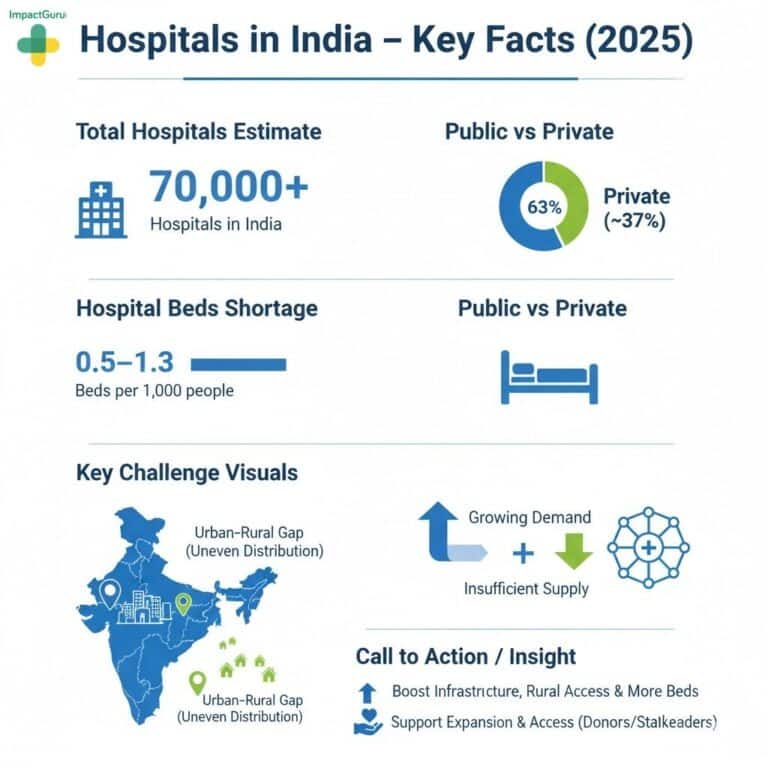
Image Source: ImpactGuru
Additionally, India has got a growing ageing population. So, there is a critical urgency for the healthcare sector to keep growing.
However, among all these, we often fail to realize that the healthcare sector is more than just about doctors. We also need allied and healthcare professionals, including nurses and pharmacists.
In the modern healthcare setup, especially post-COVID, we need a large pool of skilled professionals to work in parallel with doctors and nurses to deliver efficient patient care.
This brings us to one of the biggest career opportunities for students in 2026 - Allied and Healthcare Professions.
Allied and healthcare professionals (AHPs) are trained specialists who support diagnosis, treatment, surgeries, imaging, lab procedures, rehabilitation, and patient care. But, the awareness about allied and healthcare professions (and courses) remains low despite the skyrocketing demand and career opportunities.
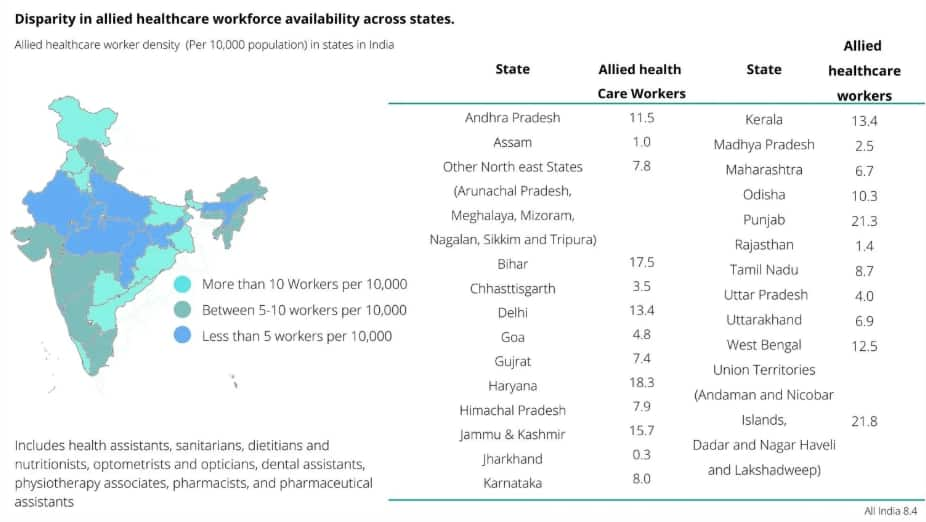
Image Source: Healthcare Executive
At present, India has got 8.4 AHPs per 10,000 population. As per WHO guidelines and other surveys, India needs 14 - 16 AHPs per 10,000 people. The gap is increasing year by year. As per Govt. and other estimates, India will face a shortage of around 6.5 million AHPs by 2030. [Sources: KPMG and BCG]
This means there will be a huge number of jobs for allied and healthcare graduates in:
Hospitals
Clinics
Diagnostic Labs
Rehabilitation Centers
Emergency Care
Medical Technology Companies
Health Startups
Pharmaceutical companies
Compared to MBBS, which takes 5.5 years to complete, most allied and healthcare courses take 2 - 4 years to complete, including both diploma and degree programs. This allows students to:
Enter the job market faster
Spend less
Gain faster clinical experience
Explore specializations sooner
Even top-tier private institutes offer these programs at a much lower cost compared to MBBS or BDS. Ultimately, this makes access to healthcare education much more affordable.
Students can choose from a wide array of options like:
Physiotherapy (BPT)
Dialysis Technology
Emergency & Trauma Care Technology
Respiratory Therapy
Each specialization offers a unique career path and the opportunity to work closely with doctors and patients.
The government has been initiating multiple projects to encourage healthcare education. In 2021, the Govt. introduced the National Commission for Allied and Healthcare Professionals (NCAHP) Act.
This landmark step aims to:
Standardize allied and healthcare education throughout India
Regulate professional standards
Improve employment opportunities
Boost the credibility of allied health careers
The primary objective of the NCAHP Act was to regulate and standardize the education, services, and practice of previously fragmented and unorganized healthcare professionals. So, apart from making the healthcare sector more professional, this Act will also create a huge number of job opportunities for millions of young people.
With such Government backing, 2026 is bound to be a great year to start your allied and healthcare career journey.
GAHET is India’s first national entrance exam for allied and healthcare courses. It has been specifically designed for admission into diploma, undergraduate, and postgraduate courses in paramedical and allied & healthcare courses. Know more about the GAHET exam.
AIMSET is another national-level competitive exam that provides scholarships to students for pursuing medical and allied health courses. It’s a great initiative to break the financial barrier for deserving students. Apart from medical and allied health courses, the scholarship scheme also supports students taking admission into agricultural science, biotechnology, forensic science, B.Pharm, etc.
So, as you can see, there is tremendous demand and opportunities in this sector. Hence, it would be only wise to grab this chance with both hands by using your passion for biology and healthcare. This will be a smart move in 2026 and beyond. High demand, shorter duration, affordable education, diverse specializations, and direct patient care make these courses ideal for significant social impact and job satisfaction.

Ranked #43 among Engineering colleges in India by NIRF | Get Upto 100% Scholarships
NEET PG All India & State College Predictor with Admission Process Guide
End-to-End NEET PG Admission Guidance | One-to-One Counselling | College Predictors | Regular Updates | E-books
Ranked #19 by NIRF, NAAC A++ Accredited | Recognized by dental council of India
NAAC A+ Accredited| Ranked #24 in University Category by NIRF
Established in 1993, with a focus on Homoeopathy and Health Sciences | Offers programmes in Homoeopathy and allied health-related disciplines