
Search Colleges, Exams, Schools & more


Login
Comparison between Turgor Pressure and Wall Pressure MCQ - Practice Questions with Answers
Edited By admin | Updated on Sep 18, 2023 18:34 AM | #NEET
Quick Facts
-

8 Questions around this concept.
Solve by difficulty
 EASY
EASYWhen a cell is plasmolysed, it becomes.
Concepts Covered - 0
Turgor Pressure and Wall Pressure
- A filled vacuole provides a rigid structure to the plant cell.
- An empty vacuole causes the cell walls to shrink and pull away from the neighbouring cells. This causes the droopy appearance of the wilted plants.
- When a plant cell is placed in a pure solvent, endosmosis occurs due to the higher osmotic pressure of the cell sap.
- This causes an increase in the size of the vacuole.
- The increased vacuole begins to pressurise the protoplasm.
- This pressure with which the cell sap of the vacuole presses the protoplasm against the cell wall is called turgor pressure.
- Hence, turgor pressure is responsible for pushing the cell membrane against the cell wall.
- The cell wall is rigid. It also exerts equal and opposite pressure on the protoplasm.
- This pressure exerted by the cell wall on the protoplasm is called wall pressure.
- The turgor pressure and wall pressure are equal and opposite in direction.
- At any given moment, turgor pressure is equal to the wall pressure and the cell is in equilibrium.
- When cells are placed in an isotonic solution, water does not flow within or outside.
- Such cells are called flaccid cells.
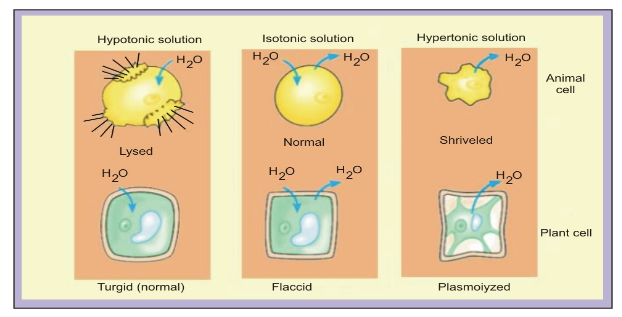
Important Tips:
- In a plasmolysed cell, Turgor pressure is zero.
- In a turgid cell turgor pressure is equal to osmotic pressure.
- Turgor pressure and wall pressure are absent in animal cells.
"Stay in the loop. Receive exam news, study resources, and expert advice!"
Get Answer to all your questions

Begin a career in Medical and Allied Sciences. Admissions Open for
Recognized as Category 1 University by UGC | Accredited with A+ Grade by NAAC | Scholarships available
Amity University Noida | Allied Health Sciences Admissions
ApplyRanked as India’s #1 Not for profit pvt. University by India Today
KCDSH- Krishnadevaraya Dental College & Sciences Admis 2026
ApplyRanked among the top Dental Colleges for 7 consecutive years by India Today poll
Max Institute of Allied and Paramedical Education (MIAPE)
ApplyGet Started With Your Healthcare Career. 2026 Admissions open.
Emversity Allied Health Programs
ApplyGet Job Ready in Healthcare | Employability-Focused Programs
Virohan Allied & Healthcare Programs
ApplyAllied & Healthcare programs | 20+ Partner Universities & Institutes | 98% placement record