
Search Colleges, Exams, Schools & more


Login
Hexose Monophosphate Shunt Pathway MCQ - Practice Questions with Answers
Edited By admin | Updated on Sep 18, 2023 18:34 AM | #NEET
Quick Facts
-

9 Questions around this concept.
Solve by difficulty
 EASY
EASYThe enzyme which converts 6-phosphogluconolactone to 6-phosphogluconate is
Concepts Covered - 0
Pentose Phosphate Pathway or Hexose Monophosphate Shunt
- It was discovered by Warburg, Lipman, and Dickens.
- It is a metabolic pathway parallel to glycolysis.
- It breaks down glucose-6-phosphate into NADPH and pentoses (5-carbon sugars) for use in downstream biological processes.
- It is important for red blood cells.
- It occurs in the cytoplasm.
- There are two distinct phases in the pathway: the oxidative phase and the non-oxidative phase.
- The first is the oxidative phase in which glucose-6-phosphate is converted to ribulose-5-phosphate.
- During this process, two molecules of NADP+ are reduced to NADPH. The overall reaction for this process is:

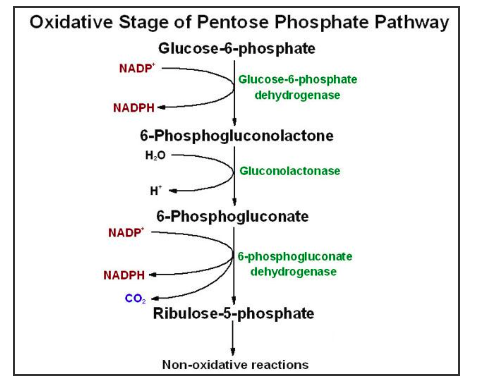
- The second phase of this pathway is the non-oxidative synthesis of 5-carbon sugars.
- The PPP is one of the three main ways the body creates molecules with reducing power, accounting for approximately 60% of NADPH production in humans.
- While the PPP does involve the oxidation of glucose, its primary role is anabolic rather than catabolic, using the energy stored in NADPH to synthesize large, complex molecules from small precursors.
- Additionally, NADPH can be used by cells to prevent oxidative stress.
- For example, erythrocytes generate a large amount of NADPH through the pentose phosphate pathway to use in the reduction of glutathione.
- This pathway generates 3, 4, 5, 6, and 7 carbon compounds which are precursors for the biosynthesis of other molecules. For Eg, nucleotides are synthesized from ribose-5-phosphate.
- Resistance to malaria in some Africans are associated with a deficiency of glucose-6-phosphate dehydrogenase enzyme because malarial parasites depend upon HMP shunt to reduce glutathione in RBCs.
"Stay in the loop. Receive exam news, study resources, and expert advice!"
Get Answer to all your questions
NEET Articles

Applications for Admissions are open.
Ranked #19 by NIRF, NAAC A++ Accredited | Recognized by dental council of India
Parul University, Goa
ApplySpecial Scholarship for Students from Goa (Get an exclusive scholarship of ₹20,000 if you're a Goa-based student) | Bringing Parul Education Trust's 30-year Education Legacy to Goa
Krishnadevaraya College of Dental Sciences and Hospital, Bangalore
ApplyRanked among the top Dental Colleges for 7 consecutive years by India Today poll