


- Home
- Study Material
- Moment Of Inertia Of The Solid Cylinder MCQ - Practice Questions with Answers
Quick Facts
-

5 Questions around this concept.
Solve by difficulty
 MEDIUM
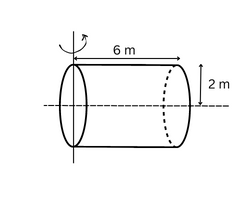
The moment of inertia of a uniform cylinder of length 6m and radius 2m about an axis perpendicular to its plane and passing through one of its ends is given by - [given mass of cylinder is 1kg]
Concepts Covered - 1
Let I= Moment of inertia of the CYLINDER about an axis through its center
To calculate I
Consider a cylinder of mass M, radius R, and length L.
mass per unit volume of the cylinder $\rho=\frac{M}{V}=\frac{M}{\pi R^2 L}$

Imagine that the cylinder is made of a large number of coaxial cylindrical shells
Take a small elemental cylindrical shell of mass dm having internal radius x and external radius (x + dx).
So for that elemental cylindrical shell $d V=(2 \pi x d x) L$
And
$$
d m=\rho d V=\frac{M}{\pi R^2 L}(2 \pi x d x) L
$$
$$
\Rightarrow d I=x^2 d m
$$
Now integrate this dI between the limits x=0 to x=R
$\begin{aligned} & I=\int d I=\int x^2 * \rho d v \\ & =\int_0^R \frac{M}{\pi R^2 L}\left(2 \pi * L x^3 d x\right) \\ & =\frac{2 M}{R^2} \int_0^R x^3 d x=\frac{M R^2}{2}\end{aligned}$
Study other Related Concepts
Moment Of Inertia Of The Solid Cylinder Current Topic
"Stay in the loop. Receive exam news, study resources, and expert advice!"
Get Answer to all your questions
Explore on Careers360
JEE Main
RPVT
Colleges By Branches
Colleges By Exam
Colleges By Branch
Colleges By Exams
Colleges By Ownership
Colleges By State
Colleges By Exams
Colleges By Degree
Colleges by State
Colleges by City
Colleges by State
Universities by Branches
By State
Colleges by City
Colleges by State
By State
BE/B.Tech
Diploma
MBA Specialization Colleges
Student Community: Where Questions Find Answers