
Search Colleges, Exams, Schools & more


Login
NEET OverviewNEET 2026NEET Exam PatternNEET SyllabusNEET Admit CardNEET ResultNEET CounsellingNEET Cutoff
NEET PG 2026NEET PG Exam DateNEET PG Exam PatternNEET PG SyllabusNEET PG Admit CardNEET PG ResultNEET PG CutoffNEET PG Counselling
NEET MDS 2026NEET MDS Application FormNEET MDS Exam PatternNEET MDS Admit CardNEET MDS ResultNEET MDS CounsellingNEET MDS Cutoff
AIAPGET 2026AIAPGET Application FormAIAPGET SyllabusAIAPGET Admit CardAIAPGET ResultAIAPGET CounsellingAIAPGET Cutoff
Top Allied & Paramedical Colleges in IndiaMedical Colleges in IndiaMedical Colleges in DelhiMedical Colleges in PuneMedical Colleges in BangaloreMedical Colleges in ChennaiMedical Colleges in KeralaMedical Colleges in Uttar PradeshMedical Colleges in Mumbai
MBBS Colleges in IndiaBDS Colleges in IndiaBAMS Colleges in IndiaPhysiotherapy Colleges in IndiaMD Colleges in IndiaMS Colleges in IndiaMDS Colleges in India
Medical Colleges Accepting NEETMedical Colleges Accepting NEET PGMedical Colleges Accepting NEET MDS
- Home
- Study Material
- Salivary Glands MCQ - Practice Questions with Answers
Quick Facts
-

24 Questions around this concept.
Solve by difficulty
 EASY
EASYThe submandibular glands are a type of salivary glands which are located
Largest salivary gland is
The pH of saliva is maintained at
Concepts Covered - 0
Salivary Glands
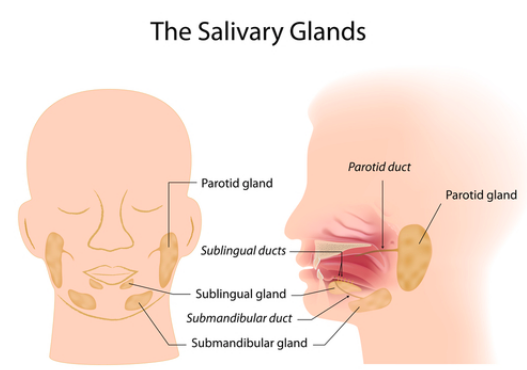
- There are three pairs of major salivary glands, which secrete the majority of saliva into ducts that open into the mouth:
Parotid Gland:
- It is the largest salivary gland.
- It lies on the sides of the face, just in front of the ear.
- It secretes saliva into the mouth through the parotid duct or Stenson’s duct, which is located near the second upper molar tooth.
- Stenson’s duct is 5 cm long.
- It is flattened yellowish salivary gland.
- It is predominantly a serous gland, secreting watery fluid with the enzyme ptyalin.
- Inflammation of the parotid glands is called mumps.
- It secretes 25% saliva.
Sublingual Gland:
- It is present under the front part of the tongue.
- The sublingual duct is known as duct of Rivinus.
- It is the smallest salivary gland.
- It is narrow, flat and almond-shaped.
- It is predominantly mucus-secreting.
- It secretes a very small amount of ptyalin.
- It secretes 5% saliva.
Submandibular Gland:
- It lies at the angle of the lower jaw.
- It secretes saliva into the mouth through the submandibular duct or Wharton’s duct.
- It is shaped like a walnut.
- It is predominantly serous gland.
- It secretes 70% saliva
Salivation
- The secretion of salivary glands is called saliva.
- The secretion of saliva is called salivation.
- Saliva is essentially (95.5 per cent) water.
- The remaining 4.5 per cent is a complex mixture of ions, glycoproteins, enzymes, growth factors, and waste products.
- The most important ingredient in saliva from the perspective of digestion is the enzyme salivary amylase, also called ptyalin, which initiates the breakdown of carbohydrates.
- Bicarbonate and phosphate ions function as chemical buffers, maintaining saliva at a pH between 6.85 and 7.4.
- Salivary mucus helps lubricate food, facilitating movement in the mouth, bolus formation, and swallowing.
- Saliva contains immunoglobulin A, which prevents microbes from penetrating the epithelium, and lysozyme, which makes saliva antimicrobial.
Regulation of Salivation:
- The sympathetic nervous system reduces salivation
- The parasympathetic nervous system increases salivation
- Chloride ions are also responsible for salivation
TIP
- Paralysis of the facial nerve or the Bell’s palsy causes permanent hyposalivation.
- Xerostomia is the condition of dry mouth resulting due to hyposalivation.
- Sialolithiasis is the obstruction in the salivary ducts.
- Drooling is the uncontrolled flow of saliva outside the mouth.
- Sjogren’s disease is an autoimmune disorder of the destruction of Salivary Glands
NOTE : Parotid is the largest Salivary gland but maximum amount of Saliva is by the Submandibular gland.
Study other Related Concepts
Salivary Glands Current Topic
"Stay in the loop. Receive exam news, study resources, and expert advice!"
Get Answer to all your questions
Explore on Careers360
JEE Main
RPVT
Colleges By Branches
Colleges By Exam
Colleges By Branch
Colleges By Exams
Colleges By Ownership
Colleges By State
Colleges By Exams
Colleges By Degree
Colleges by State
Colleges by City
Colleges by State
Universities by Branches
By State
Colleges by City
Colleges by State
By State
BE/B.Tech
Diploma
MBA Specialization Colleges
Student Community: Where Questions Find Answers