KCC Institute of Legal and Higher Education, Greater Noida
Law Admissions 2026 Open | Avail Merit-Based Scholarships


Because there are so many exceptions and so few generally-accepted laws or principles, Biology is known as the "science of exceptions”. This leads students to memorise things blindly – names of species, definitions, classifications, – rather than break down the concept. Because of this, Biology has a reputation for being the most difficult and tedious of the sciences. The difficult vocabulary doesn’t help either.
This Story also Contains

However, since Biology is the study of life, it is also a fascinating and very visual subject. It concerns everything surrounding us, including the human body. To make Biology more engaging and intellectually stimulating, we need to reevaluate how we learn it.
One way to do it is to break the subject up into smaller parts. This will also help answer “short answer questions” in exams but more importantly, enable a clearer grasp of the subject.
Learning various scientific terminologies, such as species names and classifications, is the most frequent cause of people finding biology boring.
Almost all biological terms have their roots in Latin or Greek. You can decipher the meaning of the names if you break down complex words to find their roots. You will eventually discover that learning them is more enjoyable and easier.
For example,
Meaning of biology: "Bio" or "Bios" refers to "life," and "logy" denotes a "branch of study." Consequently, "Biology" means the "study of life."
Mangifera Indica: "Mangifera" is a combination of the local names for the fruit "manga" and the Latin verb "fero," which means "I carry or bear." "Indica" means "of India." The different varieties of mango fruit from India and collectively referred to as "mango" are classified as Mangifera indica.
Epidermis, Hypodermis: "Epi" is “over” or “on” and in Biology, denotes “outermost”; "hypo" denotes “under” or “beneath” and "dermis" is skin. The top layer of the skin is epidermis and the bottom layer, hypodermis.
When you come across such terms, you should have flashcards ready with the terms and their definitions on opposite sides.
Learning from flashcards can be very effective when they’re used correctly. They provide visual cues that make connecting with the biological terminology easier.
Each flashcard should contain a single question and response.
See if you can derive the question from the answer. This will help you answer even if the question is framed differently.
Using images will be more beneficial.
Law Admissions 2026 Open | Avail Merit-Based Scholarships
BBA/MBA/PGDM Early Bird Applications Deadline 19th Oct '26. Apply now using coupon code CAREER250 and get ₹250 off the application fee
Maurice Wilkins and Rosalind Franklin | Obtained DNA images from X-ray crystallography |
James Watson and Francis crick | Proposed the double helix model of DNA in 1953 |
Erwin Chargaff | Elucidated that the DNA contains an equal amount of adenine and thymine and in the same way guanine and cytosine |
This handout lists the fundamental categories of mnemonics, including chunking, note organisation, music, name, expression or word, model, ode or rhyme, and spelling mnemonics.
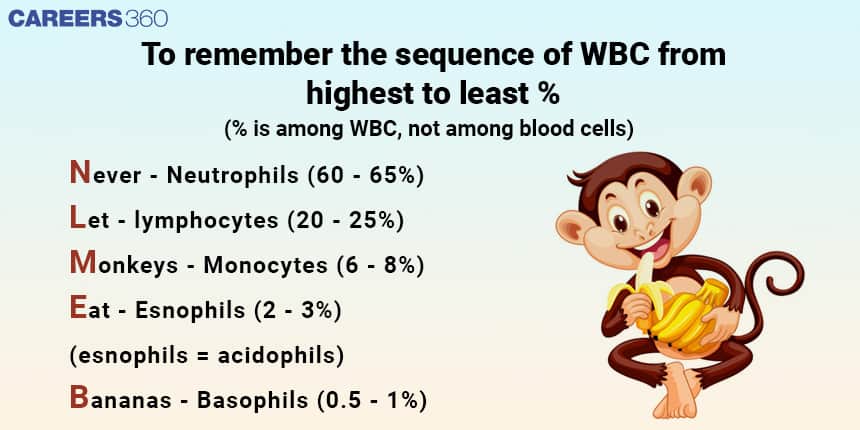
Mnemonics are short phrases that act as codes for information that needs to be remembered.
Here are some examples:
Taxonomic order
Kings Play Cards On Fat Green Stool
– Kings – Kingdom
– Play – Phylum
– Cards – Class
– On – Order
– Fat – Family
– Green – Genus
– Stools – Species
Examples Of Phylum Annelida
Hero phere ka time nahi tha
– Hero – Hirudinaria
– Phere ke time – Pheretima
– Nahi – Nereis
As this example shows, a mnemonic doesn’t have to be in the same language of the text or the medium of instruction. You can have one in the language you speak at home.
You can make up your own rhymes to help you remember the items in a list or sequence.
"Dear King Phillip Came Over For Good Soup" is another rhyme that can be used to remember the order of Taxa in Biology -
Making up your own mnemonic is a smart move. However, many of them can also be found on various websites.
Chunking is breaking and putting things together to remember
Each individual "chunk" is made up of a collection of data points, such as words, numbers, or phrases, that are closely related to one another but not particularly connected to data in other groups. Therefore, grouping related pieces of information together is referred to as "chunking," which effectively lowers the number of "things" you need to remember.
For example, Biological classification, in which related species are grouped under a certain genus or phylum.
An acronym is a word made from the first letter of a collection of words or names. For instance:
Parts of the male reproductive system
SEVEN UP
S – Seminiferous tubule
E – Epididymis
V – Vas deferens
E – Ejaculatory duct
U – Urethra
P – Penis
Short answer type questions assess the basic knowledge and understanding of the topic. Readymade mnemonics and flashcards are available for most topics at different sites, but by preparing your own, you remember things for the long term.


Law Admissions 2026 Open | Avail Merit-Based Scholarships
BBA/MBA/PGDM Early Bird Applications Deadline 19th Oct '26. Apply now using coupon code CAREER250 and get ₹250 off the application fee
Ranked #36 amongst institutions in Management by NIRF | 100% Placement
Globally Recognized by AACSB (US) & AMBA (UK) | 18 LPA Avg. CTC for PGPM 2026
Leading Design College | 95% Placement Record | Merit-cum-Means Scholarships for Deserving Students
NEET PG All India & State College Predictor with Admission Process Guide