
Search Colleges, Exams, Schools & more


Login
Calorimetry Principle MCQ - Practice Questions with Answers
Edited By admin | Updated on Sep 25, 2023 25:23 PM | #NEET
Quick Facts
-

12 Questions around this concept.
Solve by difficulty
 MEDIUM
An experiment takes 10 minutes to raise the temperature of water in a container from 00C to 1000C and another 55 minutes to convert it totally into steam by a heater supplying heat at a uniform rate. Neglecting the specific heat of the container and taking the specific heat of the water to be 1 cal/g 0C, the heat of vapourization according to this experiment will come out to be :
Equal masses of two substances of densities and
are mixed. The density of the mixture would be
Equal volumes of two substances of densities and
are mixed. The density of the mixture would be
New: NEET 2026 city intimation slip out; Download here
NEET 2026: Exam Centres List | Free NEET Coaching & Study Material
NEET Prep: Mock Test | 10 Years PYQ's | Syllabus
NEET 2026: Boards Cheat Sheet | Mind Maps & Diagrams Guide | Formula Sheet
of
at
is mixed with
of
at
. The temperature of the mixture is -
Concepts Covered - 1
Principle of calorimetry
Principle of Calorimetry -
Calorimetry means 'measurement of heat'.
When two bodies (both being liquid or one being solid and other liquid) at different temperatures are mixed or come in contact, heat will be transferred from a body at a higher temperature to a body at a lower temperature till both acquire the same temperature. The body at a lower temperature absorbs heat while body at a higher temperature releases it.
The principle of calorimetry represents the law of conservation of heat energy.
The temperature of the mixture always lies between the temperature of the liquid having lowest temperature and the temperature of the liquid having highest temperature.
Mixing of two substances when the temperature changes only. It means no phase change. Suppose two substances have masses
$$
\begin{aligned}
& \text { Hence, Heat lost }=\text { Heat gained } \\
& \Rightarrow m_1 c_1\left(\theta_1-\theta_{\max }\right)=m_2 c_2\left(\theta_{\text {mix }}-\theta_2\right) \\
& \theta_{\max }=\frac{m_1 c_1 \theta_1+m_2 c_2 \theta_2}{m_1 c_1+m_2 c_2}
\end{aligned}
$$
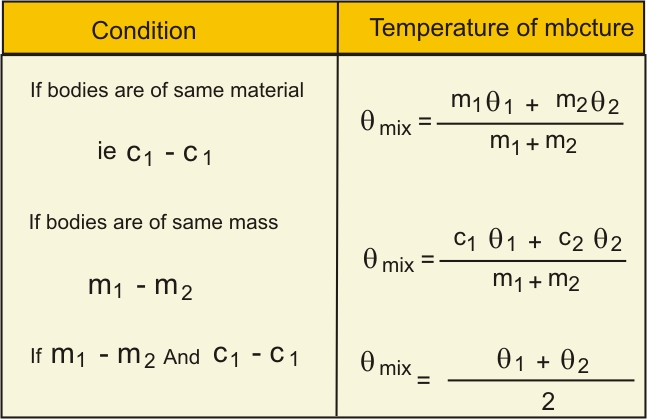
Similarly, we can derive formulas for different cases. The different cases and its result is mentioned in the table given below -
Study it with Videos
"Stay in the loop. Receive exam news, study resources, and expert advice!"
Books
Reference Books
Clear your Basics with NCERT
E-books & Sample Papers
Get Answer to all your questions

Begin a career in Medical and Allied Sciences. Admissions Open for
Get Job Ready in Healthcare | Employability-Focused Programs
MAHE Manipal BSc Nursing 2026
ApplyLast Date to Apply: 26th April | NAAC A++ Accredited | NIRF Rank #3
Virohan Allied & Healthcare Programs
ApplyAllied & Healthcare programs | 20+ Partner Universities & Institutes | 98% placement record
Amity University Noida | Allied Health Sciences Admissions
ApplyRanked as India’s #1 Not for profit pvt. University by India Today
SCSVMV Deemed to be University | AHA Admissions 2026
ApplyAlied Health Sciences at SCSVMV | NAAC 'A' Grade | AICTE & UGC Aproved | 100% Placement Support | Merit-based Scholarships
RV University Allied & Healthcare Admissions 2026
ApplyIndustry-Relevant Programmes with Clinical Excellence. Merit-based scholarships available