 MEDIUM
MAHE Manipal BSc Nursing 2026
Last Date to Apply: 26th April | NAAC A++ Accredited | NIRF Rank #3


Moment of inertia is considered one the most difficult concept.

14 Questions around this concept.
Three identical spherical shells, each of mass m and radius r are placed as shown in the figure. Consider an axis XX' which is touching two shells and passing through the diameter of the third shell.
The moment of inertia of the system consisting of these three spherical shells about XX' axis is :

Point masses $m_1$ and $m_2$ are placed at the opposite ends of a rigid rod of length $L$, and negligible mass. The rod is to be set rotating about an axis perpendicular to it. The position of point $P$ on this rod through which the axis should pass so that the work required to set the rod rotating with angular velocity $\omega_0$ is minimum, is given by :
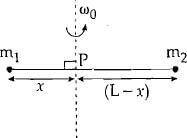
A light rod of length $l$ has two masses $m_1$ and $m_2$ attached to its two ends. The moment of inertia of the system about an axis perpendicular to the rod and passing through the centre of mass is:
New: NEET 2026 city intimation slip out; Download here
NEET 2026: Exam Centres List | Free NEET Coaching & Study Material
NEET Prep: Mock Test | 10 Years PYQ's | Syllabus
NEET 2026: Boards Cheat Sheet | Mind Maps & Diagrams Guide | Formula Sheet
The ratio of the dimensions of Plank's constant and that of the moment of inertia is the dimension of :
Two point masses, m and 2m, are joined by a light rod of length d. The moment of inertia of the system about an axis passing through its centre of mass and making an angle 30° with the light rod will be
A wheel of mass has a moment of inertia of
about its own. axis. Its radius of gyration will be -
In a crude model of a rotating diatomic molecule of chlorine, the two chlorine atoms are $2 \times 10^{-10} \mathrm{~m}$ apart and rotate about their|center of mass with angular speed $w=2 \times 10^{12} \mathrm{rad} / \mathrm{s}$. What is the rotational kinetic energy of one molecule of $\mathrm{Cl}_2$ which has a molar mass of $70 \mathrm{~g} / \mathrm{mol}$ ?

The triangular plate $ABC$ is shown in the figure.
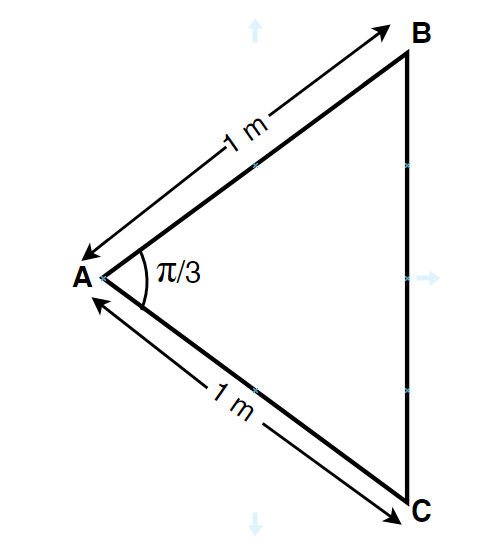
Its mass is ' 1 kg ' and its equal sides are given ass ' 1 m '. If the angle $A$ is $\frac{\pi}{3}$ then its moment of inertia about an axis passing through $A$ and perpendicular to the plane of the plate will be_____.
How does water always behave, in terms of water potential?
Definition
Moment of inertia (I) of a body is a measure of its ability to resist change in its rotational state of motion.
Moment of inertia plays the same role in rotatory motion as is played by mass in translatory motion.
Formula
Moment of inertia of a particle
$I=m r^2$
Where m is the mass of the particle and r is the perpendicular distance of the particle from the rotational axis.
Moment of inertia for system of particle
$\begin{aligned} I & =m_1 r_1^2+m_2 r_2^2+\ldots \ldots \ldots m_n r_n^2 \\ & =\sum_{i=1}^n m_i r_i^2\end{aligned}$
(This is Applied when masses are placed discreetly)
Moment of inertia for continuous body
$I=\int r^2 d m$
Where r is the perpendicular distance of a particle of mass dm of a rigid body from the axis of rotation
Dimension = $\left[M L^2\right]$
S.I. unit = $k g-m^2$
It depends on mass, distribution of mass, and on the position of the axis of rotation.
It does not depend on angular velocity, angular acceleration, torque, angular momentum, and rotational kinetic energy.
It is a tensor quantity.
Radius of gyration (K)-
Radius of the Gyration of a body about an axis is the effective distance from the axis where the whole mass can be assumed to be concentrated so that the moment of inertia remains the same.
Formula-
$$
K=\sqrt{\frac{I}{M}}
$$
or, $I=M K^2$
It does not depend on the mass of body
It depends on the shape and size of the body, distribution of mass of the body w.r.t. the axis of rotation, etc.
Dimension- $M^o L^1 T^o$
S.I. unit: Meter.
"Stay in the loop. Receive exam news, study resources, and expert advice!"

Get Job Ready in Healthcare | Employability-Focused Programs
Last Date to Apply: 26th April | NAAC A++ Accredited | NIRF Rank #3
Allied & Healthcare programs | 20+ Partner Universities & Institutes | 98% placement record
Ranked as India’s #1 Not for profit pvt. University by India Today
Alied Health Sciences at SCSVMV | NAAC 'A' Grade | AICTE & UGC Aproved | 100% Placement Support | Merit-based Scholarships
Industry-Relevant Programmes with Clinical Excellence. Merit-based scholarships available