
Search Colleges, Exams, Schools & more


Login
Multiple Alleles MCQ - Practice Questions with Answers
Edited By admin | Updated on Sep 18, 2023 18:34 AM | #NEET
Quick Facts
-

15 Questions around this concept.
Solve by difficulty
 EASY
EASYMultiple alleles are present:
Concepts Covered - 1
Multiple Alleles
- Mendel implied that only two alleles, one dominant and one recessive, could exist for a given gene. We now know that this is an oversimplification.
- Although individual humans (and all diploid organisms) can only have two alleles for a given gene, multiple alleles may exist at the population level.
- Therefore, many combinations of two alleles are observed.
- The example of ABO blood grouping also provides a good example of multiple alleles.
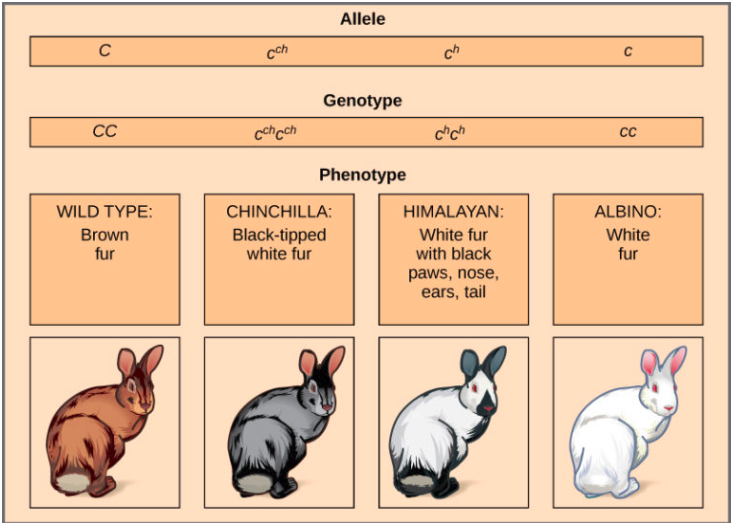
- Another example of multiple alleles is coat color in rabbits.
- Here, four alleles exist for the c gene.
- The wild-type version, C+C+, is expressed as brown fur. The chinchilla phenotype, cchcch, is expressed as black-tipped white fur. The Himalayan phenotype, chch, has black fur on the extremities and white fur elsewhere. Finally, the albino, or “colorless” phenotype, cc, is expressed as white fur.
Study it with Videos
"Stay in the loop. Receive exam news, study resources, and expert advice!"