School Of Advanced Engineering, UPES, Dehradun
Ranked #43 among Engineering colleges in India by NIRF | Get Upto 100% Scholarships


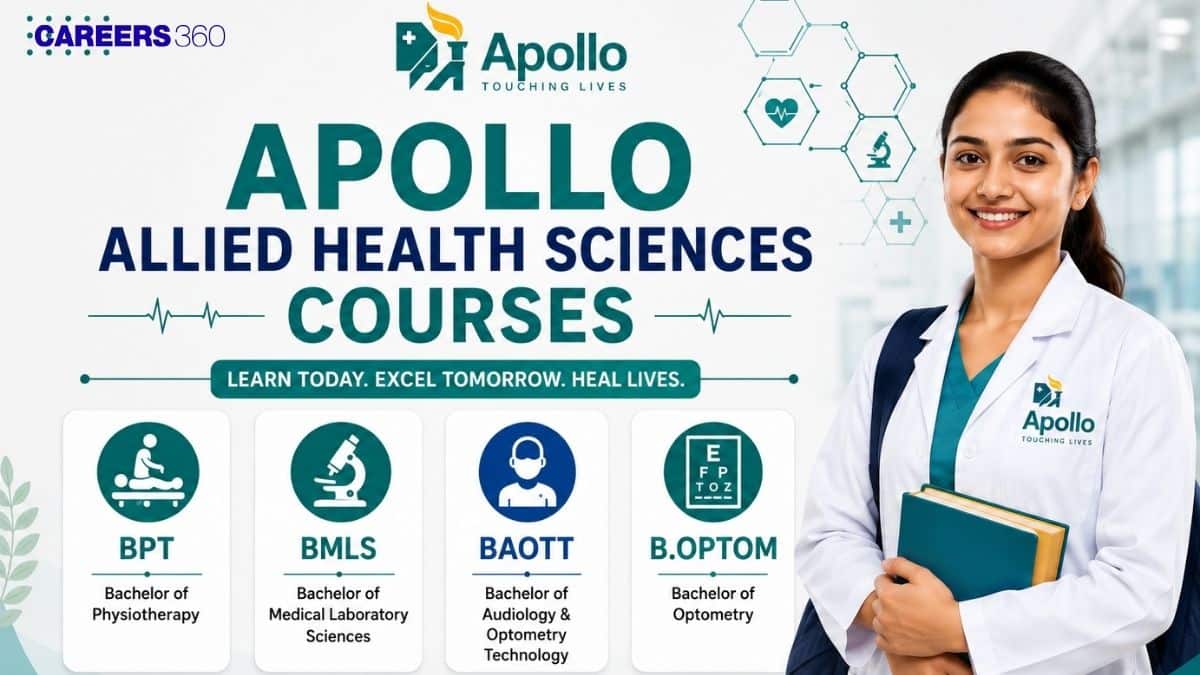
Not everyone wants to go the MBBS or nursing route, and honestly, healthcare needs way more than just doctors and nurses to function. That's where Apollo Healthcare Academy comes in. Backed by 40+ years of the Apollo Hospitals legacy, it runs a set of B.Sc. Allied Health Sciences programmes built around real hospital exposure, not just textbooks. If you're checking out Apollo Allied Health Sciences Courses 2026, here's the real breakdown: what's actually on offer, what you'll be studying, and where it can realistically take you once you're done.
This Story also Contains
Quick snapshot before we dig into specifics:
Apollo currently runs 10+ B.Sc. Allied Health programmes across different clinical specialisations
Degrees are awarded by partner universities, not by Apollo Healthcare Academy directly, and are subject to NCAHP recognition wherever applicable
Programmes typically follow a B.Sc. degree structure, generally completed over 12th pass plus a few years of undergraduate study
60% of the training happens inside actual hospitals, within the Apollo Hospitals ecosystem, so it's not a classroom-only experience
Every course includes a 100% paid internship in the final year
There's 100% placement assistance through a dedicated placement cell once you graduate
Course Name | Degree Awarded | What to Expect |
Anaesthesia and Operation Theatre Technology | Awarded by partner university; check official site for exact duration and eligibility | |
Dialysis Therapy Technology | Bachelor of Dialysis Therapy Technology | Awarded by partner university |
Respiratory Therapy | Awarded by partner university | |
Medical Laboratory Science | Bachelor of Medical Laboratory Science (BSc MLT) | Awarded by partner university |
Optometry | Bachelor of Optometry | Awarded by partner university |
Physician Associates | Bachelor of Physician Associates | Awarded by partner university |
Physiotherapy | Bachelor of Physiotherapy (BPT) | Awarded by partner university |
Critical Care Technology | Bachelor of Critical Care Technology | Awarded by partner university |
Emergency Medical Technologist | Bachelor of Emergency Medical Technologist | Awarded by partner university |
Cardiovascular Technology | Bachelor of Cardiovascular Technology (BSc CVT) | Awarded by partner university |
Generally, these are undergraduate degrees open to Class 12 pass students, mostly from the Science stream, but for the exact number of years and marks cut-off for your specific course, it's best to check directly with the admissions team or the official website.
Anaesthesia and Operation Theatre Technology: This one puts you right in the operation theatre, learning how to assist anaesthetists and surgeons; think sterilisation, equipment handling, and OT protocols.
Dialysis Therapy Technology: In BSc DDT course, you will learn how dialysis machines actually work, and how to support patients going through kidney treatment. It's a pretty niche skill, honestly, but that's exactly why it's in demand- kidney issues aren't exactly getting rarer these days. Most people who finish this course end up working as dialysis technicians, either in hospitals or in centres that specialise just in dialysis care.
Respiratory Therapy: This one's all about helping patients who are struggling to breathe- lung issues, ventilator support, running respiratory diagnostics, that kind of thing. Honestly, after COVID, nobody needs convincing about why this field matters anymore. It just became obvious.
Medical Laboratory Science: Here it's all about diagnostics; running lab tests, analysing samples, working with pathology and biochemistry. It's the science-heavy option for students who like precision work. Most graduates step into medical laboratory technologist roles in hospitals and diagnostic labs.
Optometry: This one's built around understanding the eye- how it's structured, how to run vision tests, and how to fix visual problems using lenses and a few basic procedures. B.Optom graduates typically work as optometrists in hospitals, eye clinics, or optical chains.
Physician Associates: A relatively newer, fast-growing programme where you learn to support physicians directly: patient assessment, diagnosis support, and treatment planning under supervision. It's built for students who want a role close to clinical decision-making.
Physiotherapy: Basically, you're learning how to get people moving again after something's gone wrong — an injury, a surgery, whatever it is. Lots of exercises, rehab techniques, and honestly, a ton of direct patient contact. It's not a sit-back-and-watch kind of course. Most people who finish this end up working as physiotherapists, either in hospitals, dedicated rehab centres, or even sports clinics if that's more your thing.
Critical Care Technology: You're trained to support patients in ICUs- monitoring vitals, managing critical equipment, and assisting during emergencies. It's intense, but it's one of the more essential roles in any hospital. Most graduates become critical care technologists in ICU settings.
Emergency Medical Technologist: BSc EMT course prepares you for the fast-paced world of emergency response- first aid, ambulance care, and stabilising patients before they reach the hospital. If you like working under pressure, this fits well.
Cardiovascular Technology: Career paths usually lead to cardiac care technician roles in hospitals and specialised cardiac centres.
Once you're through, there's genuinely a wide range of places you can land:
Hospitals- Apollo Hospitals and other multi-speciality hospitals hire across nearly every one of these specialisations
ICUs and critical care units- a natural fit for critical care and respiratory therapy graduates
Diagnostic and pathology labs- where MLS and cardiovascular technology graduates often start out
Eye-care chains and optical clinics- the go-to path for optometry graduates
Ambulance and emergency services- where EMT graduates put their training to direct use
Dialysis and speciality treatment centres- a growing space for dialysis therapy graduates
Operation theatres- where AOTT graduates support surgical teams daily
Since 60% of your training already happens inside real hospitals, most students walk into these roles with actual clinical experience already under their belt- not just a degree on paper.
Frequently Asked Questions (FAQs)
The partner university awards the degree, not Apollo Healthcare Academy directly. It's also subject to NCAHP recognition where applicable, so it's worth checking for your specific programme.
Nothing too crazy, just clear Class 12, and the Science stream is what most students come in with. But here's the thing: don't just assume every course has the same cutoff or subject requirement, because they don't always. Call up Apollo's admissions folks and just ask directly instead of guessing.
No, it's genuinely hands-on. We're talking 60% of your time actually inside hospitals, real Apollo hospitals, real patients, real situations. It's not one of those courses where you learn everything from a textbook and hope it translates later.
They pay you, yeah. Your final year internship isn't free labor; you're earning while you're learning, which honestly isn't that common in a lot of similar programmes out there.
Depends completely on what you pick. Could be a medical lab technologist, a physiotherapist, respiratory therapist, cardiac care tech, optometrist, or even an EMT. Most of these jobs land you in hospitals, diagnostic labs, or specialised care centres.


Ranked #43 among Engineering colleges in India by NIRF | Get Upto 100% Scholarships
NEET PG All India & State College Predictor with Admission Process Guide
End-to-End NEET PG Admission Guidance | One-to-One Counselling | College Predictors | Regular Updates | E-books
Ranked #19 by NIRF, NAAC A++ Accredited | Recognized by dental council of India
NAAC A+ Accredited| Ranked #24 in University Category by NIRF
Special Scholarship for Students from Goa (Get an exclusive scholarship of ₹20,000 if you're a Goa-based student) | Bringing Parul Education Trust's 30-year Education Legacy to Goa