Emversity Allied Health Programs
Get Job Ready in Healthcare | Employability-Focused Programs


The National Testing Agency (NTA) conducted the National Eligibility cum Entrance Test (NEET) for the 2024 session on May 5, 2024. The paper was conducted in pen and paper mode. More than 24 lakh students registered for NEET UG 2024 examination. The NEET 2024 result was announced on June 4, 2024 at the NEET official website: exams.nta.ac.in/NEET. With the declaration of result, there were reports of NEET question paper leak from few locations. Seeking clarity on the issue, a seven-member high-level committee was constituted, which submitted the NTA report on NEET. Read the article to get more insights on the NTA report on NEET 2025.
This Story also Contains
The report submitted by the committee aims to reform the National Common Entrance Testing system to get clarity on the below mentioned points.
Ensuring fairness, transparency and efficiency.
Addressing security vulnerabilities and preventing malpractices.
Making the process student-friendly and inclusive.
Leveraging technology for modernization.
Get expert advice on college selection, admission chances, and career path in a personalized counselling session.
The Department of Higher Education of Union Ministry of Education constituted a Committee of experts which was given the responsibility to focus on specific issues and provide suggestions or solutions on those areas which included:
Reform in mechanism of the examination process
Improvement in data security protocols
Structure & functioning of National Testing Agency
Get Job Ready in Healthcare | Employability-Focused Programs
After hearing the suggestions on the above mentioned points, it was unclear whether the integrity of NEET 2024 exam was violated or not. Therefore, the Supreme Court asked the Committee to submit enhanced recommendations on the below mentioned points.
Examination security and administration
Data Security and Technological enhancements
Policy and stakeholder engagement
Collaboration and International Cooperation
Support (mental health for students) and training (staff)
The Committee conducted surveys and collected views from students, parents and educators. The committee concluded that tests should be fair, transparent and reflective of a candidate's true abilities. The recommendations submitted were:
Shift from pen and paper tests to computer-based formats (CBT).
Adopt advanced scoring models like Item Response Theory (IRT) for better precision.
Introduce multi-session testing to manage large volumes of candidates.
After analysing the remits, the committee submitted some recommendations on NTA notice on NEET 2025. The major recommendations made by the committee include the below mentioned points.
The committee reported that the NTA should be strengthened by the following means:
Restructure NTA: NTA should be restructured as a robust governing body with experienced leadership.
Focus on Core Exams: Entrance exams like NEET, CUET, and JEE needs to be prioritised. The authority should expand only after strengthening its capacity.
Capacity Building: Staff members should be trained and the authority should take measures to reduce dependence on third-party agencies.
Mode of the examination needs to shift from traditional pen and paper tests to Computer-Based Testing (CBT) for efficiency and security.
The NTA should Introduce multi-session and multi-stage testing for large exams like NEET UG to manage high participation.
Using modern scoring methods like Item Response Theory (IRT) for fairer evaluation needs to be implemented.
The committee suggests introducing the Digi exam’ to ensure the candidate who is writing the exam is the one who takes admission.
Authentication needs to be done at the stage of application, test, admission and study.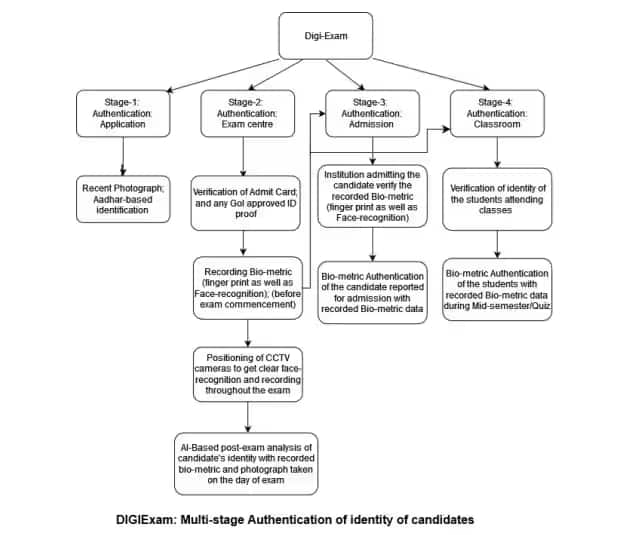
The authority should Implement advanced technologies like biometric authentication and AI-based monitoring for enhanced security.
NTA needs to take steps to prevent cheating and data breaches by enforcing strict protocols during question paper preparation, printing and transport.
Enhance surveillance with CCTV monitoring and secure question storage will be helpful.
The committee suggests building 1,000 secure testing centres nationwide which should be accessible for rural and remote candidates.
Also, introducing mobile testing centres in underserved regions to reduce travel burdens.
Students are referred to as primary stakeholders in the NTA report. The committee suggests providing mock tests, tutorial videos and multilingual resources to prepare students for the national level tests.
The authority must ensure students can choose their test centres within their district.
NTA must address the mental health of the students with stress-relief programs and provide support for high-stakes exams.
The committee recommends offering orientation sessions for students from disadvantaged backgrounds.
Also, the NTA should make exams accessible in multiple languages and provide accommodations for students with disabilities.
The authority should create a High-Powered Steering Committee to oversee the rules and regulations of the examinations.
It must ensure transparency with grievance redressal mechanisms and an online reporting system for malpractices.
The committee insists on regularly training NTA staff, invigilators, and third-party personnel on the latest technologies and test protocols.
NTA should develop a comprehensive training manual and calendar for all stakeholders.
The committee suggests gradually adopting Computer-Adaptive Testing (CAT) to make tests more personalized and efficient.
The authority should think towards transition from high-stakes exams to continuous assessment models for better student outcomes.
As soon as the NEET UG result 2024 was declared, there were reports of breaches of the NEET examination policy and question paper leaks. Several petitions were filed in the Supreme Court seeking clarifications on how a huge number of students were able to score the exact 720 score, how some of the NEET toppers were from the same centre, how the paper leak happened and many more.
NTA faced several challenges, giving clarifications on the issues raised. As soon as it was made clear by the Supreme Court that the NEET question paper leak happened, a seven-member committee was constituted. The seven members of the committee were as follows:
Dr Randeep Guleria
Prof B J Rao
Prof Ramamurthy K
Shri Pankaj Bansal
Prof Aditya Mittal
Shri Govind Jaiswal
Dr K Radhakrishnan

On Question asked by student community
Hello Savi
Please check the link below:
Hope it helps.
Hello, for AP NEET PG Category C seats, NRI documents are generally required if you are applying under the NRI quota, and eligibility depends on the applicable counselling rules. The fee payment currency and procedure should be confirmed from the current Dr. NTRUHS notification at its official website drntr.uhsap.in.
Hello, the NEET PG stipend at Parul University depends on the postgraduate course, academic year and applicable university policies.
Hello, some B.Sc Nursing colleges may offer admission without NEET, but the admission process depends on the college and its eligibility rules. You can find colleges offering B.Sc Nursing admission without NEET here: https://medicine.careers360.com/articles/bsc-nursing-admission-without-neet
Hello, you can pursue BPT in Kerala without NEET UG. Admission is generally based on the LBS Centre rank list and the applicable admission process. You can check BPT colleges in Kerala and their details here: https://medicine.careers360.com/colleges/list-of-bpt-in-physiotherapy-colleges-in-kerala
the product 'P' will be ,


| Column A | Column B |
| A |
a) Organisation of cellular contents and further cell growth. |
| B |
b) Leads to formation of two daughter cells. |
| C |
c) Cell grows physically and increase volume proteins,organells. |
| D |
d) synthesis and replication of DNA. |
Match the correct option as per the process shown in the
0.16 g of dibasic acid required 25 ml of decinormal solution for complete neutralisation. The modecular weight of the acid will be
32
64
128
256
0xone is

Know possible Govt/Private MBBS/BDS Colleges based on your NEET rank
College Predictors Webinars One to One Counselling Regular Updates Medical Almanac
Get Job Ready in Healthcare | Employability-Focused Programs
Ranked among the top Dental Colleges for 7 consecutive years by India Today poll
Ranked #19 by NIRF, NAAC A++ Accredited | Recognized by dental council of India