
Search Colleges, Exams, Schools & more


Login
An Introduction to Hydroponics MCQ - Practice Questions with Answers
Edited By admin | Updated on Sep 18, 2023 18:34 AM | #NEET
Quick Facts
-

19 Questions around this concept.
Solve by difficulty
 EASY
EASYThe advantage of hydroponics is
Concepts Covered - 0
Introduction to Mineral Nutrition and Hydroponics
- Absorption, utilization and assimilation of inorganic compounds or minerals by plants for synthesis of essential material for their growth, development, structure and physiology is called Mineral nutrition.
- Mineral nutrients are the inorganic compounds obtained from the soil and are used as a raw material by the plants.
Methods to study the mineral requirements of plants: Hydroponics
- In 1860, Julius von Sachs, a prominent German botanist, demonstrated, for the first time, that plants could be grown to maturity in a defined nutrient solution in the complete absence of soil.
- This technique of growing plants in a nutrient solution is known as hydroponics.
- The essence of all the improvised hydroponic methods involves the culture of plants in a soil-free, defined mineral solution.
- These methods require purified water and mineral nutrient salts.
- After a series of experiments in which the roots of the plants were immersed in nutrient solutions and wherein an element was added /substituted/ removed or given in varied concentration, a mineral solution suitable for the plant growth was obtained.
- By this method, essential elements were identified and their deficiency symptoms discovered.
- Hydroponics has been successfully employed as a technique for the commercial production of vegetables such as tomato, seedless cucumber and lettuce.
- It must be emphasised that the nutrient solutions must be adequately aerated to obtain optimum growth.
Hydroponics helps in knowing:
- The essentiality of the mineral element.
- The deficiency symptoms developed due to non-availability of a particular nutrient.
- Toxicity to plant when an element is present in excess.
- Possible interaction among different elements present in plant.
- The role of an essential element in the metabolism of the plant.
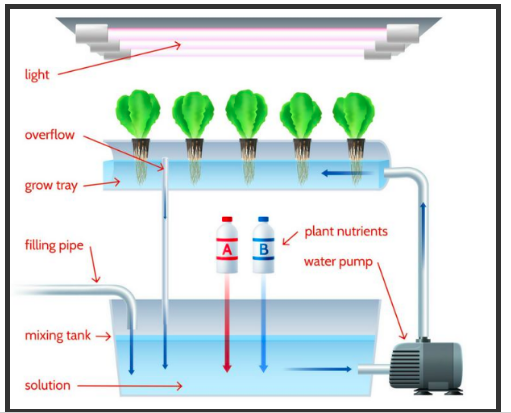
Methods to study the mineral requirements of plants
Types of Hydroponics:
1. Tank System: the roots are immersed in the nutrient solution and the air is bubbled through the solution.
2. Film technique: plants are grown in a trough or tube having a thin film of recirculated nutrient solution.
Aeroponics:
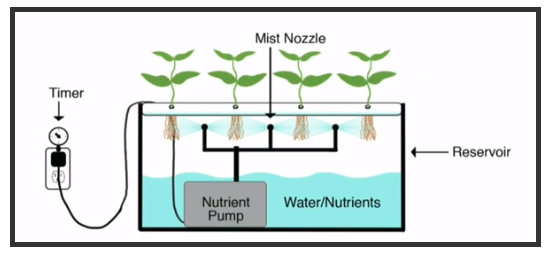
- Aeroponics is the practice of growing plants in an air or mist environment without the use of soil.
- It involves fogging the roots of the plants with a nutrient solution.
- The plants are usually housed in troughs, tubes or foam.
- Roots are constantly exposed and sprayed with microbursts of atomized water.
Mineral Nutrient Solutions:
1. Sach’s Solution: It contributes a total of nine mineral nutrients as K, N, P, Ca, S, Na, Cl, Fe, Mg.
2. Hoagland Solution: It contains all of the known mineral nutrients needed for rapid plant growth.
"Stay in the loop. Receive exam news, study resources, and expert advice!"
Get Answer to all your questions

Applications for Admissions are open.
Ranked #19 by NIRF, NAAC A++ Accredited | Recognized by dental council of India
Krishnadevaraya College of Dental Sciences and Hospital, Bangalore
ApplyRanked among the top Dental Colleges for 7 consecutive years by India Today poll