
Search Colleges, Exams, Schools & more


Login
Appendicular Skeleton : Upper Limb MCQ - Practice Questions with Answers
Edited By admin | Updated on Sep 18, 2023 18:34 AM | #NEET
Quick Facts
-

17 Questions around this concept.
Solve by difficulty
 EASY
EASYAn acromion process is characteristically found in the
The collar bone is also known as
Concepts Covered - 2
Pectoral Girdles
- Each pectoral girdle consists of two bones: 1 clavicle and 1 scapula.
- The scapula is a large triangular flat bone situated in the dorsal part of the thorax between the second and seventh ribs.
- The dorsal, flat, triangular body of the scapula has a slightly elevated ridge called the spine which projects as a flat, expanded process called the acromion.
- The clavicle articulates with the acromion.
- Below the acromion is a depression called the glenoid cavity which articulates with the head of the humerus to form the shoulder joint.
- Each clavicle is a long slender bone with two curvatures.
- This bone is commonly called the collarbone.
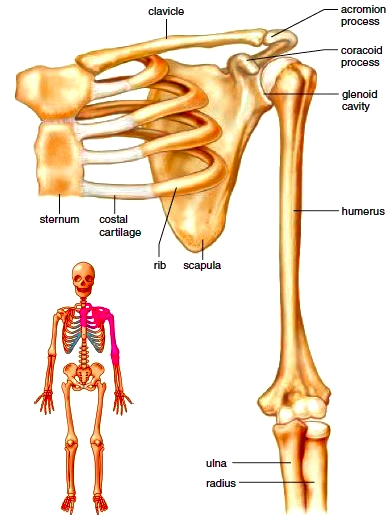
The Upper Limb
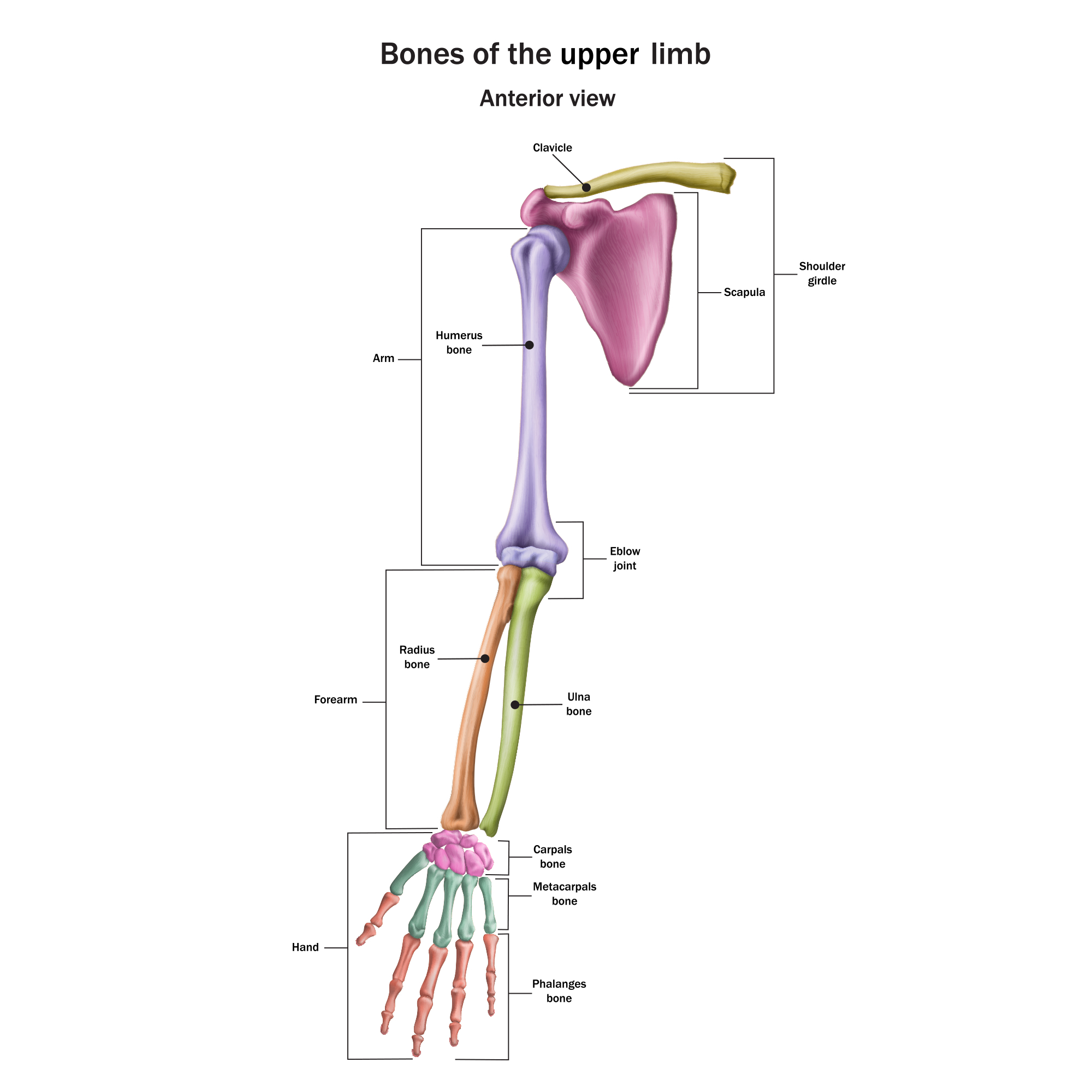
- Each Upper limb consists of the following 30 bones
- ARM = 1
- FOREARM = 2
- HAND = 27
- Wrist Bones = 8
- Palm Bones = 5
- Bones of Digits = 14
1. ARM
- The humerus is the bone of the arm.
- It is a long bone with the following features:
- head, which articulates with the glenoid cavity of the scapula;
- greater and lesser tubercles, which provide attachments for muscles that move the arm and shoulder
- intertubercular groove, which holds a tendon from the biceps brachii, a muscle of the arm
- capitulum, a lateral condyle that articulates with the head of the radius
- trochlea, a spool-shaped condyle that articulates with the ulna
2. FOREARM
- The two bones of forearm are Radius and Ulna
- The radius is on the lateral side of the forearm (the thumb side).
- The radius has the following features:
- head, which articulates with the capitulum of the humerus and fits into the radial notch of the ulna;
- radial tuberosity, which serves as a place of attachment for a tendon from the biceps;
- ulnar notch, which articulates with the head of the ulna;
- styloid process, which serves as a place of attachment for ligaments that run to the wrist
- The ulna is the long bone of the forearm.
- The ulna has the following features:
- coronoid process, which articulates with the coronoid fossa of the humerus when the elbow is flexed;
- trochlear notch, which articulates with the trochlea of the humerus at the elbow joint;
- radial notch, which articulates with the head of the radius.
- head, which articulates with the ulnar notch of the radius;
- styloid process, which serves as a place of attachment for ligaments that run to the wrist
3. HAND
- The Carpals are the bones of the wrist
- Each hand has 8 wrist bones arranged in two rows
- The Carpals are Scaphoid, Lunate, Triquetrum, Pisiform, Trapezoid, Trapezium, Capitate, Hamate
- Metacarpals are bones of the Palm. These are 5 in each hand
- Phalanges are bones of digits.These are 14 in each hand
Study it with Videos
"Stay in the loop. Receive exam news, study resources, and expert advice!"