
Search Colleges, Exams, Schools & more


Login
Calculation Of Necessary Force In Different Conditions On Rough Surface MCQ - Practice Questions with Answers
Edited By admin | Updated on Sep 25, 2023 25:23 PM | #NEET
Quick Facts
-

10 Questions around this concept.
Solve by difficulty
 EASY
EASYWhat is the minimum pushing force (in N) just to move the block?

Concepts Covered - 4
Calculation of Required force in different situations(1)
-
Case 1:- Minimum pulling force P at an angle α from the horizontal

By resolving P in the horizontal and vertical direction, we get:

where F is the friction force.
For the condition of equilibrium,
$
\begin{aligned}
& F=P \cos \alpha \\
& R=W-P \sin \alpha
\end{aligned}
$
By substituting these values in $F=\mu R$, we get:
$
\begin{aligned}
& P \cos \alpha=\mu(W-P \sin \alpha) \\
& U \operatorname{se}=\mu=\tan \theta \\
& \Rightarrow P \cos \alpha=\frac{\sin \theta}{\cos \theta}(W-P \sin \alpha)
\end{aligned}
$
$P=\frac{W \sin \alpha}{\cos (\alpha-\theta)}$
where P is the pulling force,
R is a normal reaction
W is the weight
-
Case 2:- Minimum pushing force P at an angle α from the horizontal

By resolving P in the horizontal and vertical direction, we get:

For the condition of equilibrium,
$
\begin{aligned}
& F=P \cos \alpha \\
& R=W+P \sin \alpha
\end{aligned}
$
By substituting the se values in $F=\mu R$, we get:
$
\begin{aligned}
& P \cos \alpha=\mu(W+P \sin \alpha) \\
& U s e=\mu=\tan \theta \\
& \Rightarrow P \cos \alpha=\frac{\sin \theta}{\cos \theta}(W+P \sin \alpha)
\end{aligned}
$
$P=\frac{W \sin \theta}{\cos (\alpha+\theta)}$
Calculation of Required force in different situations(2)
-
Case 3:- Minimum pulling force P to move the body upwards on an inclined plane

By resolving P in the direction of the plane and perpendicular to the plane, we get:

For the condition of equilibrium
$
\begin{aligned}
& R+P \sin \alpha=W \cos \lambda \Rightarrow R=W \cos \lambda-P \sin \alpha \\
& F+W \sin \lambda=P \cos \alpha \Rightarrow F=P \cos \alpha-W \sin \lambda
\end{aligned}
$
By substituting these values in $\mathrm{F}=\mu \mathrm{R}$, we get:
$
P=\frac{W \sin (\theta+\lambda)}{\cos (\alpha-\theta)}
$
-
Case 4:- Minimum force to move a body in a downward direction along the surface of the inclined plane

By resolving P in the direction of the plane and perpendicular to the plane, we get:

For the condition of equilibrium,
$$
\begin{aligned}
& R+P \sin \alpha=W \cos \lambda \Rightarrow R=W \cos \lambda-P \sin \alpha \\
& F=P \cos \alpha+W \sin \lambda
\end{aligned}
$$
By substituting these values in $\mathrm{F}=\mu \mathrm{R}$, we get:
$$
P=\frac{W \sin (\theta-\lambda)}{\cos (\alpha-\theta)}
$$
Calculation of Required force in different situations(3)
-
Case 5:- Minimum force to avoid sliding of a body down on an inclined plane
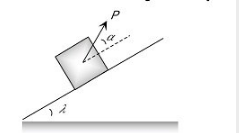
By resolving P in the direction of the plane and perpendicular to the plane, we get:-
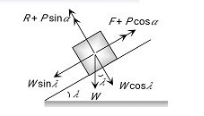
For the condition of equilibrium,
$$
\begin{aligned}
& R+P \sin \alpha=W \cos \lambda \Rightarrow R=W \cos \lambda-P \sin \alpha \\
& F=W \sin \lambda-P \cos \alpha
\end{aligned}
$$
By substituting these values in $F=\mu R$, we get
$$
P=\frac{W \sin (\lambda-\theta)}{\cos (\theta+\alpha)}
$$
Calculation of Required force in different situations(4)
-
Case 6:- Minimum Force of Motion along the horizontal surface and its direction
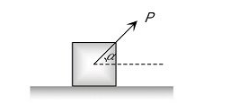
Let the force P be applied at an angle α with the horizontal.
By resolving P in horizontal and vertical direction, we get:-
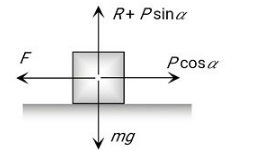
For vertical equilibrium,
$$
R+P \sin \alpha=m g \Rightarrow \therefore R=m g-P \sin \alpha
$$
and for horizontal motion,
$$
P \cos \alpha \geq F \Rightarrow P \cos \alpha \geq \mu R
$$
Substituting the value of $R$, we get:-
$$
\begin{aligned}
P \cos \alpha & \geq \mu(m f-P \sin \alpha) \\
\Rightarrow P & \geq \frac{\mu m g}{\cos \alpha+\mu \sin \alpha}
\end{aligned}
$$
For the force P to be minimum $(\cos \alpha+\mu \sin \alpha)$ must be maximum i.e.,
$$
\begin{aligned}
& \frac{\mathrm{d}}{\mathrm{~d} \alpha}[\cos \alpha+\mu \sin \alpha]=0 \\
& \Rightarrow-\sin \alpha+\mu \cos \alpha=0
\end{aligned}
$$
$$
\begin{aligned}
& \therefore \tan \alpha=\mu \\
& \Rightarrow \alpha=\tan ^{-1}(\mu)=\text { angle of friction. }
\end{aligned}
$$
i.e. For the minimum value of P, its angle from the horizontal should be
equal to the angle of friction.
$\tan \alpha=\mu$,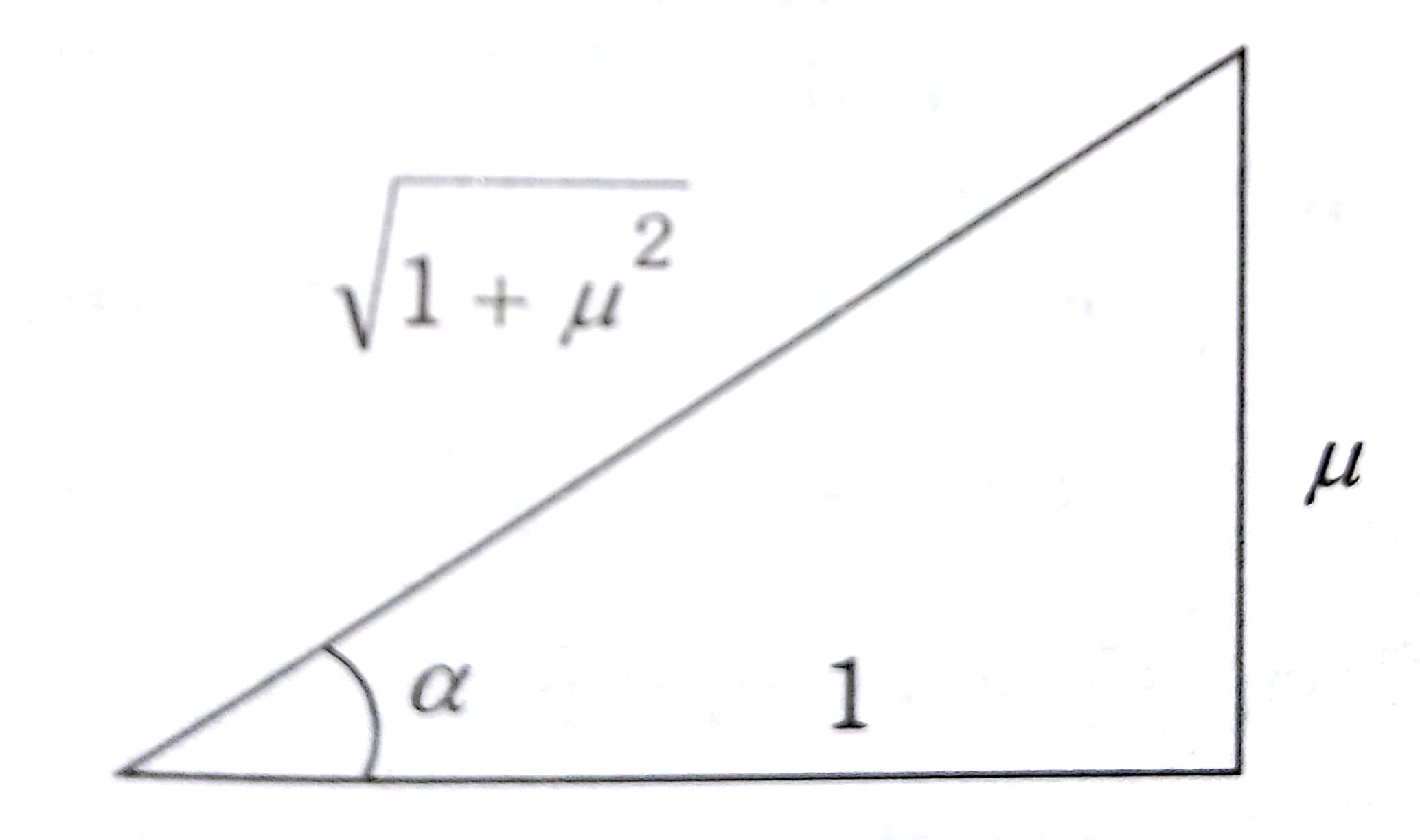
$$
\sin \alpha=\frac{\mu}{\sqrt{1+\mu^2}} \quad \operatorname{and} \quad \cos \alpha=\frac{1}{\sqrt{1+\mu^2}}
$$
By substituting these values,
$$
\begin{aligned}
& P \geq \frac{\mu m g}{\frac{1}{\sqrt{1+\mu^2}}+\frac{\mu^2}{\sqrt{1+\mu^2}}} \\
& \Rightarrow P \geq \frac{\mu m g}{\sqrt{1+\mu^2}} \\
& \therefore P_{\min }=\frac{\mu m g}{\sqrt{1+\mu^2}}
\end{aligned}
$$
Study it with Videos
"Stay in the loop. Receive exam news, study resources, and expert advice!"
Get Answer to all your questions

Begin a career in Medical and Allied Sciences. Admissions Open for
Get Job Ready in Healthcare | Employability-Focused Programs
MAHE Manipal BSc Nursing 2026
ApplyLast Date to Apply: 26th April | NAAC A++ Accredited | NIRF Rank #3
Virohan Allied & Healthcare Programs
ApplyAllied & Healthcare programs | 20+ Partner Universities & Institutes | 98% placement record
Amity University Noida | Allied Health Sciences Admissions
ApplyRanked as India’s #1 Not for profit pvt. University by India Today
SCSVMV Deemed to be University | AHA Admissions 2026
ApplyAlied Health Sciences at SCSVMV | NAAC 'A' Grade | AICTE & UGC Aproved | 100% Placement Support | Merit-based Scholarships
RV University Allied & Healthcare Admissions 2026
ApplyIndustry-Relevant Programmes with Clinical Excellence. Merit-based scholarships available