
Search Colleges, Exams, Schools & more


Login
Coefficient Of Friction Between A Body And Wedge MCQ - Practice Questions with Answers
Edited By admin | Updated on Sep 25, 2023 25:23 PM | #NEET
Quick Facts
-

2 Questions around this concept.
Solve by difficulty
 MEDIUM
A body takes just twice the time as long to slide down a plane inclined at 300 to the horizontal as if the plane were frictionless. The coefficient of friction between the body and the plane is:
In case (i) plane is smooth and in case (ii) plane is rough. If the time taken by the block in case (ii) to come down is 3 times the time to come down in case (i) then the coefficient of friction of plane in case (ii) is?

Concepts Covered - 1
Coefficient of Friction Between a Body and Wedge
- If the same wedge is made rough then the time taken by it to come down becomes n times more (nt)
Then find the Coefficient of Friction between the body and wedge in terms of n
For this make 2 cases
Case 1- A body slides on a smooth wedge of angle θ and its time of descent is t.
Case 2- If the same wedge is made rough then the time taken by it to come down becomes n times more (i.e., nt)
(The length of the path in both cases is the same)
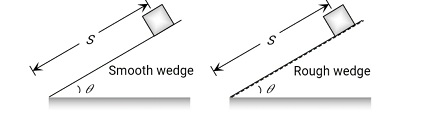
For smooth wedge
$
\begin{aligned}
& S=u \cdot t+\frac{1}{2} a t^2 \\
& S=\frac{1}{2}(g \sin \theta) t^2 \\
& \mathbf{u}=0 \\
& a=g \sin \theta
\end{aligned}
$
For Rough wedge
$
S=\frac{1}{2} g[\sin \theta-\mu \cos \theta](n t)^2
$
(i) $=$ (ii)
$
\mu=\tan \theta\left[1-\frac{1}{n^2}\right]
$
$\mu=$ coefficient of friction
$\theta=$ Angle of inclination
$\mathrm{n}=\mathrm{an}$ integer
Study it with Videos
"Stay in the loop. Receive exam news, study resources, and expert advice!"
Get Answer to all your questions

Begin a career in Medical and Allied Sciences. Admissions Open for
Get Job Ready in Healthcare | Employability-Focused Programs
MAHE Manipal BSc Nursing 2026
ApplyLast Date to Apply: 26th April | NAAC A++ Accredited | NIRF Rank #3
Virohan Allied & Healthcare Programs
ApplyAllied & Healthcare programs | 20+ Partner Universities & Institutes | 98% placement record
Amity University Noida | Allied Health Sciences Admissions
ApplyRanked as India’s #1 Not for profit pvt. University by India Today
SCSVMV Deemed to be University | AHA Admissions 2026
ApplyAlied Health Sciences at SCSVMV | NAAC 'A' Grade | AICTE & UGC Aproved | 100% Placement Support | Merit-based Scholarships
RV University Allied & Healthcare Admissions 2026
ApplyIndustry-Relevant Programmes with Clinical Excellence. Merit-based scholarships available