


Difference between Non-chordates and Chordates MCQ - Practice Questions with Answers
Quick Facts
-

6 Questions around this concept.
Solve by difficulty
 EASY
EASYCharacteristics of nonchordates is/are
Characteristics of non-chordates is/are
Concepts Covered - 1
|
BASIS OF DIFFERENCE |
NON-CHORDATES |
CHORDATES |
|
Body Temperature |
Cold blooded |
Warm or cold blooded |
|
Notochord |
Absent |
Present at some stage or throughout the life cycle |
|
Haemoglobin |
Absent or in plasma |
In red blood cells |
|
Nervous System |
Solid and ventral nerve cord |
Hollow and dorsal nerve cord |
|
Germ layers |
Absent, triploblastic or diploblastic |
Triploblastic |
|
Coelom |
Can be acoelomate, pseudocoelomate, coelomate |
Coelomate |
|
Symmetry |
Can be asymmetrical, radial or bilateral |
Bilateral |
|
Post-anal tail |
Absent |
Usually present |
|
Brain |
Either absent or present above pharynx |
Present dorsal to pharynx |
|
Position of digestive tube |
Dorsal to nerve cord |
Ventral to nerve cord |
|
Pharyngeal gill-slits |
Absent |
Present at some stage of life |
|
Blood vascular system |
Absent and if present, open or closed |
Closed |
|
Heart |
Absent and if present dorsal or lateral |
Ventrally placed |
|
Exoskeleton/ Endoskeleton |
Only exoskeleton is present |
Both are present |
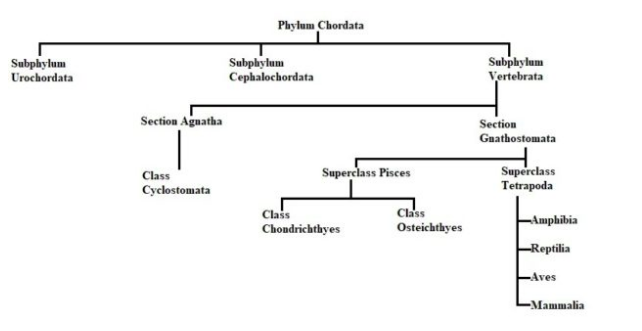
Classification of Phylum Chordata:
Study it with Videos
"Stay in the loop. Receive exam news, study resources, and expert advice!"