
Search Colleges, Exams, Schools & more


Login
Minimum Mass Hung From The String To Just Start The Motion MCQ - Practice Questions with Answers
Edited By admin | Updated on Sep 25, 2023 25:23 PM | #NEET
Quick Facts
-

2 Questions around this concept.
Solve by difficulty
 MEDIUM
A block $A$ of mass $m_1$ rests on a horizontal table. A light string connected to it passes over a frictionless pulley at the edge of table and from its other end another block $B$ of mass $m_2$ is suspended: The coefficient of kinetic friction between the block and the table is $\mu_k$. When the block A is sliding on the table, the tension in the string is:
Two masses m1=5 kg and m2=10 kg, connected by an inextensible string over a frictionless pulley, are moving as shown in the figure. The coefficient of friction of the horizontal surface is 0.15. The minimum weight m (in kg) that should be put on top of m2 to stop the motion is : (give answer till 2 decimal places)

Concepts Covered - 1
Minimum Mass Hung from the String to Just Start the Motion
Here m1 is connected to one end of the string and m2 is connected to another end of the string. And mass m2 hung from the string connected by the pulley,
Case 1:-
When a mass m1 placed on a rough horizontal plane
So the tension (T) produced in the string will try to start the motion of mass m1:
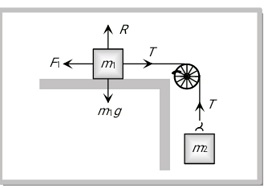
For liming condition
$
\begin{aligned}
& T=F_l \\
& m_2 g=\mu R \\
& m_2 g=\mu m_1 g
\end{aligned}
$
$m_2=\mu m_1=$ minimum value of $\mathbf{m}_2$ to start the motion
So $\mu=\frac{m_2}{m_1}$
where $\mathrm{T}=$ Tension in a string
$F_l=$ Limiting friction
$\mu=$ Coefficient of friction
-
Case 2:-
When a mass m1 is placed on a rough inclined plane
So the tension (T) produced in the string will try to start the motion of mass m1:
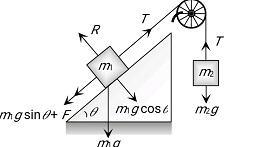
For limiting condition
For $m_2 \quad T=m_2 g$
For $m_1 \quad T=m_1 g \sin \theta+F$
$
T=m_1 g \sin \theta+\mu m_1 \cos \theta
$
Use (i) \& (ii)
$m_2=m_1[\sin \theta+\mu \cos \theta]=$ minimum value of $m_2$ to start the motion
where T = tension
m2 g = weigh of mass m2
F = limiting friction
$
\text { Here } \mu=\left[\frac{m_2}{m_1 \cos \theta}-\tan \theta\right]
$
$\mu=$ coefficient of friction
Study it with Videos
"Stay in the loop. Receive exam news, study resources, and expert advice!"
Get Answer to all your questions

Begin a career in Medical and Allied Sciences. Admissions Open for
Get Job Ready in Healthcare | Employability-Focused Programs
MAHE Manipal BSc Nursing 2026
ApplyLast Date to Apply: 26th April | NAAC A++ Accredited | NIRF Rank #3
Virohan Allied & Healthcare Programs
ApplyAllied & Healthcare programs | 20+ Partner Universities & Institutes | 98% placement record
Amity University Noida | Allied Health Sciences Admissions
ApplyRanked as India’s #1 Not for profit pvt. University by India Today
SCSVMV Deemed to be University | AHA Admissions 2026
ApplyAlied Health Sciences at SCSVMV | NAAC 'A' Grade | AICTE & UGC Aproved | 100% Placement Support | Merit-based Scholarships
RV University Allied & Healthcare Admissions 2026
ApplyIndustry-Relevant Programmes with Clinical Excellence. Merit-based scholarships available